


Why Lens Thickness Matters for High Prescriptions
This article explains how 1.67 index lenses address thickness challenges in strong prescriptions.
For optical labs, distributors, and wholesale buyers, lens thickness creates real operational pressure. Thick lenses reduce frame compatibility, increase edging difficulty, and often lead to higher remake and complaint rates from retail partners. As prescriptions grow stronger, mid-index lenses struggle to meet cosmetic and performance expectations.
In this guide, you will learn where 1.67 index lenses fit in a professional lens portfolio, how they compare with other index options, and how to position them effectively for wholesale customers to improve efficiency and long-term value.
What Are High Index Lenses?
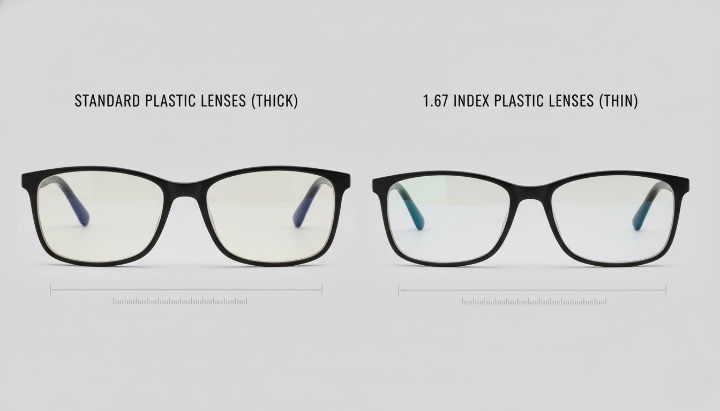
High index lenses are optical lenses made from materials that bend light more efficiently than standard plastic. This efficiency allows lenses to reach the same prescription power using less material, which directly reduces thickness and weight.
In wholesale optical supply chains, high index lenses solve practical problems rather than aesthetic ones. As prescriptions increase, excessive thickness affects edging accuracy, mounting stability, and overall acceptance by retailers and end users.
High index materials allow labs and distributors to support stronger prescriptions while maintaining consistent quality and fewer post-sale issues.
Definition of High Index Lenses
A lens qualifies as high index when its refractive index exceeds 1.60. Standard plastic lenses usually have an index of 1.50 and work best only for low prescriptions.
Common high index categories include:
-
1.60 index lenses
-
1.67 index lenses
-
1.74 index lenses
Each option reduces thickness differently and carries specific cost and performance implications.
How Lens Index Affects Thickness and Weight
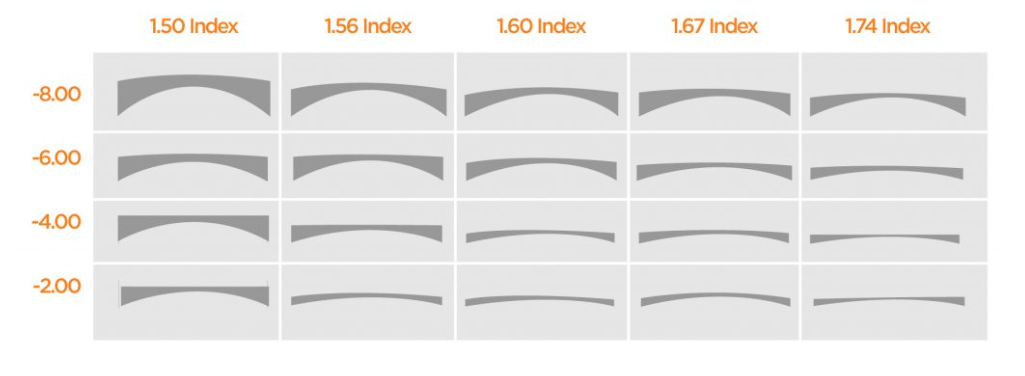
Refractive index determines how much material a lens needs to correct vision. Higher index materials bend light more efficiently, so they require flatter curves.
For minus prescriptions, this reduces edge thickness. For plus prescriptions, it reduces center thickness.
From a production and retail perspective, thinner lenses mean higher yield and fewer issues downstream.
High Index Lenses vs Standard Plastic Lenses
Standard plastic lenses remain suitable for low prescriptions, but they lose efficiency as power increases.
| Criteria | Standard Plastic (1.50) | High Index Lenses |
|---|---|---|
| Thickness at high power | Very thick | Significantly thinner |
| Weight | Heavy | Lighter |
| Frame compatibility | Limited | Broader |
| wholesale positioning | Entry-level | Mid to premium |
For wholesale suppliers, high index lenses function as problem-solving products, not optional upgrades.
What Are 1.67 Index Lenses?
1.67 index lenses sit in the middle-to-upper range of high index materials. They offer a clear thickness reduction over 1.60 lenses without the higher cost and tighter tolerances of 1.74.
In many lab and wholesale portfolios, 1.67 acts as a core SKU. It supports a wide prescription range and allows consistent recommendations across different frame types.
What Does a 1.67 Index Mean?
A refractive index of 1.67 means the lens material bends light more efficiently than mid-index options.
In practical terms, 1.67 lenses typically reduce thickness by around 20–25% compared with 1.60 lenses, depending on prescription strength and frame size.
This performance range matches the demand profile of many mid-to-high prescription wearers.
How 1.67 Index Lenses Reduce Lens Thickness
1.67 lenses achieve thinner profiles through material efficiency rather than extreme design changes.
Key effects include:
-
Flatter base curves
-
Reduced edge thickness in minus lenses
-
Better control of center thickness in plus lenses
For labs, this improves edging stability. For retailers, it improves cosmetic acceptance and frame flexibility.
Where 1.67 Fits in the High Index Lens Range
1.67 represents a balance between performance and cost. It delivers visible thickness reduction without the sharp price increase associated with ultra-high index materials.
1.67 Index Lenses vs Other Lens Indexes
Choosing the correct index directly affects inventory efficiency, pricing strategy, and customer satisfaction.
1.50 vs 1.60 vs 1.67 vs 1.74 Lenses
| Lens Index | Thickness Reduction | Typical Use Case | Cost Level |
|---|---|---|---|
| 1.50 | Minimal | Low prescriptions | Low |
| 1.60 | Moderate | Medium prescriptions | Medium |
| 1.67 | High | Medium–high prescriptions | Mid-high |
| 1.74 | Very high | Very strong prescriptions | High |
When lens thickness is clearly visible, 1.67 provides a noticeable improvement over 1.60. In many cases, the cosmetic difference between 1.67 and 1.74 is smaller than the price difference.
Who Should Choose 1.67 High Index Lenses?
1.67 lenses work best for a clearly defined prescription segment.
Ideal Prescription Ranges
1.67 index lenses are commonly recommended for:
-
Myopia around −4.00 to −8.00 D
-
Moderate to high hyperopia
-
Prescriptions with significant astigmatism
Best Frame Types for 1.67 Lenses
1.67 lenses perform well in:
-
Full-rim acetate frames
-
Metal frames
-
Semi-rimless designs
-
Larger fashion frames
When 1.67 Is Better Than 1.60
As prescriptions increase or frame size grows, 1.60 lenses often appear too thick. At that point, upgrading to 1.67 provides visible improvement with reasonable cost impact.
When 1.74 May Be a Better Option
1.74 lenses may suit extremely strong prescriptions or cases where maximum thinness matters more than cost.
Solving the Problem of Thick Lens Glasses
Thick lenses remain one of the main causes of dissatisfaction and remakes in optical retail.
Why Standard Lenses Look Thick
Standard lenses rely on steeper curves to achieve optical power. As prescriptions increase, this results in excessive edge thickness or bulky centers.
How 1.67 Lenses Minimize Edge Thickness
1.67 lenses reduce thickness where it is most visible, especially at the edges.
Cosmetic Benefits for Strong Prescriptions
For end users, thinner lenses improve confidence and frame choice. For wholesale partners, they reduce objections, remakes, and post-delivery adjustments.
Benefits of 1.67 High Index Lenses
Thinner and Lighter Lenses
The main advantage of 1.67 lenses is clear thickness reduction with controlled cost.
Improved Comfort for All-Day Wear
Lower lens weight reduces pressure on the nose and ears.
Better Aesthetics Across Frame Types
1.67 lenses expand usable frame options and simplify inventory planning.
Limitations and Trade-Offs of 1.67 Index Lenses
Cost Considerations
1.67 lenses cost more than 1.60 but remain more accessible than 1.74.
Optical Distortion and Abbe Value
Higher index materials naturally have lower Abbe values, but modern designs keep distortion within acceptable limits.
Importance of Anti-Reflective Coatings
Anti-reflective coatings are essential for 1.67 lenses.
Frequently Asked Questions About 1.67 Index Lenses
Are 1.67 Index Lenses Worth the Extra Cost?
Yes, when thickness and comfort become visible concerns.
Are 1.67 Lenses Good for Strong Prescriptions?
Yes. They are designed for medium-to-high prescription ranges.
Do 1.67 Lenses Work with All Frame Types?
They work best with full-rim and semi-rimless frames.
What Are the Thinnest Glasses Lenses for High Prescriptions?
1.74 lenses are thinner, but 1.67 provides the best balance for most commercial use cases.
Why 1.67 Index Lenses Make Sense for wholesale Buyers
1.67 index lenses offer a practical balance between thickness reduction, cost control, and operational efficiency. They reduce remakes, expand frame compatibility, and support consistent recommendations across retail channels.
Build a Stronger High Index Lens Portfolio
If you supply lenses to optical retailers or labs, review how 1.67 index lenses fit into your current portfolio. Position 1.67 as a core solution for mid-to-high prescriptions to improve acceptance, margins, and long-term partnerships.