


is a common question for people comparing modern prescription lens coatings.
Many customers hear these two terms when choosing eyeglasses, but they often think both coatings solve the same problem. This confusion can lead to poor product selection, unclear sales communication, and unnecessary coating upgrades. For optical shops, wholesalers, and eyewear brands, the difference matters even more.
This guide explains what blue cut lenses and anti-reflective lenses do, how they differ, when to choose each option, and how to build better lens coating solutions for different customer needs.
 Blue Cut vs Anti-Reflective Lenses: The Quick Answer
Blue cut lenses reduce part of blue-violet light exposure, while anti-reflective lenses reduce surface reflections on the lens. They are different technologies, and they solve different visual problems.
Blue cut lenses focus on selected light wavelengths. Anti-reflective lenses focus on improving lens transparency and reducing unwanted reflections. In many modern lens programs, the best choice is not always one or the other. A combined blue cut anti-reflective lens can support both digital lifestyle positioning and clearer daily vision.
| Feature | Blue Cut Lenses | Anti-Reflective Lenses |
|---|---|---|
| Main function | Filters part of blue-violet light | Reduces lens surface reflections |
| Common purpose | Screen use and digital lifestyle comfort | Clearer vision and less visible reflection |
| Best use case | Office work, study, screen-heavy environments | Daily wear, night driving, high-index lenses |
| Main customer concern | Digital eye comfort | Glare, reflection, clarity, appearance |
| Visible effect | May show slight tint or blue/purple reflection | Lens looks more transparent |
| Can be combined? | Yes | Yes |
Choose anti-reflective lenses if the user wants clearer vision, fewer reflections, and better lens appearance. Choose blue cut lenses if the user spends long hours around screens or wants a digital-use lens option. Choose both when the product needs a more complete coating package.
Digital eye strain involves more than blue light alone. The American Optometric Association describes computer vision syndrome as eye and vision-related problems linked to prolonged digital device use, including viewing distance, lighting, glare, posture, and screen habits.
 Blue Cut vs Anti-Glare vs Anti-Reflective Lenses: Are They the Same?
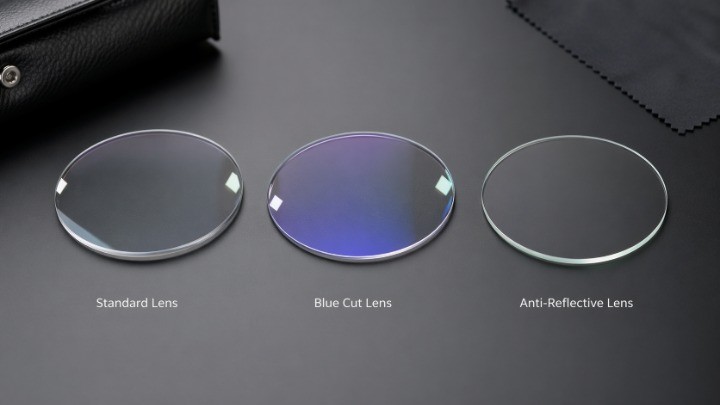
Anti-glare and anti-reflective often mean similar things in eyewear marketing, but blue cut lenses are different. Anti-reflective coating reduces reflections from the lens surface. Blue cut function filters part of the blue-violet light spectrum.
Many customers use “anti-glare,” “anti-reflective,” and “blue light glasses” as if they mean the same thing. This creates confusion during product selection. A customer may ask for anti-glare blue light glasses without knowing whether they need reflection reduction, blue light filtering, or both.
A simple explanation works best:
• Anti-reflective coating reduces reflections on the lens surface. • Blue cut function filters part of blue-violet light. • Polarized lenses reduce reflected glare from surfaces such as roads, water, and glass.
This difference matters because a standard AR lens may not block blue light. A blue cut lens may still show reflections if it does not include a good AR coating. A polarized sunglass lens solves a different outdoor glare problem.
Mayo Clinic Health System describes anti-reflective or anti-glare coating as a common eyeglass coating that helps reduce glare and improve vision in bright light conditions.
 What Are Blue Cut Lenses?
Blue cut lenses are optical lenses designed to reduce part of blue-violet light from digital screens, LED lighting, and artificial light environments. They can use lens material absorption, surface coating, or both.
These lenses are often positioned for office workers, students, online eyewear users, and people who spend long hours around digital devices. The product message usually focuses on screen comfort and digital lifestyle needs.
However, blue cut lenses should be explained carefully. They can filter selected wavelengths, but they should not be marketed as a guaranteed medical solution for eye strain, retinal protection, or better sleep.
A Cochrane review found that blue-light filtering spectacle lenses may not reduce short-term computer-related eye strain compared with non-blue-light filtering lenses. This finding does not remove the commercial value of blue cut lenses, but it does mean product claims should stay accurate and balanced.
Common lens types that can include blue cut function include:
• Single vision blue cut lenses • Progressive blue cut lenses • Bifocal blue cut lenses • Photochromic blue cut lenses • High-index blue cut lenses • PC blue cut lenses • Finished and semi-finished blue cut lenses
For optical businesses, the key question is not only whether the lens has blue cut function. Buyers should also check the filtering range, lens color, reflection color, coating stability, and whether the product keeps natural visual comfort.
 What Are Anti-Reflective Lenses?
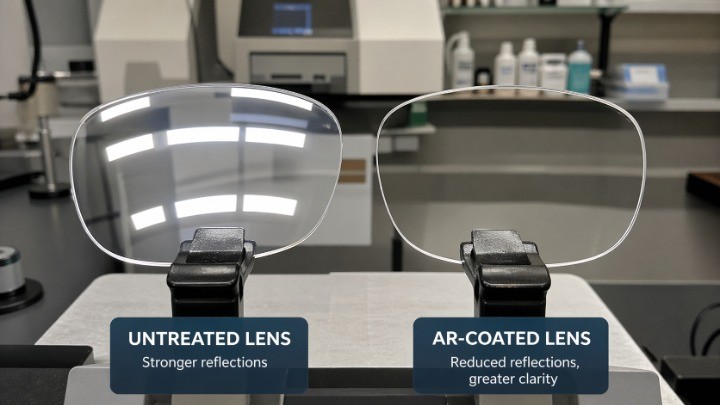
Anti-reflective lenses use a coating that reduces reflections on the front and back surfaces of the lens. This coating helps more useful light pass through the lens, so the wearer can see with better clarity.
Anti-reflective coating is one of the most practical upgrades in prescription eyewear. It improves lens appearance because other people can see the wearer’s eyes more clearly. It also reduces distracting reflections from lamps, screens, car headlights, and bright indoor lighting.
AR coating is especially important for high-index lenses. Higher-index materials can create more visible reflection than standard plastic materials. Without a good anti-reflective coating, high-index lenses may look shinier and less transparent.
Anti-reflective lenses are widely used in:
• Daily prescription glasses • Office lenses • Progressive lenses • High-index lenses • Photochromic lenses • Night driving glasses • Premium retail lens packages
The National Eye Institute explains that eyeglass lenses work by bending light so it focuses correctly on the retina. This makes clear optical performance and lens quality essential for prescription eyewear.
 Main Differences Between Blue Cut and Anti-Reflective Lenses
The main difference is that blue cut lenses control selected light wavelengths, while anti-reflective lenses control surface reflections. One focuses on blue-violet light filtering. The other focuses on clarity, transparency, and reflection reduction.
| Comparison Point | Blue Cut Lenses | Anti-Reflective Lenses |
|---|---|---|
| Technical focus | Light spectrum filtering | Surface reflection reduction |
| Main value | Digital-use positioning | Clearer vision and cleaner appearance |
| Best for | Screen-heavy users | Most daily prescription users |
| Common misunderstanding | “Blue cut means anti-glare” | “AR means blue light blocking” |
| Product role | Upgrade or specialty coating | Core coating for many lenses |
Blue Light Filtering vs Reflection Reduction
Blue cut lenses reduce part of blue-violet light. Anti-reflective lenses reduce reflections from lens surfaces. A lens can have one function without the other.
If a customer complains about screen exposure, blue cut may be relevant. If a customer complains about reflections, shiny lenses, night driving glare, or camera reflections, AR coating is usually the more direct solution.
Screen Comfort vs Visual Clarity
Blue cut lenses are often marketed for screen-heavy lifestyles. Anti-reflective lenses are more directly linked with visual clarity and lens transparency.
Screen comfort still depends on many factors. Poor lighting, dry eyes, wrong prescription, short viewing distance, and long screen time can all create discomfort. This is why blue cut lenses should not be presented as the only answer.
Lens Appearance and Residual Coating Color
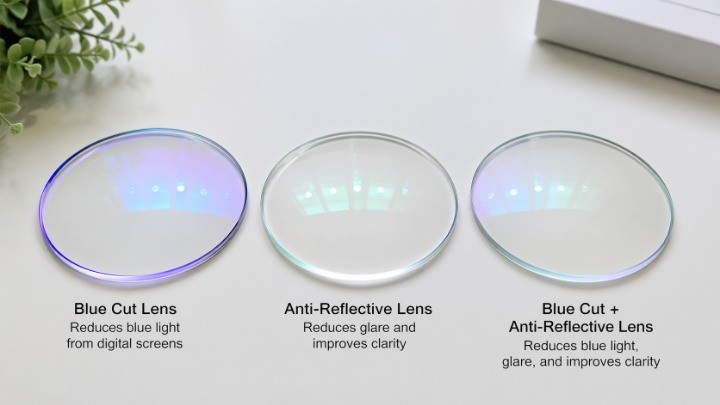
Blue cut lenses may show a slight yellowish base color or blue, purple, green, or gold reflection. Anti-reflective lenses also have residual coating color, but the main goal is low reflection and high transparency.
Different markets may prefer different coating colors. Green AR often looks classic and clean. Blue or purple reflection may support a digital protection image. Gold or other colors may work in specific retail markets.
Night Driving Performance
Anti-reflective lenses are usually more relevant for night driving than blue cut lenses. Night driving problems often involve reflections from headlights, streetlights, wet roads, and lens surfaces.
Blue cut lenses should not replace AR coating in a night driving product message. For driving, clear vision and reflection control should come first.
 Similarities Between Blue Cut and Anti-Reflective Lenses
Blue cut and anti-reflective lenses both aim to improve the wearing experience, and both can be applied to many prescription lens types. Both also depend heavily on coating quality and production consistency.
Both technologies can support better visual comfort when they match the user’s environment. For example, an office worker may prefer blue cut AR lenses because the product combines screen-related positioning with reduced surface reflections.
Both options can be used on:
• Single vision lenses • Progressive lenses • Bifocal lenses • Photochromic lenses • High-index lenses • PC lenses • Private-label lens series
The other similarity is quality risk. Poor coating can create returns and complaints. A blue cut lens with unstable color may look cheap. An AR lens with weak adhesion may peel or scratch too easily.
For wholesale and private-label buyers, coating consistency matters as much as the product name. A lens series should maintain stable reflection color, clear appearance, and repeatable performance from sample approval to bulk shipment.
Which One Is Better for Different Users?
Anti-reflective lenses are usually the better basic choice for most daily eyewear users, while blue cut lenses are better for users who want a screen-focused lens option. The best choice depends on lifestyle, prescription, visual environment, and product positioning.
For Office Workers
Office workers often spend long hours under LED lighting and in front of screens. A blue cut AR lens can be a practical option because it combines digital lifestyle positioning with reflection reduction.
However, the lens alone cannot solve every screen-related comfort issue. Screen distance, brightness, blinking habits, and regular breaks still matter.
For Students
Students often use laptops, tablets, and phones for long periods. Blue cut lenses can be positioned as part of a study and screen-use eyewear package.
Retailers should keep the message balanced. Blue cut lenses can filter part of blue-violet light, but students still need correct prescriptions and healthy screen habits.
For Drivers
Drivers should prioritize anti-reflective coating. AR coating reduces lens surface reflections and supports clearer vision in low-light or high-glare environments.
Blue cut lenses may not address the main visual challenge of night driving. For drivers, clarity and reflection control usually matter more than blue light filtering.
For People Who Wear Glasses All Day
People who wear glasses all day usually benefit from anti-reflective coating because they face many lighting conditions. They work indoors, walk outdoors, use screens, attend video calls, and drive.
Blue cut can be added when the user spends many hours with digital devices. In this case, a combined blue cut AR lens may offer a stronger product story.
For Optical Shops and Lens Retailers
Optical shops need clear product tiers. They can offer standard AR lenses for daily wear, blue cut AR lenses for screen users, and premium blue cut AR options for high-index or progressive lenses.
This structure helps sales staff explain value without confusing customers. It also reduces the risk of overselling blue cut lenses as a medical product.
For Wholesalers and Brand Owners
Wholesalers and brand owners need stable products that match market expectations. They should check coating color, lens clarity, product claims, packaging, and repeatable quality.
A good product line should connect coating function with user scenario, price level, and retail positioning.
Can Blue Cut and Anti-Reflective Coating Be Combined?
Yes, blue cut function and anti-reflective coating can be combined in one lens. This combination often creates a stronger product because it supports both digital lifestyle demand and clearer daily vision.
A combined blue cut AR lens can filter part of blue-violet light while reducing distracting surface reflections. This makes it suitable for office eyewear, online prescription glasses, private-label lens programs, and upgraded retail packages.
Combination lenses make sense for:
• Office lens collections • Student eyewear programs • Online eyewear brands • High-index lens upgrades • Progressive lens packages • Photochromic blue cut products • Private-label optical lens series
However, combination lenses are not always necessary. In price-sensitive markets, a standard anti-reflective lens may sell better because it offers visible clarity improvement at a lower cost.
The best explanation is simple: anti-reflective coating helps the lens look clearer and reduces reflections, while blue cut function filters part of blue-violet light. When both features fit the target user, combining them can create a more complete lens solution.
Common Misunderstandings About Blue Cut and Anti-Reflective Lenses
The biggest misunderstanding is that blue cut, anti-glare, anti-reflective, and polarized lenses all mean the same thing. They do not. Each technology solves a different visual problem.
| Misunderstanding | Correct Explanation |
|---|---|
| Blue cut lenses automatically reduce glare | Blue cut filters selected wavelengths; AR coating reduces reflections |
| AR lenses automatically block blue light | Standard AR coating does not equal blue cut function |
| Darker blue cut lenses are always better | Stronger filtering can affect color perception |
| All blue cut lenses perform the same | Filtering range and coating design vary |
| Anti-glare and polarized are the same | Polarization and AR coating solve different glare problems |
Blue Cut Lenses Do Not Automatically Reduce Glare
Blue cut lenses may reduce part of blue-violet light, but they do not automatically remove lens surface reflections. A blue cut lens without quality AR coating can still reflect light.
This matters when customers complain about glare from lamps, headlights, or camera reflections. In many cases, AR coating is the more direct answer.
Anti-Reflective Lenses Do Not Automatically Block Blue Light
Standard AR coating improves clarity by reducing reflections. It does not automatically block blue light.
If a buyer wants both functions, they should ask for a blue cut AR lens, not only an AR lens.
Darker Blue Cut Lenses Are Not Always Better
Some users assume stronger color means stronger protection. This is not always the right product direction.
A lens that filters too aggressively may affect color perception and appearance. For daily prescription lenses, comfort and natural vision both matter.
Not All Blue Cut Lenses Perform the Same
Blue cut performance depends on lens material, coating design, filtering range, and testing method. Two lenses with the same product name may perform differently.
This is why professional buyers should ask for technical details, samples, and stable production standards.
Procurement Guide: How to Choose the Right Lens Coating
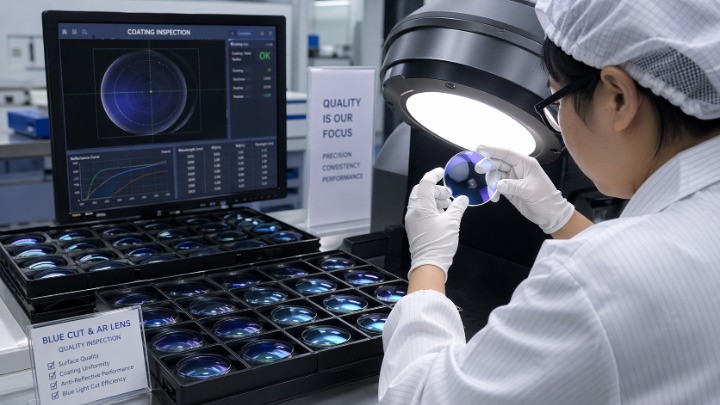 Professional buyers should choose lens coatings based on performance data, market demand, lens material, coating durability, and bulk production stability. A coating name alone is not enough.
Check the Real Blue Light Filtering Range
Buyers should ask which wavelength range the lens filters and how the factory measures it. A serious supplier should explain the filtering range clearly and avoid vague claims.
The goal is not always maximum blocking. For daily lenses, the better goal is often balanced blue cut function with acceptable color perception.
Review AR Coating Performance
AR coating quality affects clarity, appearance, and customer satisfaction. Buyers should check reflection color, transparency, surface smoothness, and consistency across different lens indexes.
A premium AR coating should look clean and stable. It should not show uneven color, coating marks, or poor reflection control.
Test Coating Durability
Coating durability matters in real use. Customers clean lenses every day, expose them to humidity, and wear them in changing environments.
Important checks may include:
• Adhesion test • Abrasion resistance test • Salt spray resistance test • Boiling or temperature resistance test • Cleaning resistance test • Visual inspection under professional lighting
Match Coating to Lens Index
Different lens materials may need different coating control. A coating that works well on 1.56 lenses may require adjustment for 1.60, 1.67, or PC lenses.
ISO 8980-3:2022 covers transmittance specifications and test methods for uncut finished spectacle lenses. This supports the idea that lens performance should be checked through defined test methods, not only visual claims.
Confirm Coating Color Acceptance in the Target Market
Coating color affects customer perception. Green reflection often looks classic and professional. Blue or purple reflection may support a digital lens image.
Buyers should match coating color with local preferences. A technically good lens may still sell poorly if the appearance does not fit the market.
Compare Coating Stability Between Sample and Bulk Production
Sample approval is only the first step. Bulk production must match the approved sample in color, clarity, coating quality, and packaging.
Professional buyers should ask how the supplier controls batch consistency. They should also keep approved samples for comparison during future shipments.
Ask for Samples Before Bulk Orders
Samples help buyers check real product performance before committing to volume. A sample set should include the actual lens index, coating color, power range, packaging, and private-label details.
For distributors and optical brands, sample review also helps sales teams understand how to explain the product.
Consider OEM/ODM and Private Label Needs
For private-label programs, coating performance is only one part of the product. Buyers also need envelopes, labels, barcodes, product names, and clear product specifications.
A manufacturer that supports OEM/ODM can help buyers create a complete lens series instead of only supplying unbranded stock lenses.
How Optical Businesses Can Build a Better Lens Product Range
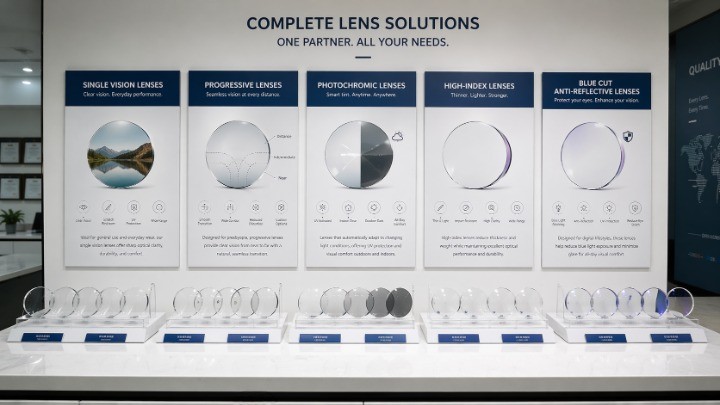 Optical businesses can build a stronger lens range by separating basic, upgraded, premium, functional, and professional coating packages. This helps customers choose more easily and helps sales teams explain value.
| Product Range | Lens Type | Best For | Main Value |
|---|---|---|---|
| Basic range | Standard AR lenses | Daily prescription users | Clearer vision and reduced reflections |
| Upgrade range | Blue cut AR lenses | Office workers and students | Digital lifestyle positioning |
| Premium range | High-index blue cut AR lenses | Stronger prescriptions | Thinner appearance and coating value |
| Functional range | Photochromic blue cut AR lenses | Indoor-outdoor users | Sun adaptation and screen-related positioning |
| Professional range | Progressive blue cut AR lenses | Presbyopia users | Multi-distance vision and modern coating package |
Basic Range: Standard Anti-Reflective Lenses
A standard AR lens should be the foundation of most modern prescription lens ranges. It offers visible value and fits daily wear.
This range works well for price-sensitive markets, optical chains, and basic prescription packages.
Upgrade Range: Blue Cut Anti-Reflective Lenses
A blue cut AR range gives retailers a clear upgrade option for screen users. It can serve office workers, students, and online eyewear customers.
The sales message should stay realistic. The lens filters part of blue-violet light and reduces reflections, but it does not replace healthy screen habits or proper eye exams.
Premium Range: High-Index Blue Cut AR Lenses
High-index lenses benefit strongly from AR coating because they need better reflection control. Adding blue cut function can create a premium package for users who want thinner lenses and screen-use positioning.
This range works well for eyewear brands that want to improve product value and upgrade options.
Functional Range: Photochromic Blue Cut AR Lenses
Photochromic blue cut AR lenses can serve users who move between indoor and outdoor environments. The product combines sun adaptation, UV-related positioning, screen-use messaging, and clearer lens appearance.
This type of range can help optical businesses offer more complete lifestyle solutions.
Professional Range: Progressive Blue Cut AR Lenses
Progressive lenses require stronger product trust because users expect comfortable near, intermediate, and distance vision. A blue cut AR coating can support office and daily-use positioning for presbyopia customers.
Blue Cut vs Anti-Reflective Lenses: Final Recommendation
For most daily prescription lenses, anti-reflective coating should be treated as a core feature. Blue cut function should be added when the user profile, market demand, and product positioning support it.
Choose blue cut lenses if the product targets screen-heavy users, office workers, students, or customers who specifically ask for digital lifestyle eyewear. Choose anti-reflective lenses if the main goal is clearer vision, reduced reflections, better appearance, and daily comfort.
Choose both when you want a modern lens package that combines practical clarity with screen-use positioning. This is often the best strategy for optical retailers, wholesalers, and private-label brands that need a simple upgrade from basic lenses.
Work With a Professional Optical Lens Manufacturer
Vena Optics supplies optical lenses with blue cut function, anti-reflective coating, UV protection, photochromic options, progressive designs, high-index materials, and customized coating solutions. As a Danyang-based optical lens manufacturer, we support buyers who need stable supply, consistent quality, and flexible product configuration.
If you are building a lens range for retail, wholesale, regional distribution, or private-label supply, you can explore our