


Choosing lens options can feel confusing, especially when terms like anti reflective, anti glare, blue light, and polarized are often used together. An anti reflective lens is usually a regular eyeglass lens with a coating that reduces surface reflections and glare. That simple definition answers the main search question, but it does not tell you when AR lenses are worth choosing, what problems they solve, or where they fall short.
That is why this topic matters. People often compare anti reflective lenses with polarized lenses, blue light lenses, or standard clear lenses without understanding that each one solves a different problem. The American Academy of Ophthalmology notes that anti-reflective coatings reduce glare, make eye contact easier, and improve appearance, while the American Optometric Association recommends anti-reflection coating on prescription lenses to reduce reflections during night driving.
This guide explains what an anti reflective lens does, how AR coating works, when it is worth paying for, how it compares with other lens features, and how to choose the right option for daily wear or wholesale product planning.

What Is an Anti Reflective Lens?
An anti reflective lens is not a separate lens design like single vision, bifocal, or progressive. In most cases, it is a lens with anti-reflective coating applied to the surface. The coating reduces reflections from the front and back of the lens so more light passes through to the eye.
That distinction matters because many buyers use “lens” and “coating” as if they mean the same thing. In practice, a single vision lens, a progressive lens, or a high-index lens can all be made with or without AR coating. If you want background on lens types, you can compare What Is a Single Vision Lens? and Progressive Lenses – Complete Guide to Progressive Glasses before you decide which lens design and which coating package you actually need.
People also confuse anti reflective, anti glare, and non reflective terms because retail language is not always precise. In many everyday eyeglass listings, anti glare is just a consumer-facing way to describe the benefit of AR coating. However, the better buying question is not what the label says. The better question is what performance the coating actually delivers in glare reduction, cleanability, and durability.
What Does an Anti Reflective Lens Do?
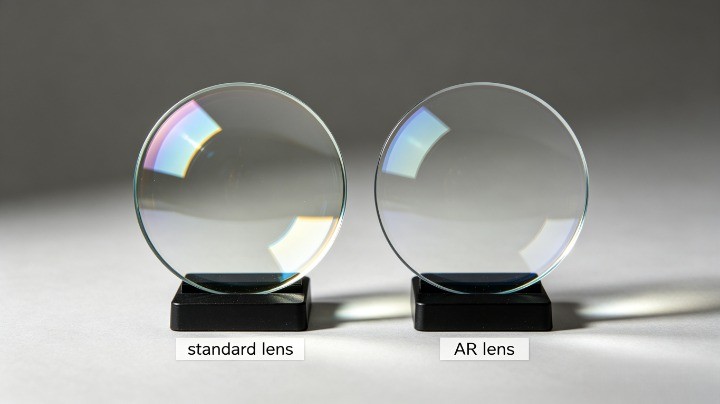
An anti reflective lens reduces visible reflections on the lens surface, so vision looks clearer and the lens looks more transparent. That is the practical answer most readers need.
Every clear lens reflects some light. Those reflections can come from office lights, computer screens, overhead fixtures, dashboard lights, and headlights at night. When those reflections build up, wearers often feel that the lens looks shiny, distracting, or tiring over time. AR coating lowers that surface reflection and allows more useful light to pass through the lens.
This matters both visually and cosmetically. On the visual side, reduced reflection can make indoor vision feel cleaner and more comfortable. On the cosmetic side, lower reflection makes the wearer’s eyes easier to see in meetings, retail interactions, photos, and video calls. That is one reason AR coating often feels more valuable than buyers expect after they start using it.
How Does Anti Reflective Coating Work?
AR coating works by using very thin optical layers that reduce the intensity of reflected light. You do not need to study thin-film optics to choose AR lenses well, but you do need to understand that the coating is engineered, not decorative.
Manufacturers apply multiple thin layers so that reflected light waves interfere with each other in a way that lowers visible reflection. The goal is not to eliminate every reflection under every condition. The goal is to reduce reflection enough to improve clarity and comfort in real use. That is also why two coatings can both be sold as “anti reflective” while performing very differently in daily wear.
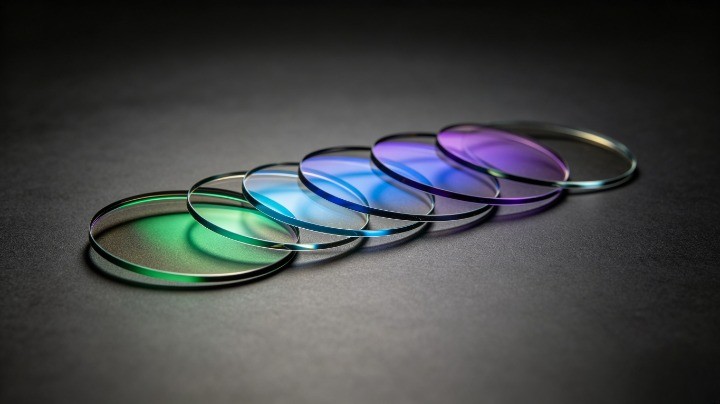
Many AR-coated lenses also show a slight green, blue, or purple residual reflection. That faint color is normal and usually reflects the coating design, not a defect. In the market, residual color also affects how premium the finished lens looks, which is why brands and wholesalers often care about its consistency across batches.
Anti Reflective vs Anti Glare vs Polarized vs Blue Light Lenses
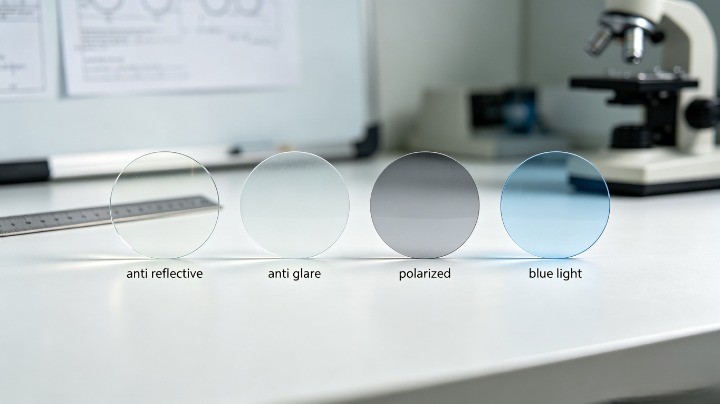
These terms overlap in sales language, but they do not solve the same problem. This is one of the most important distinctions in the article.
Anti reflective and anti glare usually refer to the same everyday benefit on clear prescription glasses: reducing surface reflections. Polarized lenses are different. The AAO page on polarized lenses explains that polarized sunglass lenses reduce intense glare from reflective outdoor surfaces such as water, roads, and snow. They improve comfort in bright sun, but they do not automatically guarantee UV protection on their own.
Blue light lenses are different again. They are marketed for screen use, sleep, or eye protection. However, the 2023 Cochrane review on blue-light filtering spectacles found that blue-light filtering spectacles probably make no difference to eye strain from computer use or to sleep quality in the short term. That does not mean buyers can never prefer them, but it does mean the evidence is weaker than the marketing suggests.
| Lens feature | Main purpose | Best use case | What it does not automatically do |
|---|---|---|---|
| Anti reflective coating | Reduce surface reflections on clear lenses | Office wear, night driving, premium everyday glasses | Does not automatically mean blue light filtering or UV protection |
| Anti glare | Consumer term often used for AR benefit | General eyewear retail language | May not describe a separate technical category |
| Polarized lenses | Reduce harsh reflected outdoor glare | Water, roads, snow, bright daylight driving | Does not automatically guarantee UV protection |
| Blue light lenses | Filter part of short-wavelength visible light | Buyers who specifically want this feature | Evidence does not clearly show less eye strain or better sleep |
If you wear clear everyday glasses, AR is usually the first upgrade to evaluate. If your problem is bright outdoor reflected glare, polarized sunwear addresses that more directly. If you are comparing blue light products, it is worth separating evidence-based benefit from marketing language.
What Problems Can Anti Reflective Lenses Solve in Daily Use?
Anti reflective lenses are most useful when the problem comes from lens-surface reflections in indoor or night environments. That is where the benefit is easiest to notice.
A common example is screen work. Reflections from office lighting, monitor glare, and bright indoor fixtures can make glasses feel visually busy. AR coating does not solve every case of digital eye strain, because dry eye, blink rate, screen distance, and prescription accuracy also matter. Still, reducing surface reflections often makes the visual experience calmer and easier over long work sessions.
Night driving is another important use case. The AOA recommends anti-reflection coating on prescription eyeglass lenses to minimize reflections from dashboard lights, street lights, and headlights. That is a practical, real-world reason many optometrists and optical shops recommend AR coating even when they do not push many other upgrades.
AR also solves a cosmetic problem. Lenses with strong reflections can hide the wearer’s eyes and make the glasses look more mirror-like than clear. This becomes more noticeable on video calls, face-to-face communication, and photos. On high-index lenses, the benefit is often even stronger because higher-index materials tend to reflect more light.

Benefits of Anti Reflective Lenses
The biggest benefits of anti reflective lenses are better clarity, less distracting glare, and a cleaner-looking lens. Those three advantages explain most of the product’s long-term value.
For full-time wearers, AR coating often improves comfort in ordinary daily situations rather than one dramatic single moment. Reading under indoor lights, moving between screen tasks and face-to-face work, or driving after dark can all feel a little easier when reflections are lower. Those small gains repeat across many hours, which is why AR is often worth more to a daily wearer than to someone who uses glasses only occasionally.
AR also supports better appearance. The AAO notes that anti-reflective coatings reduce glare, make eye contact easier, and improve appearance. That matters for professionals in sales, education, client service, management, and any role where facial visibility supports communication.
| Benefit | What you may notice |
|---|---|
| Reduced reflections | Less mirror-like glare on the lens surface |
| Better clarity | Cleaner indoor visual experience |
| Improved appearance | Your eyes are easier to see through the lens |
| Better screen comfort | Fewer distracting reflections from office lighting |
| Better support for night driving | Less light scatter and reflection from common night sources |
If you want to compare AR with other lens categories that solve different needs, you can also review What Is a Photochromic Lens? for adaptive tinting and Progressive Lenses – Complete Guide to Progressive Glasses for multifocal correction.
Are Anti Reflective Lenses Worth It?
For most full-time eyeglass wearers, anti reflective lenses are worth it. They are especially useful for people who wear glasses indoors, use screens often, drive at night, choose high-index lenses, or care about how their lenses look in conversation and photos.
The value becomes clearer when you think in hours, not in features. If you wear glasses all day, small improvements in glare reduction and clarity repeat again and again. In that case, the extra coating cost spreads across daily use and tends to feel justified. If you only use glasses briefly for a very specific task, the value may feel lower.
The other key factor is coating quality. A basic AR upgrade may reduce reflections but still smudge badly or wear faster. A stronger AR package often includes hydrophobic and oleophobic top coats that make the lens easier to clean and more pleasant to own. So the real question is not only “Is AR worth it?” but also “Which AR level is worth paying for?”

The Drawbacks of Anti Reflective Lenses
Anti reflective lenses are helpful, but they are not perfect. The drawbacks are real, and buyers should understand them before choosing a coating package.
The first drawback is smudging. Lower-grade AR coatings often show fingerprints and face oils more easily. Even the AAO has noted that some lower-cost anti-reflective coatings can be harder to keep clean. This is why premium coatings usually compete not only on lower reflection, but also on easier cleaning performance.
The second drawback is durability variation. Not all AR coatings perform the same in scratch resistance, adhesion, cleanability, or long-term wear. Two lenses can both be labeled anti reflective while delivering very different user experiences after three or six months.
The third drawback is expectation mismatch. AR coating reduces lens-surface reflections. It does not replace polarized sunwear in bright outdoor glare, and it does not automatically include blue-light filtering or UV protection. Buyers who expect one feature to solve every glare problem often end up disappointed.

Common Anti Reflective Lens Problems and How to Avoid Them
Most AR complaints come from smudges, scratches, cleaning mistakes, or choosing the wrong coating level for the job. In other words, the product and the care routine both matter.
Smudging is the most common complaint. If the coating lacks a strong top coat, fingerprints and oily residue can become annoying quickly. This is one reason a low-priced AR offer may look attractive at first but disappoint later in real use.
Scratches and coating wear are the next major issue. Dry wiping dusty lenses, using paper towels, cleaning with rough fabric, or storing glasses carelessly all increase damage risk. Good AR coating helps, but poor cleaning habits can still shorten its life.
The simplest prevention steps are practical:
• choose AR coating with hydrophobic and oleophobic top-coat features
• rinse off dust before wiping
• use lens-safe cleaner or mild soap and water
• avoid paper towels, tissues, and clothing
• keep glasses in a case when not in use
These steps sound basic, but they explain why one wearer says AR coating is excellent while another says it is hard to live with.
How to Choose the Right Anti Reflective Lens
The right anti reflective lens depends on prescription, daily use, coating level, and expected lifespan. There is no single best option for every wearer.
Start with prescription strength. High-index lenses generally reflect more light than basic standard-index lenses, so AR usually adds more value there. If thinness and appearance are part of the reason for choosing high-index material, skipping AR often weakens the result.
Then look at use case. Office workers, students, drivers, retail staff, and people who spend time on video calls usually notice more benefit from AR than someone who only uses glasses occasionally. If your main issue is strong sunlight reflecting off outdoor surfaces, you may need polarized sunglasses rather than relying on AR on a clear lens.
Finally, compare standard AR and premium AR coating honestly.
| Selection factor | What to ask |
|---|---|
| Prescription | Is the lens high-index and therefore more reflective? |
| Daily environment | Will you use it for office work, night driving, or all-day wear? |
| Coating level | Is it basic AR or premium AR with better top-coat performance? |
| Cleanability | Does it include hydrophobic and oleophobic features? |
| Appearance | Does residual reflection color matter for retail presentation? |
| Durability | What complaint rate, adhesion standard, or support policy is offered? |
For procurement teams, the decision is also a positioning choice. A value line may justify basic AR. A premium private-label line usually needs stronger cleanability, better cosmetics, and more stable batch consistency.
How to Clean and Care for Anti Reflective Lenses
Clean AR lenses gently and consistently. Good care habits often decide whether the coating remains pleasant to use.
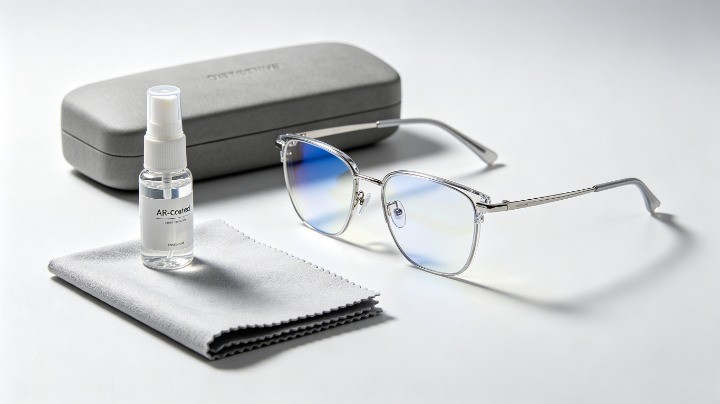
A safe routine is simple. First rinse the lenses to remove dust. Then use a lens-safe cleaner or mild soap with warm water. After that, dry the lenses with a clean microfiber cloth. This routine reduces abrasion risk and helps preserve coating performance over time.
Do not dry-wipe dusty lenses. Do not use paper towels, rough tissues, or the edge of your shirt. These habits feel convenient in the moment, but they increase scratches and coating wear.
Storage matters too. Put the glasses in a case when you are not wearing them. Keep them away from unnecessary heat, harsh chemicals, and cluttered desk surfaces. A good AR coating lasts longer when the handling routine supports it.
FAQs About Anti Reflective Lenses
Do anti reflective lenses help with night driving?
Yes, they can help reduce distracting reflections at night, especially from headlights, dashboard lights, and street lights. The AOA specifically recommends anti-reflection coating on prescription eyeglass lenses for this reason.
Do anti reflective lenses reduce eye strain?
They can reduce one source of visual discomfort: surface reflections. However, eye strain also depends on dry eye, screen habits, blink rate, lighting, and prescription accuracy. AR helps, but it is not the only factor.
Do anti reflective lenses block UV?
Not automatically. UV protection depends on the lens material or a specific UV treatment, not just on the presence of AR coating. Polarization also does not automatically mean UV protection.
Do anti reflective lenses include blue light protection?
Not by default. Some product packages combine AR and blue-light filtering, but those are separate design choices. Current evidence does not clearly show that blue-light filtering spectacles reduce eye strain or improve sleep in the short term.
Are anti reflective lenses better for high-index lenses?
Usually yes. High-index lenses reflect more light than standard-index lenses, so AR often delivers more visible improvement on those materials. That is why many premium thin-lens programs pair high-index materials with AR by default.
For Optical Buyers and Brands: What to Check Before Choosing AR Lens Supply
If you are sourcing AR-coated lenses for a brand, distributor, lab, or optical chain, the key issue is not whether a supplier offers AR coating. The real issue is how stable that AR program is in production. Batch consistency, cleanability, residual reflection control, and complaint handling matter more than a generic “AR available” label.
Vena Optics states on its homepage that it serves optical retailers, distributors, and eyewear brands across 50+ countries, offers annual production exceeding 10 million lenses, supports ISO 13485-based traceability, and provides OEM/ODM services, private labeling, and multiple coating systems including HMC and SHMC. The site also links readers to related product and content pages such as Vena Optics blog, What Is a Single Vision Lens?, and Progressive Lenses – Complete Guide to Progressive Glasses, which can help buyers compare lens categories before specifying an AR package.
For wholesale review, this checklist is more useful than a simple price comparison:
• coating consistency across batches
• adhesion and scratch-performance claims
• cleanability and top-coat chemistry
• residual reflection color consistency
• complaint and remake handling
• fit by market tier, from value to premium
• OEM/ODM, packaging, and traceability support
If you want a supplier discussion to be productive, ask how the AR program performs after real wear, not just how it looks on a fresh sample tray.
Final Verdict: Should You Choose Anti Reflective Lenses?
Yes, in most cases anti reflective lenses are a smart upgrade for everyday eyewear. They reduce distracting reflections, improve lens appearance, and add practical value for indoor work, screen use, high-index lenses, and night driving. They are not the same as polarized lenses, and they do not automatically include blue-light filtering or UV protection, but they solve a real and common optical problem.
If you are choosing for yourself, focus on use case and coating quality rather than the upgrade label alone. If you are choosing for a product line, focus on consistency, cleanability, and positioning. The right anti reflective lens is not just the one with less reflection on day one. It is the one that still performs well after real use.