


Choosing an optical lens manufacturer is not just a sourcing task. It is a business decision that affects product quality, delivery performance, and customer trust.
That decision matters because the need for reliable vision correction remains huge. According to the , at least 2.2 billion people globally live with near or distance vision impairment, and at least 1 billion of those cases could have been prevented or still need to be addressed. WHO also says uncorrected refractive error remains a leading cause of vision impairment. ()
So when you choose an optical lens manufacturer, you are not only comparing catalogs. You are choosing the partner that will support your product strategy, your replenishment cycle, your packaging standards, and your reputation in the market.
 Why Choosing the Right Optical Lens Manufacturer Matters
The right manufacturer helps you grow. The wrong one creates hidden cost. That is the short answer.
In real buying work, price is only one part of the picture. If a supplier sends unstable coating quality, inconsistent powers, or late shipments, your actual cost goes up fast. You spend more time on remakes, complaint handling, urgent replacements, and account recovery. A cheap quotation can become an expensive relationship.
This point gets stronger when you sell into regulated markets. The states that sunglasses, spectacle frames, spectacle lenses, and magnifying spectacles are medical devices that are exempt from 510(k), but other FDA rules still apply. The same guidance also says spectacle lenses sold in the U.S. must comply with the impact-resistant lens regulation in 21 CFR 801.410, and each lot seeking entry into the U.S. should be accompanied by a certificate showing compliance. ()
That is why a dependable supplier does more than make lenses. It helps you lower operational risk.
What Type of Optical Lens Supplier Do You Need?
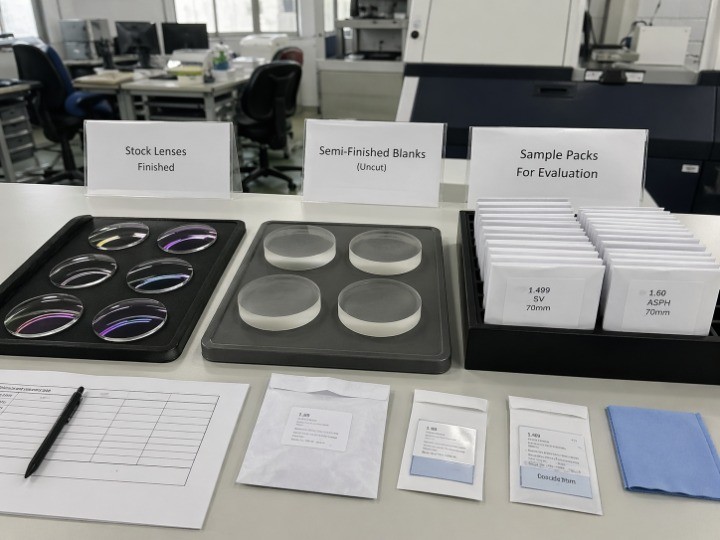 You should identify the supplier type before you compare prices. Many buyers skip this step and lose time.
Not every optical lens supplier plays the same role. A trading company, a stock lens supplier, a semi-finished lens producer, and an RX or freeform manufacturer may all look similar in a brochure. In practice, they control very different parts of the process.
If you mainly sell stocked single vision lenses, you probably need strong inventory depth, stable replenishment, and a broad routine range. If you run a lab or work with local edging partners, you may need semi-finished blanks with predictable processing behavior. If you focus on premium programs, you may need better control in progressive, photochromic, blue cut, or high-index production.
A true manufacturer often gives you more direct visibility into production, inspection, coating control, and corrective action. A trader may still be useful in some cases, but you should know early who actually makes the lens, who controls coating, and who releases the batch.
| Supplier Type | Best For | What You Need to Confirm |
|---|---|---|
| Trading company | Mixed sourcing and flexible communication | Who the real factory is and how QC is managed |
| Stock lens supplier | Fast-moving repeat orders | Range depth, stock discipline, replenishment speed |
| Semi-finished lens supplier | Labs and local finishing partners | Base quality, coating stability, processing consistency |
| RX/freeform supplier | Higher-value customized programs | Turnaround time, design capability, QC standards |
| Full-range manufacturer | Supply consolidation | Which categories are truly strong, not just listed |
Key Factors to Consider Before Choosing an Optical Lens Manufacturer
You should judge the manufacturer as a full operating partner, not only as a price source. That means checking product fit, real manufacturing capability, quality stability, compliance support, lead times, and after-sales response.
Most weak supplier decisions happen because the buyer focuses too early on one attractive point. It may be the cheapest price. It may be a beautiful sample. It may be fast replies. None of those points alone tell you how the supplier will perform once you place repeat orders.
A stronger decision comes from looking at the whole operating picture. The rest of this article follows that logic.
Product Fit and Manufacturing Scope
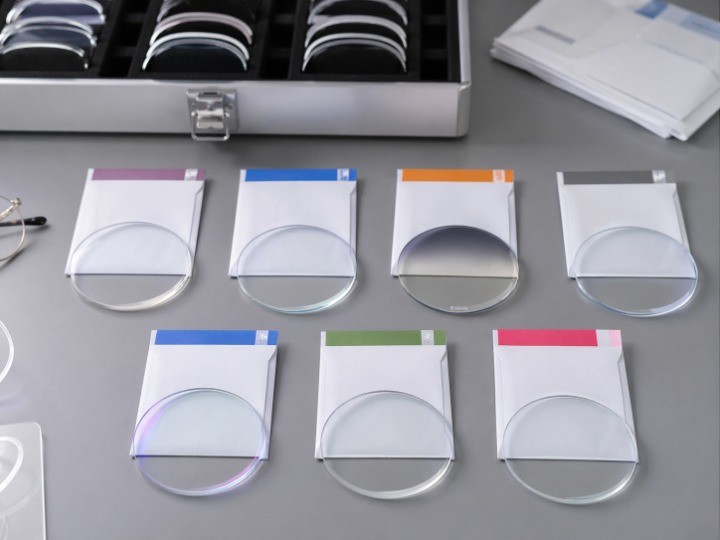 First, confirm whether the supplier fits your product strategy. If the product fit is weak, the rest does not matter much.
Start with the core categories you actually plan to buy. For most professional buyers, that means some mix of single vision, bifocal, progressive, photochromic, blue light protection, high-index, and polycarbonate lenses. Do not stop at asking whether the supplier “can do” those products. Ask which ones are regular production, which ones are made to order, and which ones are outsourced.
Then check materials and index range. A wider and more stable range helps you reduce supplier overlap and makes purchasing simpler. It also helps you build more coherent programs for your customers instead of splitting similar items across different suppliers.
You should also match the supplier’s range to your market position. An entry-level volume program needs a different supply setup than a premium optical brand. The best manufacturer for one model may not be the best one for the other.
Real Manufacturing Capability
 A real manufacturer should be able to explain how production works. That is the clearest answer to this heading.
Ask direct questions. Which steps happen in-house. Which steps are outsourced. What is the normal output by category. How does the factory manage urgent orders. How does it avoid pushing one shipment late to save another. Good factories usually answer these questions clearly because they already manage around them every day.
If you cannot visit the site, do a remote audit. Ask for a live video tour instead of only polished marketing footage. Ask to see the production flow, the inspection area, the packaging area, and the lot coding or internal traceability system. You are not looking for a perfect-looking workshop. You are looking for visible control.
This is also where quality system discipline matters. The says the Quality Management System Regulation became effective on February 2, 2026 and amended 21 CFR Part 820 by incorporating ISO 13485:2016 by reference. FDA also says this move aligns U.S. medical device quality management system requirements with internationally recognized standards and now specifically requires risk management. ()
That does not mean every good supplier will speak in regulatory language all day. It means a strong supplier should already think in terms of controlled process, risk, and traceability.
Lens Quality and Consistency
Lens quality is really about repeatability. One good-looking sample is not enough.
A supplier can send a clean first sample and still disappoint on the next bulk order. That is why you should judge consistency across power accuracy, coating appearance, surface quality, cosmetic finish, and packaging discipline. If you only judge the first impression, you may miss the real risk.
In practical terms, you want to know how the supplier holds quality across batches. Ask how it tracks common defects. Ask what causes remakes most often. Ask what happens after a reject. If the answers stay vague, the process may depend too much on individual workers instead of a stable system.
You should also pay attention to how the supplier talks about tolerances and inspection. A serious factory does not treat tolerances as a sales topic. It treats them as a daily production rule.
Certifications and Compliance
Certifications are useful, but they are not enough on their own. You should check both the document and the real process behind it.
For medical device quality systems, the explains that ISO 13485 is intended for organizations involved in the design, production, installation, and servicing of medical devices and related services, and it can also benefit suppliers and external parties that provide product or quality-management-related services to them. ()
That makes ISO 13485 a strong signal, especially if you sell into documentation-heavy or regulated markets. But a certificate alone does not prove that daily execution is strong. You still need to ask how the system works in practice. Who approves release. How nonconformities are handled. How records are retained. How traceability is maintained.
If you sell into Europe, this question becomes even more practical. The states that spectacle lenses are highly individualized devices intended to correct refractive errors, and the guidance outlines assignment, labeling, packaging, vigilance reporting, and timeline rules for Master UDI-DI. It also notes that the 2025 delegated regulation applies from November 1, 2028 after a three-year transitional period. ()
So when you ask for compliance support, do not only ask for “CE” or “documents.” Ask what the factory can actually provide and maintain for your market.
Product Range and Customization Capability
A strong product range helps you consolidate buying. Strong customization helps you build a better commercial program. Both matter.
Many buyers do not only buy lenses. They buy finished business programs. That usually includes envelopes, labels, carton marks, barcodes, private-label design, and market-specific packaging details. So you should check customization early, not after price approval.
Ask which packaging elements are standard and which will change MOQ or lead time. Ask whether the supplier can keep the same packaging rules and printing quality across repeat orders. Ask whether coating naming, lens marking, and packaging descriptions stay stable from batch to batch.
This is where many factories sound flexible at first but become inconsistent later. Customization only adds value when the factory can repeat it reliably at production scale.
Sample Evaluation Before Approval
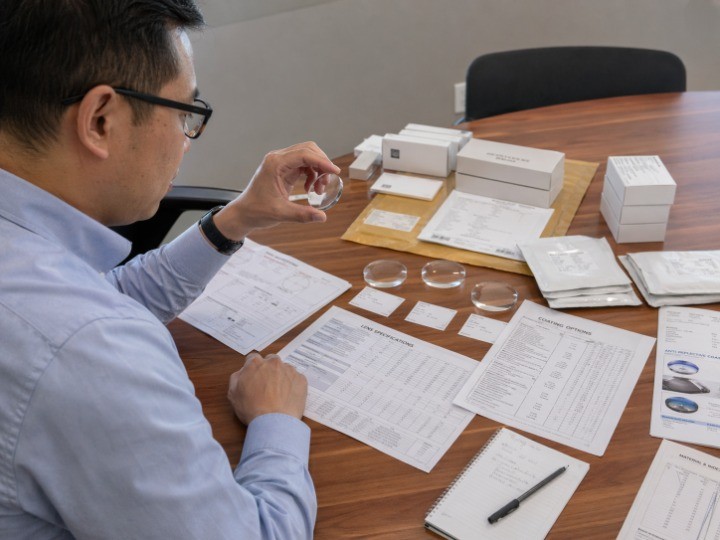 You should treat sample approval as a production test, not a beauty test. That is the most useful way to answer this section.
Before shipment, ask for the product specification sheet, power range list, coating details, and sample identification. When the samples arrive, compare the physical goods with the written details. Check optical clarity, surface cleanliness, coating uniformity, cosmetic finish, labeling, and packaging.
One sample is rarely enough. A better approach is to request a small but representative set across the powers, coatings, or lens types you actually plan to buy. That gives you a more honest view of consistency.
A practical sample review can include:
-
checking whether the packing label matches the actual lens type and index
-
reviewing coating appearance under consistent light
-
comparing packaging accuracy with your requested format
-
recording any mismatch between promised and delivered details
-
asking the supplier to explain any deviation clearly
This process takes more effort up front, but it prevents much bigger trouble later.
Quality Control System and Proof of Consistency
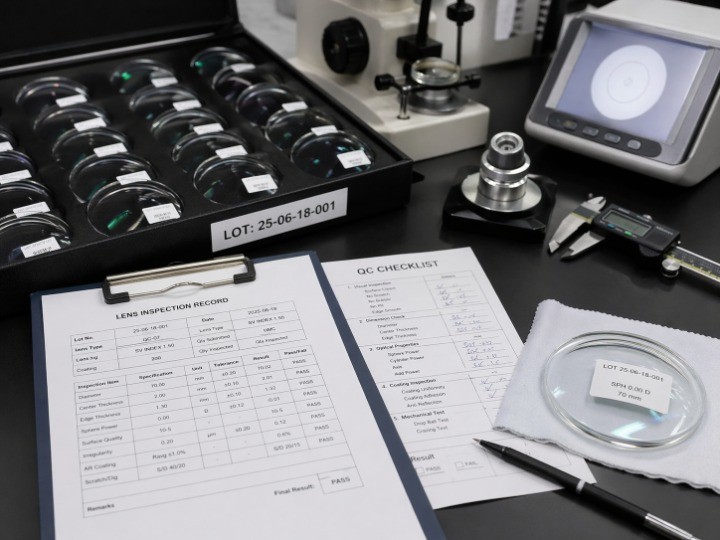 A good manufacturer should be able to show you its QC system. It should not rely on vague phrases like “strict inspection.”
You should ask how the factory handles incoming material checks, in-process inspection, final inspection, defect recording, and corrective action. Then ask for proof. That can include inspection records, internal reports, traceability examples, or photos of the inspection flow.
This matters even more in markets where traceability and device identification are getting more attention. The EU guidance for spectacle lenses specifically discusses labeling, packaging, vigilance reporting, and the role of the manufacturer in assigning and managing Master UDI-DI. ()
A useful QC review often comes down to five simple questions:
-
What do you inspect before production starts
-
What do you inspect during production
-
What must pass before shipment
-
How do you record a defect
-
What happens after a defect appears
If the supplier cannot answer these questions in a clear sequence, the QC system may be weaker than it sounds.
| QC Area | What to Ask For | Why It Matters |
|---|---|---|
| Incoming inspection | Material check records | Shows raw input control |
| In-process inspection | Control points and reject rules | Shows process discipline |
| Final inspection | Release basis and sample records | Shows shipment control |
| Traceability | Lot or internal coding example | Helps claims and root-cause review |
| Corrective action | Example of a past issue and fix | Shows whether the factory learns |
Lead Time, Inventory Support, and Supply Reliability
 A supplier who ships late is still an expensive supplier. Delivery performance matters almost as much as lens quality.
Do not ask only for the best-case lead time. Ask for the normal lead time by product type, the peak-season lead time, and the urgent-order policy. A disciplined factory usually gives a more structured answer. It can explain how it plans routine production, fast-moving items, and exceptional demand.
You should also ask whether the supplier keeps safety stock for key items or can support faster replenishment for best sellers. That becomes important when demand changes faster than expected.
The main goal is simple. You do not want a supplier that can deliver one good order. You want one that can support stable repeat business.
Price vs Real Value
You should compare full buying value, not only unit price. That is often where the real decision sits.
A quotation only helps if it is complete. It should state lens specifications, coating structure, packaging details, MOQ, delivery terms, and claim policy. Without those items, you may think you are comparing equal offers when you are not.
A lower unit price may still lead to higher real cost if the supplier creates more remakes, slower replacements, weaker packaging, or more internal handling work for your team.
| Cost Element | Lower-Price Offer | Better-Value Offer |
|---|---|---|
| Unit price | Lower | Slightly higher |
| Remake risk | Often unclear | Usually discussed and controlled |
| Delivery stability | Less certain | More planned |
| Documentation | Basic | More complete |
| Claim handling | Reactive | More structured |
| Long-term cost | Often higher | Often lower |
When a quotation looks unusually low, ask one direct question: What has been reduced, excluded, or delayed to reach this price. That question often reveals more than the price sheet.
Communication and Service Responsiveness
Good communication is an early sign of operational quality. It often tells you what daily cooperation will feel like.
You should pay attention to the quality of the response, not only the speed. Strong suppliers reply clearly, confirm key assumptions, and write down important details. Weak suppliers keep answers broad, shift details later, or avoid direct replies when you ask technical questions.
This matters because poor communication usually creates downstream errors in sampling, packaging, delivery, and claims. In other words, weak communication is rarely a small issue. It often reflects weak internal alignment.
If a supplier answers commercial questions well but stays vague on production, inspection, or documentation, you should treat that as a warning sign.
After-Sales Support and Claim Handling
You should judge a manufacturer by how it handles problems, not only by how it wins orders. Every factory faces issues at some point. The real difference lies in the response.
Ask what evidence the supplier needs for a claim. Ask how replacement or remake decisions are made. Ask how fast the team normally responds. Then compare those answers with the supplier’s QC and traceability claims. If those two sides do not match, the after-sales promise may not hold up later.
A responsible supplier should be able to trace the lot, review the issue, explain the likely cause, and propose a practical next step. That response protects your customer relationship and lowers future risk.
How wholesale Buyers Can Vet Optical Lens Manufacturers Efficiently
The fastest way to vet suppliers is to use one structured comparison process for all of them. That keeps the decision clear.
A practical process looks like this:
-
Shortlist three to five suppliers that match your product scope
-
Screen them for real manufacturing capability and relevant documents
-
Compare sample quality against written specifications
-
Review QC proof, lead-time discipline, and customization support
-
Move one or two suppliers to a trial order before any larger program
This kind of process helps you compare real performance instead of being pulled by sales style or a single attractive price.
You should also use the same first-round questions for each supplier. That gives you cleaner answers and a more honest side-by-side comparison.
Red Flags That Suggest You Should Not Move Forward
Most strong warning signs show up early. You should take them seriously.
Common red flags include:
-
unusually low pricing with no clear reason
-
vague answers about who actually makes the lenses
-
incomplete or outdated certificates
-
weak packaging even in samples
-
no visible QC records or lot examples
-
repeated changes to lead times or specifications
-
heavy marketing language with little technical detail
One issue may still be manageable. Several together usually point to future trouble in quality, delivery, or claims.
Buyer Checklist Before Placing the First Order
Before you place the first order, confirm that the supplier fits your product, process, and service needs. That is the safest final step.
Use this checklist:
-
product categories and index range match your plan
-
sample results match the written specifications
-
QC records and traceability examples are clear
-
lead times are realistic, not only optimistic
-
packaging and OEM details are confirmed in writing
-
claim handling rules are practical
-
quotation details are complete and comparable
-
communication quality stays stable over several rounds
A first order should reduce uncertainty, not increase it. If you still cannot explain how the supplier controls quality and delivery, you should not place the order yet.
 Conclusion
If you compare suppliers through a structured process, you will make better buying decisions and avoid hidden cost later. The best optical lens manufacturer is the one that fits your product strategy, proves its process, and supports your growth without creating avoidable risk.
Work With a Manufacturer That Supports Your Growth
If you need stable quality, flexible OEM/ODM support, broad lens options, and reliable delivery, Vena Optical gives you a practical manufacturing partner, not just a quotation. We help optical brands, wholesalers, and distributors build steady supply programs with consistent products, responsive communication, and support that fits real purchasing work.