


Polycarbonate lenses are one of the most widely recommended lens materials in eyewear. Yet many readers still struggle to understand how they compare with standard plastic, high-index, or Trivex. That confusion creates real problems. A buyer may choose the wrong material for safety eyewear, overpay for a lens that does not solve the real issue, or miss a better option for comfort, clarity, or durability. This guide explains what a polycarbonate lens is, why it is popular, where it works best, where it has limits, and how to choose it more confidently for everyday wear, sports, safety use, or product planning. ()
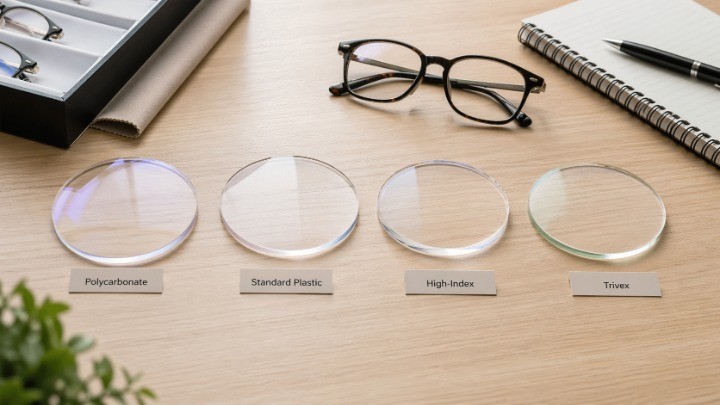 Polycarbonate Lens: A Quick Answer
A polycarbonate lens is a lightweight, impact-resistant lens material that many optical professionals recommend for children’s eyewear, sports eyewear, safety eyewear, and many everyday prescription glasses. It is popular because it combines low weight, strong impact performance, and inherent UV protection in one material. The National Academy of Opticianry lists polycarbonate at a refractive index of about 1.586, which helps it produce thinner results than standard plastic in many prescriptions.
That short answer helps, but it does not tell the whole story. Polycarbonate is often the safest practical choice, yet it is not always the best optical choice. The same NAO guide explains that higher Abbe values mean less chromatic dispersion, and it lists polycarbonate below CR-39 and Trivex on Abbe value. That is why some wearers may notice more color fringing or edge distortion, especially in stronger minus prescriptions or larger frames. Polycarbonate is strong because it balances safety, comfort, and practicality, not because it wins every category.
What Is a Polycarbonate Lens?
A polycarbonate lens is an ophthalmic lens made from a tough thermoplastic material rather than glass or standard CR-39 plastic. In the eyewear industry, the material is valued for function more than tradition. Its main advantage is that it gives wearers much better impact resistance without the weight penalty of glass. The NAO guide notes that polycarbonate was first developed for safety devices before it moved into industrial and later dress eyewear.
The legal background also explains why impact-resistant materials matter. Under 21 CFR 801.410, eyeglasses and sunglasses in the United States must be fitted with impact-resistant lenses except in narrow written exceptions, and lenses must be capable of withstanding the required impact test. FDA’s impact-resistant lens guidance also states that these lenses reduce the number of eye injuries from eyeglasses and sunglasses and that the guidance addresses test procedures, apparatus, record maintenance, and testing exemptions. ()
That is why this topic goes beyond basic product knowledge. When you choose a lens material, you are not only choosing thickness or price. You are also choosing how the lens handles impact, how comfortable it feels, how it performs in larger frames, and whether it fits the real risks of the wearer’s routine. A good lens recommendation starts with use case, not just with material names.
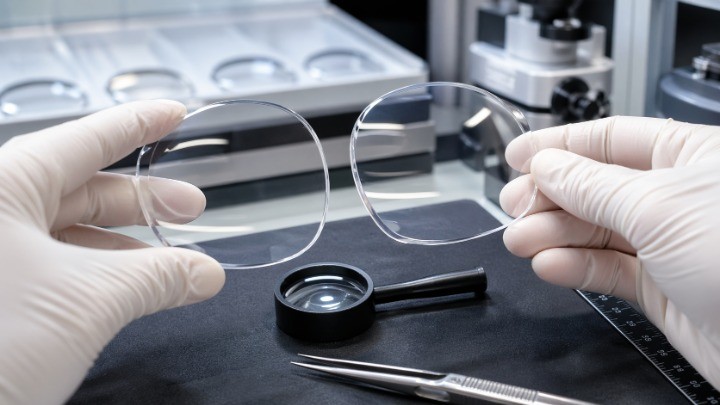
Why Polycarbonate Lenses Are So Popular
Polycarbonate lenses are popular because they solve several common problems at the same time. They reduce weight, improve impact protection, and simplify UV protection. For many wearers, that mix matters more than chasing the absolute highest optical clarity from the substrate alone. The NAO guide also notes that polycarbonate offers lighter weight than some lens materials and built-in ultraviolet light protection.
The National Eye Institute gives a very practical reason for this popularity. Its sports eye safety guidance says ordinary prescription glasses, contact lenses, and sunglasses do not protect users from sports-related eye injuries, while protective eyewear made of ultra-strong polycarbonate offers the best protection. NEI also warns that sports-related eye injuries are a leading cause of blindness among children in the United States, and that most of these injuries can be prevented with the right protective eyewear. ()
Polycarbonate also works well from a commercial point of view. A retailer, lab, or distributor can use it across children’s products, sports products, safety products, and many mainstream everyday prescriptions. That broad fit helps reduce overcomplicated material strategies. A material becomes mainstream when it works in real life for many wearers, not just when it looks good in a spec sheet.
Advantages of Polycarbonate Lenses
The biggest advantage of polycarbonate lenses is impact resistance. The NAO guide states that polycarbonate and Trivex pass ANSI Z87.1 impact-resistance testing and describes them as the safest lens materials currently available for dress or industrial safety impact-resistant lenses. It also explains that polycarbonate and Trivex pass high-mass impact testing.
That safety benefit matters because it changes who can wear the lens with confidence. Children drop glasses, active adults wear glasses in unpredictable environments, and safety users need a lens material that offers protection before style. Polycarbonate’s lighter weight also helps long-term comfort, especially for all-day wear. The NAO guide lists polycarbonate at a lower specific gravity than CR-39, which helps explain why it feels lighter in use.
• High impact resistance for sports, safety, and daily accidents • Lower weight than CR-39 and far lower weight than glass • Inherent UV protection in the material • Thinner results than standard plastic in many prescriptions • Broad product fit across kids, sports, safety, and many everyday frames
These advantages explain why polycarbonate often becomes the default recommendation. It is not the most luxurious material. It is not always the sharpest optical material. But it covers a very wide range of real-world needs. That is exactly why it has stayed relevant for so long.
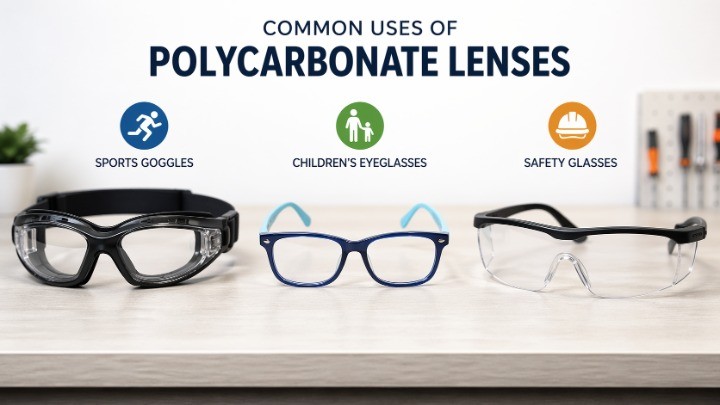
Disadvantages of Polycarbonate Lenses
The main disadvantage of polycarbonate is that its trade-offs show up in optics and surface performance, not in safety. The NAO guide states that polycarbonate has a lower Abbe value than CR-39 and Trivex, and it specifically lists chromatic aberration as one of the material’s disadvantages. It also notes that the wearer may notice this more in higher minus prescriptions and larger eyesizes.
Scratch performance is another important issue. The same guide says polycarbonate has poor scratch resistance and requires a hard coating because it is considered the softest lens material. That does not make it a weak material overall, but it does mean you should not think about the substrate alone. A polycarbonate lens usually performs best as a coated lens, not as a bare lens.
Thickness can also create confusion. Polycarbonate is thinner than standard plastic in many cases, but it is not always the best choice when the wearer’s main problem is a very strong prescription. The NAO guide explains that as refractive index increases, a lens of the same prescription and diameter needs less material and can become thinner, especially for stronger prescriptions. That is why high-index often enters the conversation for cosmetic thickness control.
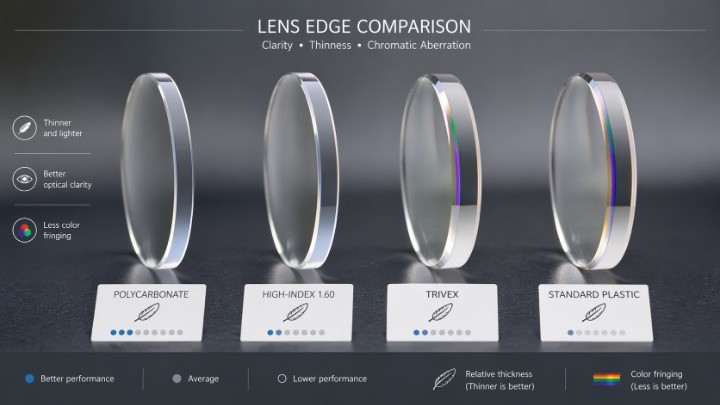 Polycarbonate vs. Other Lens Materials: A Quick Comparison
Polycarbonate sits in the middle of the lens-material decision tree. It is tougher than standard plastic, more practical than glass for impact-sensitive use, and often less optically refined than Trivex or some premium higher-index options. That makes it a very strong mainstream material, but not a universal winner.
The comparison below summarizes the most practical differences.
| Lens Material | Main Strength | Main Limitation | Best Fit |
|---|---|---|---|
| Polycarbonate | Impact resistance, low weight, UV protection | Lower Abbe value, needs hard coat | Kids, sports, safety, everyday use |
| Standard plastic (CR-39) | Strong optical clarity, lower cost | Less impact resistant, thicker | Everyday wear, moderate prescriptions |
| High-index | Thinner profile in stronger prescriptions | Higher cost, trade-offs vary by index | Strong prescriptions, cosmetic thinness |
| Trivex | Strong impact resistance with better optics than polycarbonate | Usually higher cost | Premium active wear, drill-mount, comfort-driven buyers |
| Glass | Strong optics and scratch resistance | Heavy and less practical for impact safety | Limited niche use |
This comparison follows the lens-material factors outlined by the NAO guide, which highlights refractive index, Abbe value, specific gravity, and impact resistance as the main decision points. If safety comes first, polycarbonate stays near the top. If visual refinement or the thinnest look comes first, another material may be smarter.
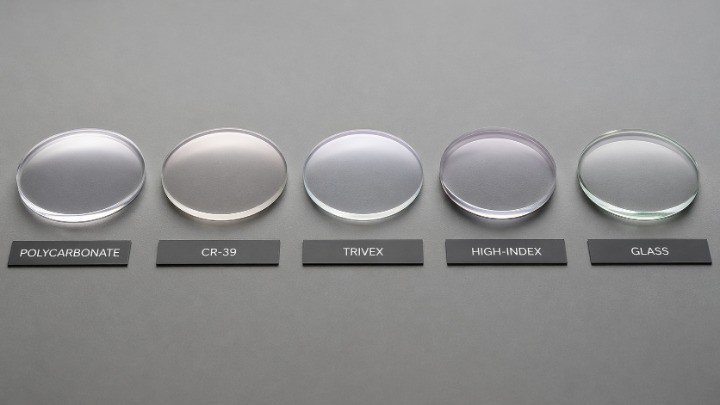 Polycarbonate vs. Plastic Lenses
Polycarbonate is usually the better choice when durability and safety matter more than maximum optical comfort. Standard plastic, especially CR-39, still works well for many everyday prescriptions and often offers a more forgiving optical experience because of its higher Abbe value. The NAO guide lists CR-39 with a much higher Abbe value than polycarbonate, which helps explain why some wearers find it visually cleaner.
At the same time, standard plastic does not carry the same safety position. Polycarbonate delivers stronger impact performance and lower weight, so it tends to win where active use, children’s eyewear, or accidental drops matter. If the wearer faces very little impact risk and cares more about price and clarity, plastic can still make sense. If the wearer needs protection, polycarbonate usually makes more sense.
Polycarbonate vs. High-Index Lenses
High-index lenses are usually the better answer when prescription strength is the main issue. The NAO guide explains that higher-index materials require less curvature and thickness to produce the same power, which is why they are often selected for stronger plus and minus prescriptions. That means high-index often wins when the wearer wants a thinner profile and a more cosmetic result.
Polycarbonate still has a strong case, however. It offers better impact performance than many high-index options and often gives a lighter, safer result for daily wear. The NAO guide also notes that higher-index lenses should mainly benefit the group of patients with higher power prescriptions, not everyone. Choose high-index when thinness and appearance drive the decision. Choose polycarbonate when protection, durability, and mainstream practicality drive the decision.
Polycarbonate vs. Trivex Lenses
Trivex is often the closest premium alternative to polycarbonate. The NAO guide lists Trivex with a higher Abbe value than polycarbonate, very low specific gravity, and strong impact performance. It also describes Trivex as offering excellent optics, strength characteristics, and ultra-lightweight qualities in a single material.
That means the choice often comes down to budget and priorities. Polycarbonate usually wins on availability and mainstream value. Trivex often wins when a buyer wants a better balance between safety and optical quality. If the wearer is sensitive to edge color, wants a premium drill-mount result, or wants a lighter-feeling premium lens, Trivex deserves a direct comparison instead of being treated as a minor upgrade.
Who Should Choose Polycarbonate Lenses?
Polycarbonate lenses are a strong choice for people who need extra protection without giving up everyday comfort. That includes children, teenagers, sports users, safety users, and many general wearers who simply want a more durable lens. NEI’s protective eyewear guidance also says that most protective eyewear can be made to match a prescription, which makes polycarbonate especially practical for real-world safety use.
Polycarbonate is usually a smart fit for:
• Children and teens • Sports and active lifestyles • Safety eyewear users • People who want lightweight everyday glasses • Wearers who rely heavily on one seeing eye and want more daily protection • Product lines that need one practical material across several categories
Workplace safety adds another layer. OSHA requires employers to ensure that affected employees use appropriate eye or face protection when exposed to eye or face hazards, and it also requires prescription wearers in hazardous operations to use protective eyewear that incorporates the prescription or fits over it properly. That does not make polycarbonate the only answer, but it helps explain why it remains so common in prescription safety products. ()
Who May Want an Alternative Instead?
Polycarbonate is not always the best option for people who care most about optical refinement or minimum thickness. A wearer with a strong minus prescription, a large frame, or high sensitivity to edge color may get a better experience from high-index or Trivex. The NAO guide repeatedly emphasizes that lens selection should balance refractive index, Abbe value, weight, and impact resistance instead of relying on one measure alone.
This matters because “best lens material” is never one-size-fits-all. A strong prescription may justify high-index. A visually demanding wearer may prefer CR-39 or Trivex. A premium rimless frame may need a different material strategy than a sports frame. The best recommendation comes from matching the material to the job, not from repeating a default script.
How Lens Coatings Affect Polycarbonate Performance
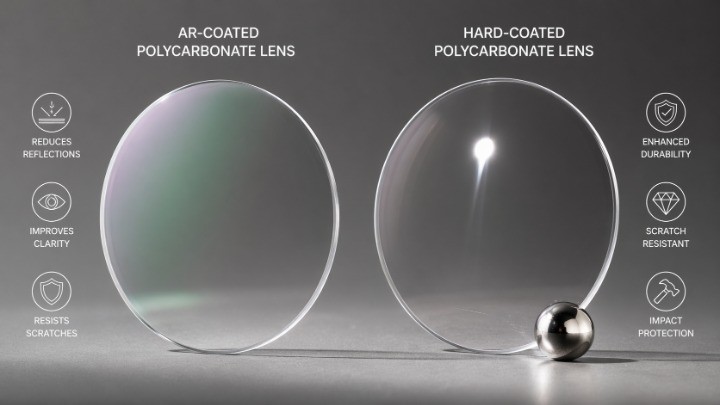 Polycarbonate performs best when the right coatings are part of the package. The NAO guide specifically states that polycarbonate requires a hard coating to prevent scratching, and it also warns that AR coatings can reduce impact resistance depending on the material and coating type. That is especially important when lenses are used in industrial or sports eyewear with high-energy impact exposure.
For most wearers, the practical coating order looks like this:
-
Hard coat for better scratch resistance
-
Anti-reflective coating for lower glare and better comfort
-
Hydrophobic or easy-clean layer for easier maintenance
-
Optional photochromic or blue-light features when the use case justifies them
This topic also connects to UV protection. NEI advises consumers to choose sunglasses that block 99% to 100% of both UVA and UVB rays. Polycarbonate helps at the material level, but finished outdoor eyewear still needs to be judged as a complete product. Material choice and coating choice should be made together, not as two separate decisions.
How to Choose the Right Polycarbonate Lens for Your Needs
 The right polycarbonate lens depends on prescription, lifestyle, frame style, and performance priorities. If you skip one of those four factors, you may recommend a lens that sounds right in theory but feels wrong in use. The NAO guide makes this point clearly when it says the most important factor depends on the intended usage of the eyewear.
A simple decision path works well:
-
Start with risk. If the wearer is a child, athlete, or safety user, polycarbonate should move high on the shortlist.
-
Check prescription strength. If thickness is the main complaint, compare polycarbonate with high-index instead of assuming polycarbonate is thin enough.
-
Check visual sensitivity. If the wearer notices edge color or distortion easily, compare with CR-39 or Trivex.
-
Check frame design. Larger frames and premium rimless styles can change the best material choice.
-
Add coatings based on use. Long-term satisfaction often depends as much on coating quality as on the substrate itself.
This same logic also works for brands, distributors, and wholesalers. Do not position polycarbonate as the answer for every product. Position it where safety, durability, broad acceptance, and commercial practicality matter most. That creates a better assortment and reduces mismatched expectations later.
Common Questions About Polycarbonate Lenses
Are polycarbonate lenses good for everyday glasses? Yes. They are widely used for everyday eyewear because they are light, impact resistant, and practical across many prescription ranges.
Do polycarbonate lenses block UV? Polycarbonate is valued for built-in UV protection, but finished sunglasses should still be checked for 99% to 100% UVA and UVB blocking.
Are polycarbonate lenses better than plastic? They are usually better for safety and weight. Standard plastic can still be better for some wearers on optics and price.
Are polycarbonate lenses good for children? Yes. NEI guidance on sports and protective eyewear strongly supports polycarbonate for higher-risk users, including children and active wearers.
Do polycarbonate lenses scratch easily? They need a good hard coating because scratch resistance is one of the material’s weaker points.
Are polycarbonate lenses good for strong prescriptions? Sometimes, but not always. If reducing thickness is the first priority, high-index may be the better fit.
Are polycarbonate lenses worth it? For many users, yes. The value becomes strongest when safety, light weight, and everyday practicality matter together.
Do polycarbonate lenses cause glare or distortion? Glare usually connects more to surface reflections and coating quality, while distortion complaints often connect to lens power, fitting, frame size, and polycarbonate’s lower Abbe value.
How to Care for and Clean Polycarbonate Lenses
Polycarbonate lenses last longer when you clean them gently and protect the coatings. The material is durable against impact, but surface performance still depends on coating care. That is especially true when the lens includes AR, hard-coat, or hydrophobic layers.
Use lukewarm water, a lens-safe cleaner, and a clean microfiber cloth. Avoid paper towels, rough fabrics, strong household chemicals, and dry wiping when dust is present. Those habits matter because surface damage often starts with repeated small cleaning mistakes, not with one dramatic accident. Good care protects the coating system as much as the lens itself.
Final Verdict: Are Polycarbonate Lenses Right for You?
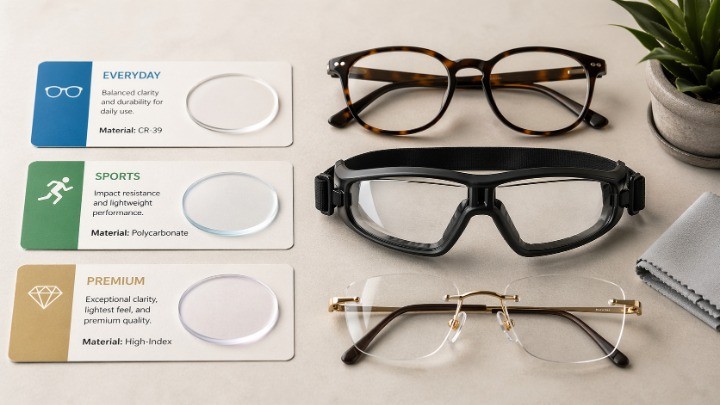 Polycarbonate lenses are right for many people because they solve real problems well. They are strong, light, practical, and especially useful for children, sports, safety use, and many everyday prescriptions where impact resistance matters. Federal rules on impact-resistant eyewear, NEI guidance on sports and protective eyewear, and OSHA requirements for hazardous work all help explain why polycarbonate remains a mainstream material.
If your first priority is maximum optical clarity, the thinnest result in a strong prescription, or a premium rimless finish, compare polycarbonate with Trivex or high-index before making the final call. If you want to explore lens solutions or product options for your market, you can start with . The best lens material is not the most advertised one. It is the one that fits the real job best.