


Evaluating an optical lens factory requires more than comparing low prices.
Many eyewear brands, wholesalers, distributors, optical chains, and lens labs face the same risk. A sample may look good, but bulk orders may bring coating problems, power errors, wrong labels, late delivery, or weak after-sales support.
This guide shows you how to evaluate an optical lens factory from product range, production capacity, quality control, certification, OEM service, and long-term supply stability.
 Why Evaluating an Optical Lens Factory Is Different From Comparing Product Prices
Evaluating an optical lens factory is different from comparing prices because lenses carry optical, coating, packaging, and compliance requirements. A low price only has value when the factory can keep quality stable, control specifications, and support repeat orders.
The real cost of a lens includes more than the unit price. It also includes inspection time, remake cost, delivery risk, customer complaints, wrong packaging, and the time your team spends solving problems after shipment.
The global need for vision correction also makes supply stability important. The World Health Organization reports that at least 2.2 billion people have near or distance vision impairment, and uncorrected refractive error remains a major cause of vision impairment worldwide. ()
Optical lenses are technical products, not simple commodities
An ophthalmic lens must match prescription needs, material expectations, coating performance, optical clarity, diameter, thickness, and packaging details. A 1.67 high-index lens and a 1.56 resin lens may look similar in a photo, but they serve different prescription needs and price levels.
A qualified factory should explain these differences clearly. It should help you choose the right lens index, material, coating, and packaging plan for your target market.
Low unit prices may hide quality, coating, delivery, and after-sales risks
A cheap quotation can look attractive at first. However, poor production control can create higher costs later.
Common hidden costs include:
• Remakes caused by wrong power or coating defects • Extra inspection after receiving goods • Delayed sales due to unstable delivery • Customer complaints caused by wrong labels or packaging • Brand damage from inconsistent lens quality
The safest supplier is not always the cheapest supplier. The safest supplier keeps quality, delivery, and communication stable over time.
A reliable factory should support both product quality and long-term supply stability
A good optical lens factory helps you build a repeatable supply system. It gives you consistent specifications, clear documents, stable lead times, and quick problem analysis when something goes wrong.
That is why factory evaluation should cover both technical capability and business reliability.
Quick Answer: What Makes a Reliable Optical Lens Factory?
A reliable optical lens factory has stable production capacity, a complete ophthalmic lens range, consistent coating quality, accurate power control, batch traceability, OEM/ODM support, and clear communication. You should evaluate the factory as a long-term supply partner, not only as a one-time product source.
The table below gives you a quick way to compare suppliers.
| Evaluation Area | What to Check | Why It Matters |
|---|---|---|
| Product range | Lens type, index, coating, function | Confirms whether the factory can support your market |
| Production capacity | Daily output, repeat orders, peak season planning | Protects long-term supply stability |
| Optical accuracy | SPH, CYL, ADD, axis, prism control | Reduces fitting and complaint risks |
| Coating quality | Adhesion, reflection, scratch resistance, durability | Prevents coating returns and after-sales issues |
| QC system | Incoming, in-process, and final inspection | Controls defects before shipment |
| Documentation | Certificates, test reports, lot records | Supports compliance and traceability |
| OEM/ODM support | Packaging, labels, barcodes, private label | Helps brands and channels manage products |
| After-sales response | Complaint analysis, replacement rules, technical support | Shows the factory’s real service value |
A good supplier should not only say, “We have strict quality control.” It should show you how it controls quality, records defects, traces batches, and handles claims.
Stable production capacity
A factory should have enough output to support your regular order volume. It should also manage urgent orders, repeat orders, and seasonal demand with realistic planning.
Complete ophthalmic lens product range
Professional buyers often need more than one lens type. A complete factory should support single vision lenses, progressive lenses, bifocal lenses, photochromic lenses, blue light protection lenses, high-index lenses, PC lenses, and coating options.
Consistent coating quality and power accuracy
Coating and power accuracy affect user experience directly. A lens may pass a visual check, but it can still fail in real use if the coating peels, reflects poorly, scratches too easily, or does not match the prescription.
Clear quality control and batch traceability
A factory should trace each batch by production date, coating batch, inspection record, and packaging details. Traceability turns after-sales problems into solvable technical cases instead of arguments.
OEM/ODM and private-label packaging support
Many eyewear brands and distributors need custom packaging, barcode labels, product line names, and local-market inserts. A strong factory should support these details without creating confusion during shipment.
Transparent communication and reliable delivery planning
Good communication reduces sourcing risk. The factory should confirm specifications clearly, update production progress, and explain delays before they become bigger problems.
1. Check Whether the Factory Specializes in Ophthalmic Lenses
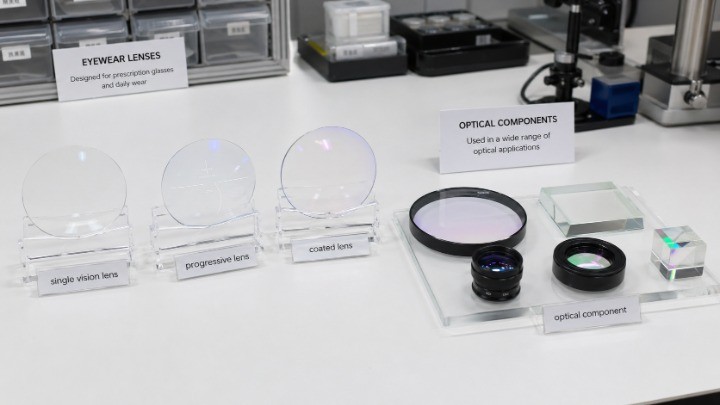 You should first confirm whether the factory truly specializes in ophthalmic lenses for eyewear use. A factory that makes general optical components may not understand the production, packaging, prescription, and channel needs of eyewear lenses.
The term “optical lens” can refer to many products. It may mean camera lenses, optical windows, glass domes, instrument lenses, or prescription eyewear lenses. These products use different processes and serve different buyers.
Why ophthalmic lens manufacturing experience matters
Ophthalmic lenses require stable control of optical power, lens index, coating, appearance, diameter, thickness, and packaging. Buyers also care about repeat ordering because the same SKU may sell for months or years.
A factory with eyewear lens experience will understand stock lens ranges, semi-finished blanks, progressive lens options, coating differences, and private-label packaging.
Difference between optical components and eyewear lenses
Precision optical components often serve industrial, imaging, laser, or instrument applications. Eyewear lenses focus more on prescription correction, coating durability, comfort, appearance, and market-ready packaging.
Both fields require precision, but they do not follow the same buyer logic. An eyewear lens supplier should understand channel sales, retail complaints, packaging accuracy, and fast replenishment.
Key ophthalmic lens categories to confirm before cooperation
Before you go deeper, confirm whether the factory can supply:
• Single vision lenses • Progressive multifocal lenses • Bifocal lenses • Photochromic lenses • Blue light protection lenses • High-index lenses • PC lenses • Coated lenses, including HC, HMC, and SHMC options
Questions to ask about the factory’s main production focus
Ask direct questions:
-
What percentage of your production is ophthalmic lenses?
-
Do you mainly produce finished lenses, semi-finished blanks, or both?
-
Which lens indexes do you supply regularly?
-
Which markets do you export to most often?
-
Can you show repeat production records for the same lens type?
The answers will show whether the factory fits your real purchasing needs.
2. Review the Factory’s Product Range and Lens Options
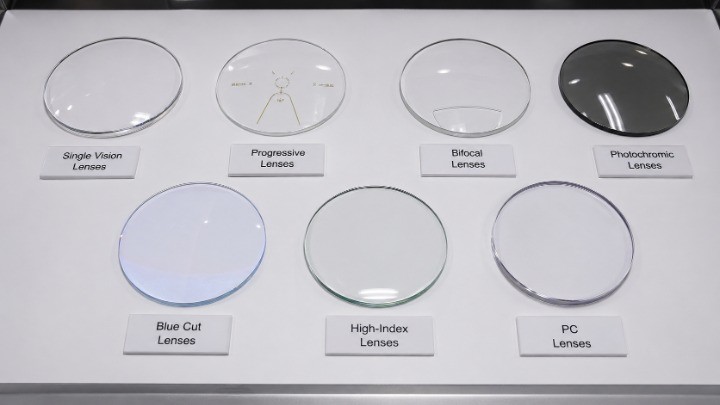 You should review the factory’s product range because it affects your future purchasing efficiency. A stronger factory can support multiple lens categories, indexes, and coatings, so you can reduce supplier fragmentation and manage orders more easily.
If a factory only supplies a narrow range, you may need several suppliers for one product line. That can increase communication cost, quality variation, and delivery complexity.
Stock lenses, semi-finished lenses, and customized lens solutions
Stock lenses work well for fast-moving standard prescriptions and wholesale channels. Semi-finished lenses help labs that need further processing. Customized lens solutions support special parameters, packaging, or market needs.
A good factory should explain which category it handles best. It should not promise everything without showing process control.
Index options: 1.499, 1.56, 1.60, 1.67, and 1.74
Lens index affects thickness, weight, appearance, and price. Standard indexes such as 1.499 and 1.56 often serve general prescriptions. Higher indexes such as 1.60, 1.67, and 1.74 help reduce thickness for stronger prescriptions.
A complete index range gives buyers more flexibility across budget, mid-range, and premium product lines.
Functional lens options: blue cut, photochromic, progressive, bifocal, tinted, and PC lenses
Different markets need different lens products. Some buyers focus on blue cut lenses for office use. Others need photochromic lenses for outdoor wear, progressive lenses for presbyopia, or PC lenses for impact-related applications.
For buyers planning a wider product program, can support mainstream and functional optical lenses, including single vision, progressive, bifocal, photochromic, blue light protection, high-index, PC, and coated lens options.
Why a complete product range improves purchasing efficiency
A complete product range helps you build a more consistent supply chain. You can align coating names, packaging systems, inspection standards, and order schedules under one supplier.
This helps you reduce mismatch between product lines and simplify supplier management.
3. Evaluate Production Capacity and Long-Term Supply Stability
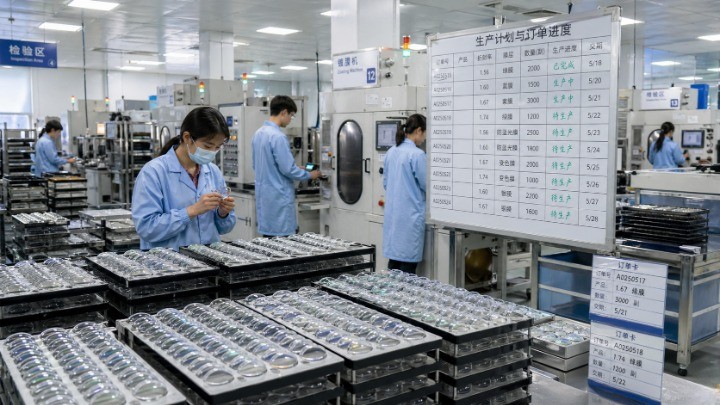 You should evaluate production capacity because a factory must support both current orders and future growth. A factory with weak capacity may deliver good samples but fail when order volume increases.
Capacity is not only about machines. It also depends on raw material supply, coating line stability, labor management, inspection speed, packaging workflow, and export coordination.
Daily and monthly output capacity
Ask the factory for daily and monthly output by product category. Do not accept one general number without context.
For example, the factory may have strong capacity for 1.56 stock lenses but limited capacity for customized progressive lenses or special coatings. You should evaluate the product category that matters to your business.
Ability to support repeat orders and seasonal demand
Many optical markets have seasonal purchasing cycles. Buyers may increase orders before exhibitions, retail promotions, school seasons, or year-end sales.
A reliable factory should explain how it plans raw materials and production slots during busy periods.
Production line stability for large-volume buyers
Large-volume buyers need batch consistency. If each order changes in coating color, packaging details, or delivery timing, the factory creates risk even when the unit price looks good.
Ask whether the factory uses stable production lines for repeat SKUs. Also check whether it can reserve capacity for long-term cooperation.
How to verify whether capacity claims are realistic
You can verify capacity with practical questions:
• How many coating lines do you operate? • What is your average monthly output for this lens type? • What is your normal lead time during peak season? • Can you show shipment records for repeat orders? • How do you handle urgent replenishment orders?
A factory that gives specific answers usually has better production management.
4. Check Lens Power Accuracy and Optical Performance Control
You should check power accuracy because optical performance defines the basic value of an ophthalmic lens. If a lens does not meet the required power, axis, prism, or ADD specification, good packaging and low price cannot fix the problem.
Prescription control becomes especially important when buyers serve optical shops, chains, and labs. Any mistake can create remake costs and customer complaints.
Why SPH, CYL, ADD, prism, and axis accuracy matter
SPH controls spherical correction. CYL and axis control astigmatism correction. ADD matters for progressive and bifocal lenses. Prism affects alignment and comfort.
Even small errors can affect user experience when the prescription is strong or the lens design is complex.
Common problems caused by poor prescription control
Poor power control can cause:
• Blurred vision • Poor adaptation to progressive lenses • Eye strain or discomfort • Higher remake rates • More complaints from optical shops • Lower trust in your brand or channel
For this reason, buyers should treat optical accuracy as a core evaluation point.
Inspection points for finished lenses and semi-finished blanks
For finished lenses, check power accuracy, surface quality, coating appearance, lens diameter, center thickness, and edge condition.
For semi-finished blanks, check base curve, diameter, thickness, surface quality, and suitability for further processing.
QC reports or testing records buyers should request
Ask for inspection records that match your order type. A general certificate helps, but it does not replace batch-level quality data.
You can request:
• Final inspection reports • Power tolerance records • Coating inspection results • Surface defect reports • Batch sampling records
The best factories make quality visible through records, not only through verbal promises.
5. Evaluate Coating Quality and Coating Consistency
 You should evaluate coating quality because coating problems often create the most visible after-sales complaints. A reliable factory must control coating adhesion, reflection color, scratch resistance, cleaning performance, and batch consistency.
Buyers should not judge coating only by one attractive sample. They should ask how the factory keeps coating stable during bulk production.
Common coating options: HC, HMC, SHMC, blue cut, hydrophobic, oleophobic, and anti-static coatings
Different coating options serve different market positions. HC improves surface hardness. HMC adds anti-reflective layers. SHMC often targets better durability and a more premium appearance. Hydrophobic and oleophobic coatings improve cleaning experience.
Blue cut coatings or blue light materials may serve office, school, and screen-use markets.
Key coating risks: peeling, weak adhesion, scratches, color inconsistency, and poor durability
Coating problems can appear after shipment, especially when lenses face cleaning, humidity, heat, or long storage. A buyer may not detect these risks during a quick sample check.
Common issues include peeling, cloudy surfaces, uneven reflection color, weak scratch resistance, and poor water resistance.
Coating tests buyers should ask about before bulk cooperation
Ask the factory what coating tests it performs. Depending on product type and buyer requirements, coating evaluation may include adhesion checks, abrasion resistance, salt spray testing, transmittance testing, and durability observation.
The factory should explain its internal standards clearly. It should also tell you whether testing applies to every batch or only selected samples.
Why coating consistency matters more than a perfect sample
A perfect sample does not guarantee stable production. Bulk production tests the factory’s real process control.
When you evaluate coating, ask this question: can the factory make the 10,000th pair look and perform like the first sample?
6. Review the Factory’s Quality Control System
You should review the quality control system because quality cannot depend on final inspection alone. A professional optical lens factory controls quality from incoming materials to production, coating, final inspection, and packing.
A factory with weak QC may catch some defects before shipment. However, it will still repeat problems if it does not control the root cause.
Incoming material inspection
Incoming inspection checks whether raw materials, semi-finished blanks, coating materials, packaging materials, and labels match requirements.
This step helps the factory prevent quality problems before production begins.
In-process production inspection
In-process inspection checks key steps during casting, curing, surfacing, tinting, coating, cleaning, and handling.
The factory should not wait until packing to find defects. It should identify problems early and stop the same issue from spreading across the batch.
Final lens inspection before packing
Final inspection should check optical power, surface defects, coating appearance, lens diameter, labeling, and packaging details.
For OEM orders, final inspection should also check brand envelopes, boxes, barcodes, and market-specific inserts.
Batch sampling and defect classification
A reliable factory should classify defects by type and severity. For example, it should separate minor appearance marks from coating defects, power errors, wrong labels, and packaging mistakes.
This helps both buyer and factory analyze problems more clearly.
How professional factories prevent defective lenses from entering shipment
Strong factories set rejection rules. They also train workers to recognize defects before packing.
A good QC system does not only find defects. It reduces the chance that defects happen again.
7. Check Batch Traceability and Documentation
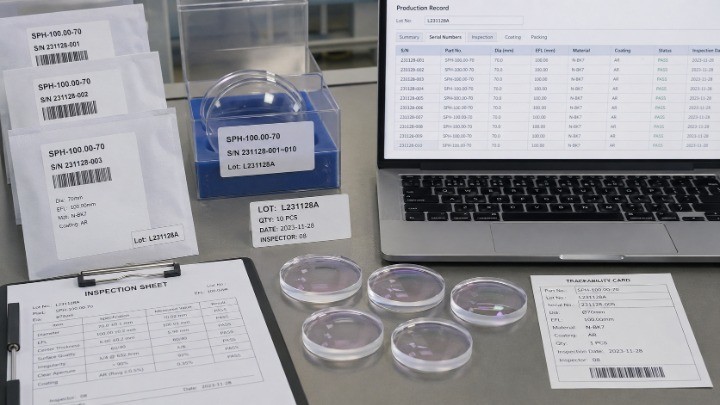 You should check traceability because it helps solve problems after shipment. Without batch records, a quality complaint becomes hard to investigate and easy to repeat.
Traceability matters most when buyers supply optical chains, wholesalers, distributors, and labs that handle repeat orders across different regions.
Why traceability matters for wholesalers, optical chains, and regional distributors
A distributor may sell the same lens SKU to many customers. If one batch has a coating or packaging issue, the distributor needs to know which shipment, lot, or production date created the problem.
Traceability helps limit the issue to a specific batch instead of damaging the entire product line.
Lot numbers, production dates, coating batches, and inspection records
Useful traceability records may include:
• Lot number • Production date • Coating batch • Material batch • Inspection result • Packing date • Shipment reference
These records allow the factory to connect complaints with real production data.
How traceability helps solve quality complaints and after-sales issues
When a problem appears, traceability allows the factory to compare complaint samples with retained samples or production records.
This helps the factory identify whether the issue came from coating, handling, storage, shipping, or packaging.
Red flags when a supplier cannot trace production or coating problems
Be careful if a supplier cannot tell which batch a product came from. Also be careful if it cannot provide any inspection record after a complaint.
A factory without traceability may solve today’s problem with replacement, but it cannot prevent tomorrow’s problem with data.
8. Verify Certifications, Test Reports, and Compliance Documents
You should verify certifications and documents because they show whether the factory understands quality systems and market requirements. Certificates do not replace factory evaluation, but they help confirm whether a supplier has a structured quality and compliance foundation.
For optical lens buyers, documents should match the product, market, and cooperation model.
CE, ISO 13485, ISO 9001, and market-related documentation
ISO 13485 sets requirements for a quality management system specific to the medical device industry. ISO describes it as an internationally agreed standard for medical device quality management. ()
ISO 9001 is a broader quality management standard. ISO explains that it helps organizations use a quality management system to improve performance and meet customer expectations. ()
In Europe, the European Commission’s MDCG guidance states that spectacle lenses, spectacle frames, and ready-to-wear reading spectacles are considered class I medical devices. ()
Product test reports, coating test records, and material safety documents
Ask whether the factory can provide product test reports, coating test records, material information, and relevant export documents.
The goal is not to collect documents for appearance. The goal is to confirm whether documents match the products you will actually buy.
Export documents for international optical lens buyers
International buyers may need different documents depending on the destination market, product category, and customs requirements.
For the U.S. market, FDA rules require impact-resistant lenses for eyeglasses and sunglasses, with certain exceptions. The regulation also includes testing and recordkeeping requirements for impact-resistant lenses. 12
How to judge whether certificates match the actual products
Check the company name, product scope, certificate validity, issuing body, and product category.
A certificate helps only when it applies to the real factory and the actual products you plan to order.
9. Compare Sample Quality With Bulk Production Standards
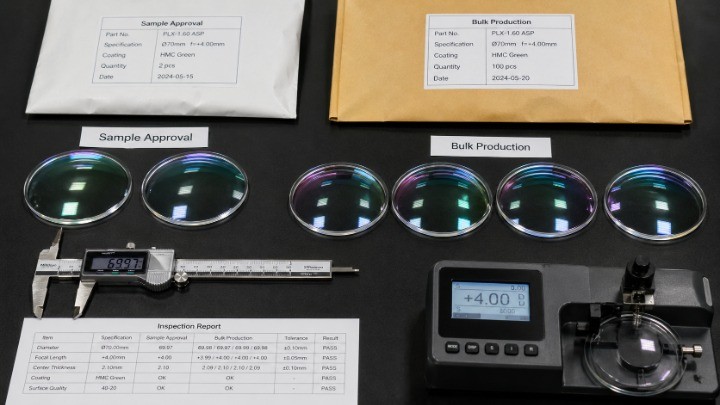 You should compare sample quality with bulk production standards because good samples do not always prove stable mass production. The real test is whether the factory can repeat the same quality in large quantities.
This is one of the most important steps in optical lens sourcing.
Why good samples do not always mean stable bulk quality
Factories often prepare samples with extra care. Bulk production may involve different workers, faster handling, larger batches, and more complex packaging.
That is why buyers should not approve a factory only because the first sample looks good.
How to compare sample specifications with order specifications
Create a written sample approval sheet. Include lens type, index, diameter, coating, power range, packaging, labeling, and special requirements.
Then compare the bulk order against the same sheet.
Power accuracy, coating reflection, surface quality, and packaging checks
When receiving samples, check:
• Power accuracy • Coating reflection color • Surface cleanliness • Scratch or dot defects • Lens thickness and edge condition • Envelope and box information • Barcode and label accuracy
Do not rely only on appearance photos.
What to inspect after receiving the first bulk shipment
The first bulk shipment should receive stronger inspection than later repeat orders. Check whether bulk goods match the approved sample in coating, appearance, packaging, and specifications.
If you find differences, document them early and discuss the cause with the factory.
How to avoid sample-to-bulk inconsistency
Use written specifications, approved samples, batch records, and pre-shipment inspection. Also ask the factory to confirm any material, coating, or packaging changes before production.
A clear sample approval process protects both the buyer and the factory.
10. Evaluate OEM/ODM, Packaging, and Private Label Support
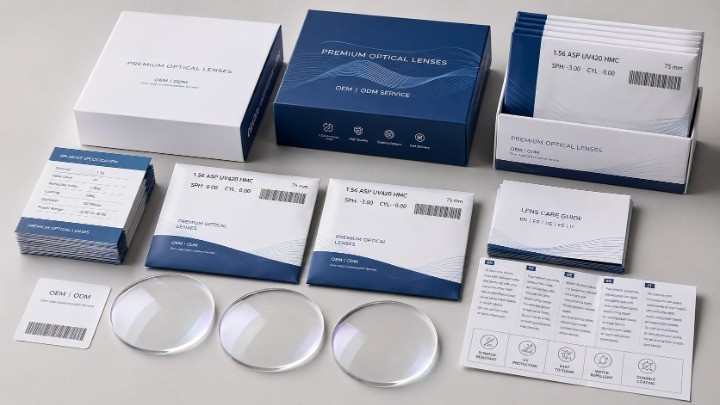 You should evaluate OEM/ODM and packaging support if you sell under your own brand or supply organized optical channels. Packaging accuracy is part of product quality because wrong labels, wrong envelopes, and wrong barcodes can create real commercial losses.
A factory that handles private-label details well can support your channel growth more effectively.
Brand envelopes, boxes, labels, sleeves, and barcode systems
Ask what packaging options the factory can provide. This may include lens envelopes, outer boxes, labels, sleeves, carton marks, barcode labels, and product inserts.
For optical chains and distributors, barcode accuracy can be as important as lens appearance.
Customized coating names and product line positioning
Some buyers want customized coating names or product series names. For example, a distributor may use different product names for standard AR, blue cut, photochromic, or premium hydrophobic coatings.
The factory should help align product names with actual specifications.
Multilingual packaging and market-specific inserts
Regional markets may require different languages, product descriptions, or usage information.
A good OEM supplier should manage these details carefully to prevent packaging confusion.
Why OEM/ODM support improves brand consistency and channel management
OEM/ODM support helps you create a consistent product identity across markets. It also helps sales teams explain products more clearly.
For buyers who want private-label growth, packaging and documentation are not minor details. They are part of the product experience.
11. Review Lead Time, Communication, and After-Sales Response
You should review lead time, communication, and after-sales response because they show how the factory performs after the quotation stage. A reliable factory gives realistic schedules, communicates problems early, and helps analyze quality issues instead of avoiding responsibility.
Good service reduces risk before, during, and after production.
Standard lead time vs custom order lead time
Standard stock lens orders usually move faster than customized orders. Custom packaging, special coatings, progressive designs, or unusual power ranges may require more time.
Ask the factory to separate standard lead time from custom lead time.
How raw materials, coating, packaging, and order volume affect delivery
Delivery time depends on more than production speed. Raw material availability, coating queue, packaging preparation, inspection workload, and export booking can all affect shipment.
A professional factory explains these factors clearly.
How reliable factories communicate production schedules
Reliable factories provide production updates when needed. They also confirm key details before production, especially for customized packaging and large orders.
If a supplier only replies quickly before payment but slowly after payment, that is a warning sign.
12.Common after-sales issues in optical lens supply
Common after-sales issues include coating defects, wrong labels, power errors, mixed products, carton damage, and shipment shortage.
A good factory should have a clear process for checking photos, samples, batch records, and inspection data.
How professional factories analyze complaints and provide solutions
A professional factory first identifies the problem. Then it checks whether the issue came from production, packaging, storage, transportation, or customer handling.
Solutions may include replacement, credit, remake, process improvement, or updated packing control.
Compare Price, Quality, and Total Sourcing Risk
You should compare price, quality, and total sourcing risk together. A low quote can become expensive when it creates remakes, complaints, delays, or unstable repeat supply.
Professional buyers should calculate value through the whole supply process, not only the unit cost.
Why the cheapest quote is not always the safest choice
The cheapest supplier may reduce cost by using weaker coating, unstable materials, limited inspection, or poor packaging control.
These risks may not appear during the quotation stage. They appear after shipment, when the buyer has less time to fix them.
How material, index, coating, packaging, and order volume affect price
Lens price depends on several real factors:
• Lens material • Refractive index • Coating type • Power range • Diameter and design • Packaging requirements • Order volume • Inspection and documentation needs
A transparent factory should explain how these factors affect the quotation.
Hidden costs caused by poor quality, rework, delay, and customer complaints
Hidden costs can include return freight, local inspection, replacement, lost sales, and damaged channel trust.
For wholesale and chain buyers, these costs can exceed the small saving from a cheaper quotation.
How to compare price, quality, and supply stability together
Use a balanced supplier scorecard.
| Factor | Low-Risk Supplier | High-Risk Supplier |
|---|---|---|
| Price | Clear and connected to specifications | Very low but unclear |
| Quality | Has QC records and testing logic | Relies on verbal promises |
| Coating | Shows consistency across batches | Only shows attractive samples |
| Delivery | Gives realistic lead time | Promises fast delivery without detail |
| After-sales | Analyzes problems with records | Avoids responsibility |
| Documentation | Provides relevant documents | Sends unrelated certificates |
The best factory gives you predictable quality at a fair cost.
13.What Different Buyers Should Focus on When Evaluating a Lens Factory
Different buyers should focus on different evaluation points because their business risks are different. A good factory can serve various channels, but each buyer type should check the areas that affect its own market most directly.
This section helps you evaluate a factory based on your actual business model.
| Buyer Type | Main Focus | Key Questions |
|---|---|---|
| Eyewear brands | Product consistency and private label | Can the factory support stable packaging and brand identity? |
| Wholesalers | Stock range and repeat supply | Can the factory provide fast-moving SKUs regularly? |
| Optical chains | Batch consistency and labeling accuracy | Can the factory reduce store-level complaints? |
| Optical labs | Semi-finished blanks and technical support | Can the factory support Rx processing needs? |
| Regional distributors | Market-fit products and replenishment | Can the factory support local demand over time? |
Eyewear brands should focus on product consistency and private-label support
Eyewear brands need consistent appearance, coating, packaging, and product naming. They should ask whether the factory can keep brand standards stable across repeat orders.
Wholesalers should focus on stock range, price stability, and repeat supply
Wholesalers need fast-moving products and predictable replenishment. They should check stock lens range, MOQ, lead time, and price stability.
Optical chains should focus on packaging accuracy and batch consistency
Optical chains need repeatable product standards across branches. Wrong labels and unstable coating can create problems at store level.
Optical labs should focus on semi-finished blanks, Rx support, and technical documentation
Labs should check base curve options, semi-finished blank quality, Rx range support, and technical documents.
Regional distributors should focus on market-fit products and reliable replenishment
Regional distributors need products that match local prescription habits, climate, price level, and channel demand.
A strong factory should help adjust product mix for the market instead of only selling a fixed catalog.
14.Common Red Flags When Choosing an Optical Lens Factory
Common red flags include unclear QC processes, unstable bulk quality, unrealistic delivery promises, missing traceability, and suppliers that only compete on low price. If a factory avoids technical questions, you should treat that as a sourcing risk.
Red flags do not always mean you must stop cooperation. But they do mean you need stronger verification before placing a large order.
The factory cannot explain its QC process clearly
If a factory cannot explain incoming inspection, coating control, final inspection, and defect handling, it may not have a strong quality system.
The sample quality is good, but bulk quality is unstable
This is a serious warning sign. It means the factory may lack repeat process control.
The supplier only competes on low price
Price matters, but a supplier that only talks about price may ignore coating, documentation, traceability, and after-sales risk.
The supplier cannot provide traceability or inspection records
Without traceability, you cannot solve quality complaints efficiently.
The factory avoids technical questions about coating, materials, or tolerances
A professional factory should be willing to discuss coating types, material differences, power tolerance, inspection methods, and packaging details.
The supplier gives unrealistic delivery promises
Very short lead times may sound attractive. However, they can create risk if the factory does not explain how it will secure materials, production slots, coating time, and final inspection.
The supplier has weak after-sales analysis when problems happen
A weak supplier only argues about responsibility. A strong factory checks evidence and improves the process.
Optical Lens Factory Evaluation Checklist
An optical lens factory evaluation checklist helps buyers compare suppliers with the same standards. Use this checklist before sample approval, first bulk order, and long-term supplier selection.
You can also use it as an internal sourcing document for your purchasing team.
| Checklist Area | What to Confirm |
|---|---|
| Product capability | Lens type, index, function, coating, diameter, power range |
| Production capacity | Monthly output, peak season plan, repeat order support |
| Quality control | Incoming inspection, process inspection, final inspection |
| Coating and material | Coating type, adhesion checks, durability control, material source |
| Certification and documentation | CE, ISO-related documents, test reports, export documents |
| Sample approval | Written specs, approved sample, packaging confirmation |
| OEM/ODM packaging | Envelopes, boxes, labels, barcodes, inserts |
| Communication and delivery | Lead time, order updates, after-sales process |
Product capability checklist
Check whether the factory can support your required lens categories now and in future product expansion.
Production capacity checklist
Confirm whether the factory can support your order volume during normal and peak seasons.
Quality control checklist
Ask how the factory controls defects before goods enter shipment.
Coating and material checklist
Check coating appearance, performance, consistency, and durability testing logic.
Certification and documentation checklist
Confirm whether documents match the actual company, product category, and target market.
Sample approval checklist
Use written specifications and keep approved samples for comparison.
OEM/ODM and packaging checklist
Confirm design files, label content, barcode rules, carton marks, and language requirements.
Communication, delivery, and after-sales checklist
Evaluate how the factory communicates after payment, not only before payment.
How Vena Optics Helps Buyers Build a More Stable Optical Lens Supply Chain
helps professional buyers build a more stable optical lens supply chain through large-scale manufacturing, broad product coverage, OEM/ODM support, coating solutions, quality inspection, and long-term cooperation. We focus on buyers who need repeatable quality, cost performance, and continuous supply.
As an optical lens manufacturer based in Danyang, China, Vena Optics supports eyewear brands, wholesalers, distributors, optical chains, and lens-related channels with practical production and customization services.
Large-scale optical lens manufacturing in Danyang, China
Danyang is one of China’s important optical lens manufacturing bases. For buyers, this manufacturing environment can support supply chain efficiency, product variety, and production cooperation.
Vena Optics uses large-scale manufacturing to help reduce cost while maintaining stable order support.
Full product range for professional optical lens buyers
Vena Optics supplies mainstream and functional optical lenses, including single vision lenses, progressive lenses, bifocal lenses, photochromic lenses, blue light protection lenses, high-index lenses, PC lenses, and coated lens options.
This product range helps buyers manage more SKUs through one manufacturing partner.
OEM/ODM, private label, coating, and packaging support
Vena Optics can support OEM/ODM needs such as brand envelopes, boxes, labels, parameter customization, coating solutions, and private-label product planning.
This helps buyers build product lines that match their local market and channel positioning.
Quality inspection and stable batch supply
Vena Optics understands that procurement teams need stable batch quality, not only attractive samples.
The company supports quality inspection, specification confirmation, and supply chain collaboration to reduce sourcing risk.
Supply chain collaboration for eyewear brands, wholesalers, distributors, optical chains, and labs
Different buyers have different priorities. Vena Optics can help eyewear brands with private-label support, wholesalers with product range, distributors with repeat supply, and optical channels with stable specifications.
The goal is not only to sell lenses. The goal is to help buyers build a more reliable supply plan.
Choose an Optical Lens Factory, Not Just a Lens Supplier
Choosing an optical lens factory requires more than comparing quotations. You need to evaluate product range, production capacity, power accuracy, coating consistency, QC process, traceability, certifications, sample-to-bulk control, OEM support, lead time, communication, and after-sales response.
The right optical lens factory should reduce your sourcing risk and support long-term growth. Before you place a bulk order, use a structured checklist and judge the supplier by repeatable quality, clear documentation, stable delivery, and problem-solving ability.
Call to Action: Work With a Reliable Optical Lens Factory
If you are evaluating optical lens factories for your next product line or supply project, Vena Optics can help you compare lens options, coating solutions, packaging requirements, and production plans. We support professional buyers with stable manufacturing, OEM/ODM service, private-label packaging, quality inspection, and long-term supply collaboration.
Contact