


Choosing an optical lens supplier takes more than a low quote.
Many buyers first compare prices because lens sourcing looks simple on a spreadsheet. Yet one weak supplier can cause coating complaints, wrong labels, late shipments, unstable batches, and repeat customer pressure across your sales channels, especially when you manage wholesale programs or private label orders.
This guide shows you how to evaluate optical lens suppliers with clear checks for quality, capacity, documentation, communication, OEM support, and long-term supply stability.
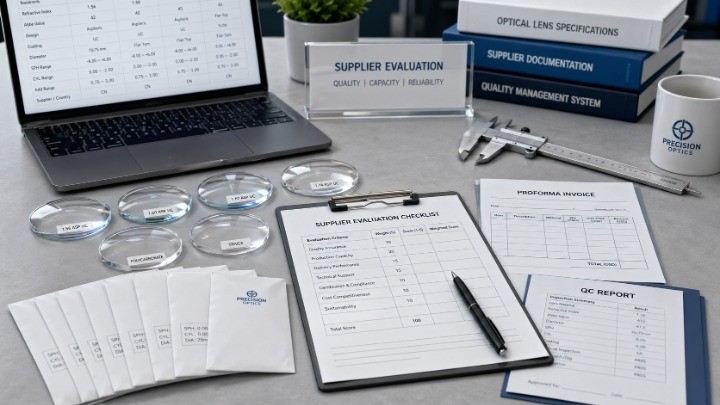 What Makes a Reliable Optical Lens Supplier?
A reliable optical lens supplier provides consistent lens quality, stable production capacity, clear technical specifications, strong coating control, proper documentation, and responsive support. The supplier should help you reduce sourcing risk, not simply offer the lowest price.
Eyeglasses remain one of the most common ways to correct refractive errors, and WHO states that reduced vision from refractive errors can be corrected with appropriate eyeglasses, contact lenses, or laser surgery. This makes stable lens supply important for both business performance and customer trust. ()
A strong supplier should perform well in these areas:
| Evaluation Area | What to Check | Why It Matters |
|---|---|---|
| Product quality | Power accuracy, surface quality, coating stability | Reduces complaints and remakes |
| Product range | Single vision, progressive, bifocal, photochromic, blue cut, high-index, PC | Supports wider market demand |
| Production capacity | Output, lead time, peak-season planning | Protects repeat supply |
| Documentation | CE-related files, ISO system records, test reports, batch records | Supports compliance and buyer confidence |
| OEM/ODM support | Packaging, labels, private label, custom specs | Helps brand and channel growth |
| Communication | RFQ response, order confirmation, after-sales process | Reduces costly mistakes |
The best supplier makes your sourcing process more predictable. If a supplier cannot explain quality control, coating options, lead time, documentation, and problem-solving clearly, you should treat the cooperation as risky.
Understand Your Own Lens Requirements Before Contacting Suppliers
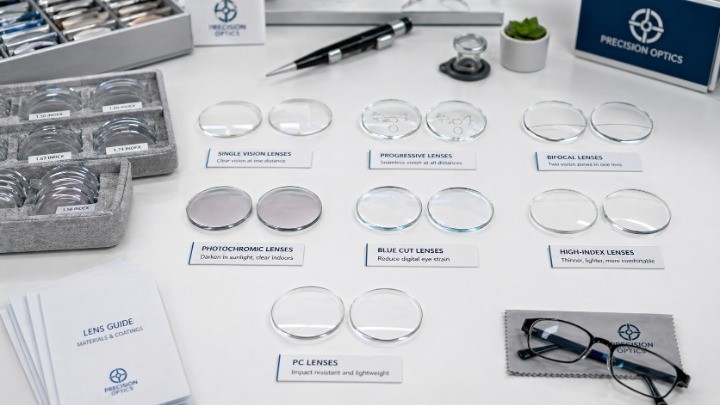 You should define your lens requirements before contacting suppliers because unclear specifications often lead to wrong quotations, wrong samples, and wrong expectations. A supplier can only recommend the right solution when you explain your product, coating, packaging, and market needs.
Start with your sales channel. A wholesaler may need fast-moving stock lenses. An eyewear brand may need private label packaging. An optical lab may care more about semi-finished blanks, Rx range, base curve, and parameter consistency.
Define Your Main Lens Categories
Your supplier search should begin with a clear product list. This list helps you compare suppliers fairly and prevents vague communication.
Common categories include:
• Single vision lenses • Progressive lenses • Bifocal lenses • Photochromic lenses • Blue cut lenses • High-index lenses • PC or polycarbonate lenses • Semi-finished lens blanks • Stock lenses with standard coatings • Private label lens programs
If your supplier only offers a narrow product range, you may need to manage several suppliers later. That usually increases communication cost and batch variation.
Confirm Material and Index Requirements
Different markets need different lens materials and refractive indices. Many buyers work with 1.499, 1.56, 1.60, 1.67, and 1.74 lenses, depending on prescription strength, price level, and thickness expectations.
For example, 1.56 lenses often suit price-sensitive stock programs. 1.60 and 1.67 lenses can support thinner prescription lens programs. PC lenses may suit children’s eyewear, sports eyewear, and safety-related applications where impact resistance matters.
Prepare Coating and Packaging Requirements
Coating details affect price, appearance, durability, and customer satisfaction. You should confirm whether you need UC, HC, HMC, SHMC, blue cut, photochromic, mirror, hydrophobic, oleophobic, anti-static, or UV protection features.
Packaging also matters. Before you request a quotation, prepare details such as:
• Lens envelope design • Box design • Barcode requirements • Power label format • Multilingual inserts • Private label logo • Carton marks • Market-specific label content
A complete RFQ saves time because it helps each supplier quote the same product instead of guessing your needs.
Compare Different Types of Optical Lens Suppliers
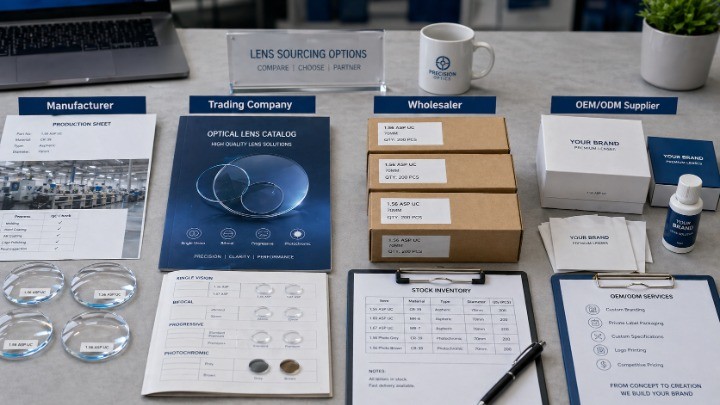 You should compare supplier types because optical lens manufacturers, trading companies, wholesalers, and OEM/ODM suppliers serve different sourcing needs. The right option depends on your order volume, customization level, delivery timeline, and quality control expectations.
A direct manufacturer usually gives you stronger control over production, coating, packaging, and repeat orders. A trading company may help you source mixed products, but it may not control factory-level details. A wholesaler can support fast stock supply, but customization often stays limited.
| Supplier Type | Best For | Main Advantage | Main Risk |
|---|---|---|---|
| Optical lens manufacturer | Bulk orders, OEM/ODM, stable supply | Better production control | Requires clearer specs and MOQ planning |
| Trading company | Mixed sourcing | Flexible product sourcing | Weaker factory-level control |
| Wholesaler | Fast stock supply | Quick availability | Limited customization |
| OEM/ODM supplier | Private label programs | Brand and product development support | Needs stronger project communication |
Optical Lens Manufacturers
Optical lens manufacturers suit buyers who need long-term supply, repeatable quality, and customized programs. They usually offer more control over materials, coatings, batch records, packaging, and technical documents.
A manufacturer can also support product planning. For example, you may want one 1.56 HMC stock line, one 1.60 blue cut line, and one photochromic line for outdoor use. A factory with a broad range can help you build this system step by step.
Trading Companies
Trading companies may help when you need many unrelated optical products from different factories. However, they may not control production directly. This structure can create delays when technical issues appear.
You should ask whether the company owns production facilities, controls coating lines, and can provide batch-level inspection records.
Wholesalers and Distributors
Wholesalers work well when you need available stock and fast replenishment. However, they may not support custom coating, special envelopes, or long-term private label development.
If your business depends on brand consistency, ask whether the wholesaler can keep the same specifications across repeat orders.
Evaluate the Supplier’s Product Range and Market Fit
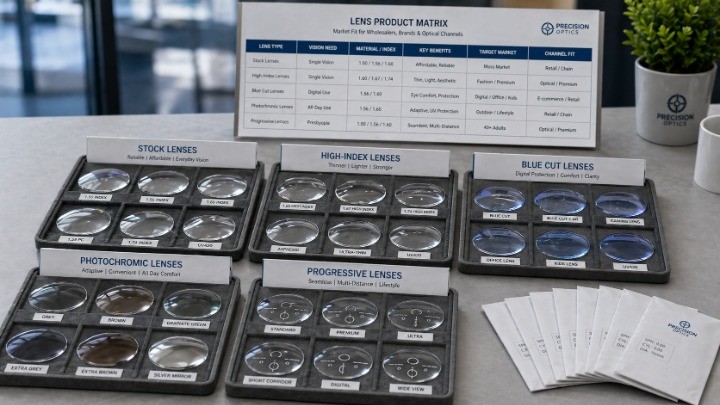 You should evaluate product range because the supplier must match your market position. A broad product range helps you serve different prescriptions, price levels, customer groups, and seasonal demand.
A supplier with only basic stock lenses may work for simple wholesale programs. However, if you plan to expand into progressive, photochromic, blue cut, high-index, or PC lenses, you need a supplier that can grow with your catalog.
Check Mainstream Prescription Lens Categories
A professional supplier should cover common daily lens categories. These products help you serve optical shops, labs, chains, and distributors with a more complete catalog.
Ask for a product matrix that includes:
• Lens type • Material • Index • Coating options • Diameter • Power range • MOQ • Standard lead time • Packaging options
This matrix helps you compare suppliers quickly. It also shows whether the supplier understands organized wholesale purchasing.
Review Functional Lens Demand
Functional lenses can improve your market positioning. Blue cut lenses may suit digital device users. Photochromic lenses may suit outdoor and daily-use programs. High-index lenses may suit customers who need thinner lenses for stronger prescriptions.
You should also ask whether the supplier can recommend products for your target market. A supplier who understands regional demand can help you avoid products that look good on paper but move slowly in your channel.
Avoid a Narrow Product Range
A narrow product range can limit future growth. It can also force you to manage too many suppliers, which increases communication work and quality variation.
A supplier with a broad, well-controlled range helps you simplify sourcing and build a stronger product system.
Check Manufacturing Capacity and Supply Stability
You should check manufacturing capacity because stable supply matters more than a low first-order price. A supplier must support repeat orders, seasonal peaks, packaging needs, and urgent replenishment without losing quality control.
Capacity does not only mean monthly output. You should also check whether the supplier controls coating quality, raw material planning, production scheduling, and shipment timing.
Why Production Scale Matters
Wholesalers, chains, and distributors often need repeat supply. If one batch sells well, they need the same product again with the same coating color, packaging, and power range.
A weak supplier may produce good samples but fail during bulk production. This creates a common sourcing problem: the sample looks fine, but the next batch changes.
How to Evaluate Capacity
Ask direct questions:
-
What is your regular monthly output by lens type?
-
Which lens categories do you produce in-house?
-
Which coating processes do you control directly?
-
What is the lead time for stock lenses and custom packaging?
-
How do you plan production during peak season?
-
Can you reserve capacity for repeat orders?
A reliable supplier should answer with clear ranges and real production logic. Vague promises do not help your inventory plan.
Warning Signs of Weak Capacity
Be careful if a supplier cannot explain normal lead time, avoids production details, changes delivery dates often, or gives an unusually low price without discussing production planning.
Stable supply comes from factory systems, not sales promises.
Review Quality Control Standards Before You Place a Bulk Order
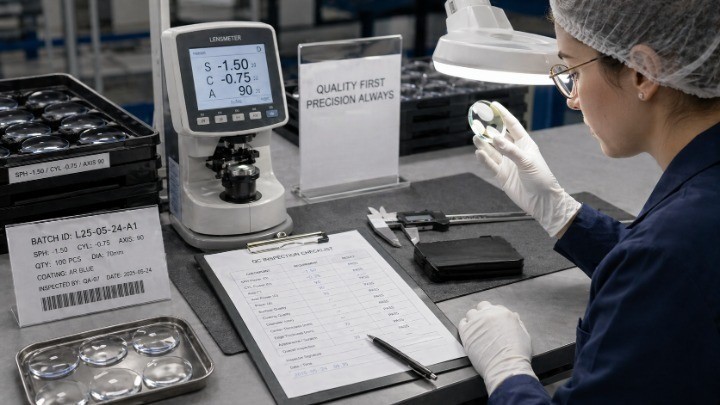 You should review quality control before bulk orders because optical lenses require accurate power, clean surfaces, correct dimensions, and stable coating performance. Weak inspection can create customer complaints, remakes, and lost trust.
ISO 13485 sets requirements for a quality management system for the medical device industry and helps organizations meet customer and regulatory requirements. For lens buyers, a supplier’s quality system can show whether the factory controls production, inspection, records, and corrective actions in a structured way. ()
Ask What the Supplier Inspects
A professional optical lens supplier should inspect more than appearance. You should ask how they check:
• Lens power • Cylinder and axis • Diameter • Center thickness • Surface defects • Coating uniformity • Transmittance • UV or blue light performance when claimed • Package labeling • Batch records
This detail matters because optical lenses combine both optical performance and physical product consistency.
Confirm Batch Consistency
Batch consistency matters more than one perfect sample. You should ask whether the supplier keeps lot numbers, inspection records, coating batch data, and production dates.
These records help trace problems. If a customer reports coating peeling, wrong powers, or label mistakes, batch information helps the supplier find the cause faster.
Ask for Sample Testing
You should test samples before bulk orders, especially for new coatings, private label projects, or new product lines.
A sample order should check:
• Optical accuracy • Coating reflection color • Surface finish • Hydrophobic effect • Package design • Barcode and label accuracy • Lens envelope information • Carton strength
A sample should test both the product and the supplier’s working process.
Evaluate Coating Capability and Performance Consistency
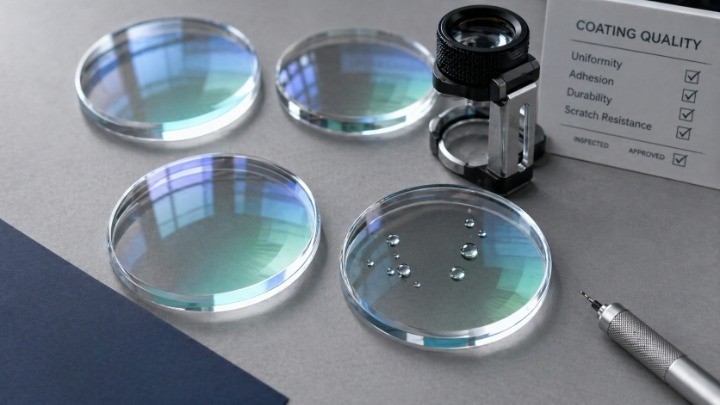 You should evaluate coating capability because coating quality affects durability, clarity, appearance, and after-sales risk. Many lens complaints come from coating problems, not from lens material alone.
Coating quality depends on surface preparation, hard coating, vacuum coating, cleaning, curing, inspection, and storage control. Two suppliers may both offer “HMC,” but their final coating stability can differ greatly.
Compare Coating Options
Different coating options serve different price levels and market needs.
| Coating Type | Main Function | Buyer Consideration |
|---|---|---|
| HC | Scratch resistance | Basic durability |
| HMC | Anti-reflective performance | Common daily-use upgrade |
| SHMC | Better clarity and surface protection | Premium positioning |
| Blue cut | Blue-violet light filtering claim | Requires clear test data |
| Photochromic | Light-adaptive function | Check activation and fading |
| Mirror coating | Fashion and outdoor use | Check color consistency |
| Hydrophobic coating | Easier cleaning | Check surface effect over time |
Ask About Coating Color Consistency
Coating color may seem small, but it affects product appearance. If one batch shows green reflection and the next batch shows purple reflection, customers may question quality consistency.
You should ask whether the supplier can keep coating color stable across repeat orders. You should also confirm whether samples represent mass production.
Check Common Coating Risks
Common coating risks include:
• Peeling • Crazing • Scratches • Reflection inconsistency • Poor adhesion • Weak hydrophobic effect • Color difference between batches • Edge coating defects
A strong coating supplier explains how they prevent these problems, not only that the coating is “good.”
Check Certifications, Compliance, and Export Documentation
You should check certifications and export documentation because different markets may require different compliance evidence, product records, and customs documents. Certifications do not replace quality control, but they help buyers reduce regulatory and import risk.
For the European market, the European Commission states that manufacturers take primary responsibility for getting medical devices CE-marked under the applicable framework. That means buyers should confirm whether the supplier can support the correct product documents for the target market. ()
Common Documents Buyers May Request
Your document needs may change by market, product type, and importer role. Common requests include:
• CE-related documents • Declaration of Conformity • ISO 13485 or ISO 9001 quality system certificate • Test reports • Product specifications • Commercial invoice and packing list • Certificate of origin when needed • Lot or batch records • Impact resistance evidence for specific markets
For the U.S. market, FDA rules require eyeglasses and sunglasses to use impact-resistant lenses unless a specific exemption applies. The rule also refers to certificates for lenses entering the U.S. market. ()
Why Certification Alone Is Not Enough
A certificate tells you that a system or claim exists. It does not prove that every batch meets your order requirements.
Ask these questions before you rely on any certificate:
• Does the certificate match the legal manufacturer? • Is the certificate still valid? • Does the product scope cover your lens type? • Can the supplier provide batch-level documents? • Can the supplier support your importer’s document needs?
Good compliance support combines valid documents, real production control, and clear batch traceability.
Compare Price, Value, and Total Supply Cost
You should compare total supply cost because the lowest unit price may become expensive when defects, delays, wrong labels, or unstable coatings create extra costs. A good supplier helps protect your margin through reliability.
Professional sourcing should look beyond the quotation sheet. You should compare what the price includes and what risks the supplier can reduce.
What Should Be Included in a Fair Quotation?
A complete optical lens quotation should show:
• Lens type • Material and index • Diameter • Power range • Coating type • Quantity and MOQ • Packaging method • Private label cost • Lead time • Payment terms • Incoterms • Document support • Sample cost • Quote validity period
If a quotation only shows a unit price, you cannot compare suppliers accurately.
Hidden Costs in Lens Sourcing
Hidden costs often appear after shipment. You may spend extra money on remakes, repacking, customer compensation, urgent air freight, or product returns.
| Hidden Cost | Common Cause | How to Reduce It |
|---|---|---|
| Remakes | Wrong power or coating defects | Sample testing and QC reports |
| Repacking | Wrong labels or weak packaging | Packaging proof before production |
| Delays | Weak planning or unclear lead time | Production schedule confirmation |
| Complaints | Inconsistent coating or surface defects | Batch inspection and traceability |
| Inventory pressure | Unstable replenishment | Repeat-order planning |
Value means the supplier protects your business from avoidable problems.
Review OEM, ODM, and Private Label Support
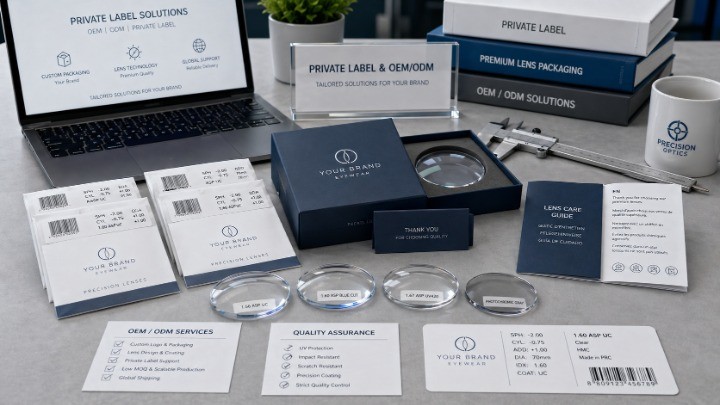 You should review OEM, ODM, and private label support if you want to build your own product line, serve specific markets, or improve brand recognition. A supplier should support both product specifications and market-facing packaging.
Private label support goes beyond printing a logo. It includes envelope design, carton layout, barcode rules, product naming, coating descriptions, multilingual information, and stable repeat production.
Ask About Packaging and Labels
You should confirm whether the supplier can support:
• Branded lens envelopes • Custom boxes • Power labels • Barcodes • SKU labels • Multilingual inserts • Carton marks • Product instruction sheets • Market-specific label content
Wrong packaging can create serious problems. A perfect lens with the wrong power label can still damage customer trust.
Check Parameter Customization
OEM/ODM support may include index selection, coating combinations, photochromic colors, corridor options, diameter requirements, and packaging systems.
You should ask which changes are standard and which changes need higher MOQ or longer development time.
Review MOQ Requirements
MOQ often changes with customization level. Standard stock lenses may allow smaller orders, while custom packaging, special coating, or proprietary designs may need larger quantities.
A good supplier explains MOQ clearly and helps you plan a realistic launch path.
Test Communication, Technical Support, and Response Speed
You should test communication before placing bulk orders because poor communication often predicts poor cooperation. A reliable supplier should understand technical lens specifications, confirm order details clearly, and respond quickly when problems appear.
Communication matters most when the order involves custom coating, private label packaging, mixed power ranges, or strict shipping deadlines. In these cases, unclear communication can create expensive mistakes.
Check Technical Understanding
You can test a supplier by asking practical technical questions:
• Which index do you recommend for high-prescription stock lenses? • How do you control coating reflection color? • What power range do you supply regularly? • Can you provide diameter and center thickness references? • What inspection report can you provide before shipment?
A professional supplier should answer with product logic, not only sales language.
Confirm Specifications Before Production
Before production starts, ask the supplier to confirm:
• Product name • Index and material • Coating • Power range • Diameter • Quantity • Packaging artwork • Label format • Lead time • Shipping method
Never rely only on chat messages for complex orders. Use a confirmed proforma invoice, artwork proof, and product specification sheet.
Ask About Lead Time, MOQ, Logistics, and Delivery Terms
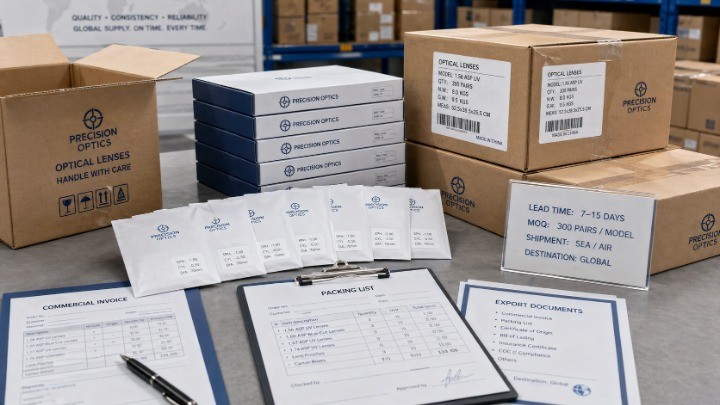 You should ask about lead time, MOQ, logistics, and delivery terms because these details affect inventory planning, customer commitments, and cash flow. A supplier may have good products but still create problems if delivery planning is weak.
Lead time depends on lens type, coating, quantity, packaging, and factory workload. Standard stock lenses usually move faster than customized private label projects.
Confirm Lead Time by Order Type
You should ask for different lead times:
• Stock lens lead time • Semi-finished lens lead time • Customized coating lead time • Private label packaging lead time • Sample production lead time • Peak-season lead time
This helps you build a realistic ordering calendar.
Clarify MOQ by Product Type
MOQ may change by lens category. A supplier may accept smaller quantities for common 1.56 HMC stock lenses but require higher MOQ for private label photochromic or mirror-coated lenses.
You should ask whether the MOQ applies by lens type, power range, coating, packaging, or total order value.
Review Shipping and Incoterms
You should discuss shipping before confirming the order. Small urgent orders may use express or air freight. Larger orders may use sea freight.
You should also clarify Incoterms, export documents, carton size, gross weight, and packing standards. These details help you calculate landed cost.
Evaluate After-Sales Handling and Problem-Solving Ability
You should evaluate after-sales handling because every long-term supply relationship may face occasional problems. The key question is not whether a supplier promises zero issues. The real question is whether the supplier can analyze and solve issues responsibly.
After-sales support matters when you face coating complaints, wrong powers, damaged cartons, missing documents, or labeling mistakes. A weak supplier may disappear after shipment. A strong supplier helps identify the cause and prevent repeat problems.
Ask How Complaints Are Handled
Ask the supplier to explain its complaint process:
-
What evidence do you need?
-
How long does analysis take?
-
Who checks the problem internally?
-
Do you provide a written response?
-
Do you offer replacement, credit, or corrective action when needed?
This process tells you whether the supplier works like a long-term partner or only a seller.
Confirm Technical Analysis
Technical analysis helps when defects repeat. A supplier should review photos, batch numbers, coating process, packing method, and shipping condition.
A clear after-sales process protects both sides because it turns problems into corrective actions.
Common Mistakes When Choosing an Optical Lens Supplier
The most common mistake is choosing an optical lens supplier only by price. Buyers also make mistakes when they skip sample testing, ignore coating details, accept vague lead times, or treat certificates as the only proof of quality.
These mistakes often appear when buyers rush sourcing. A better method evaluates the supplier as a complete system: product, factory, quality control, communication, delivery, and after-sales.
| Mistake | Why It Creates Risk | Better Approach |
|---|---|---|
| Choosing only the lowest price | Quality and service may suffer | Compare total supply cost |
| Skipping samples | Bulk quality stays uncertain | Test samples before mass orders |
| Ignoring coating details | Complaints may increase | Confirm coating type and test data |
| Forgetting packaging checks | Wrong labels damage trust | Approve artwork and label format |
| Accepting vague lead time | Inventory planning fails | Confirm timeline by order type |
| Overtrusting certificates | Documents do not prove every batch | Request QC records and traceability |
A reliable sourcing decision needs evidence, not assumptions.
Supplier Evaluation Checklist and RFQ Questions
A supplier evaluation checklist helps you compare optical lens suppliers in a structured way. It also helps you send a clear RFQ, avoid missing details, and receive quotations that you can compare fairly.
Use the checklist below before you select a supplier or place a trial order.
Product Range Checklist
• Which lens categories do you produce regularly? • Which indices and materials do you offer? • Do you supply stock lenses, semi-finished lenses, or Rx lenses? • Can you support progressive, photochromic, blue cut, and high-index programs?
Technical Specification Checklist
• What power range do you support? • What diameters are available? • Can you provide base curve and thickness references? • Do you provide product specification sheets?
Coating and Quality Control Checklist
• What coating types do you offer? • How do you inspect coating adhesion and surface quality? • Can you provide transmittance or UV-related test data when needed? • Can you provide batch inspection records?
Certification and Document Checklist
• What quality system certificates can you provide? • What product documents support the target market? • Can you provide Declaration of Conformity when needed? • Can you support lot-level documentation?
Key RFQ Questions to Ask Before Cooperation
-
What lens types and indexes do you produce regularly?
-
What coating options can you provide?
-
What is your normal production capacity and lead time?
-
Can you provide samples before bulk orders?
-
What inspection steps do you follow before shipment?
-
Can you support OEM packaging and private label orders?
-
What documents can you provide for export and market compliance?
-
How do you handle quality complaints or after-sales issues?
How to Build a Long-Term Supplier Relationship
You build a long-term supplier relationship by starting with clear specifications, testing samples, planning repeat orders, and sharing market feedback. A stable relationship should improve quality, delivery, pricing structure, and product matching over time.
A supplier becomes more valuable when they understand your market. For example, a Latin American distributor may need strong price-performance products and stable stock supply. A European private label buyer may focus more on documentation, packaging, and product consistency.
Start With Clear Specifications
Clear specifications reduce mistakes from the beginning. Keep a standard product list that includes lens type, index, coating, power range, diameter, packaging, and target price level.
This list can become your repeat-order base.
Use Sample Orders Wisely
A sample order should test product quality, communication, packaging accuracy, and delivery speed. You should not judge only the lens surface.
You should also review how the supplier confirms details, responds to feedback, and handles small revisions before larger production starts.
Share Market Feedback
Suppliers can support you better when you share sales feedback. If one coating sells better, one package style gets stronger customer response, or one index has higher demand, the supplier can help adjust future planning.
Long-term sourcing works best when both sides treat quality, cost, and delivery as a shared system.
How Vena Optics Supports Stable Optical Lens Supply
Vena Optics supports stable optical lens supply through large-scale manufacturing, a broad product range, OEM/ODM service, coating solutions, quality inspection, and supply chain support for professional optical channels. This makes it suitable for buyers who need repeatable quality and long-term cooperation.
Vena Optics describes itself as a Danyang-based optical lens manufacturer serving optical retailers, distributors, and eyewear brands. Its website highlights single vision, progressive, photochromic, blue light blocking, bifocal, and coating systems, along with OEM/ODM capability and quality documentation support. ()
Large-Scale Production for Stable Supply
Large-scale production helps buyers manage repeat orders and cost control. It also supports wider product planning when you need stock lenses, functional lenses, and private label programs.
Vena Optics states that it serves optical retailers, distributors, and eyewear brands across more than 50 countries and highlights annual production exceeding 10 million lenses. ()
Wide Lens Product Range
A broad product range allows buyers to build a more complete optical lens catalog. This can include single vision, progressive, bifocal, photochromic, blue cut, high-index, and PC lenses.
A complete range also helps reduce the number of suppliers you need to manage.
OEM/ODM and Packaging Support
OEM/ODM support helps brands, wholesalers, and optical channels build market-specific lens lines. Packaging customization can include envelopes, boxes, labels, barcodes, and branded documentation.
This support becomes especially useful when you want to create a private label product line instead of selling generic lenses.
Coating and Quality Inspection
Coating solutions and inspection records help buyers reduce after-sales risk. When a supplier can provide clear coating options, inspection steps, and lot references, buyers can manage quality problems more efficiently.
For long-term cooperation, quality control should be visible, traceable, and repeatable.
Conclusion: Choose a Supplier That Can Support Long-Term Growth
Choosing an optical lens supplier should start with one core question: Can this supplier support stable quality, clear communication, reliable delivery, and future product growth? Price matters, but it should never become the only standard. A better supplier helps you control total sourcing cost through fewer defects, better coating consistency, stronger documentation, and smoother repeat orders.
Before you make a final decision, prepare your lens specifications, sample plan, packaging requirements, compliance needs, and RFQ questions. Then compare suppliers by product range, manufacturing control, quality system, lead time, after-sales process, and long-term support.
Looking for a Reliable Optical Lens Supplier?
If you need a stable optical lens supplier for wholesale, private label, optical retail, or long-term channel supply, Vena Optics can help you review lens specifications, coating options, packaging requirements, and order planning. The right preparation helps both sides reduce mistakes and build a more efficient supply program.