

Choosing the best lenses for myopia starts with one practical question: what does the wearer really need?
Many people only ask for “thin lenses,” “blue light lenses,” or “high-index lenses,” but myopia lens selection is more detailed than that. Prescription strength, age, frame size, lens material, refractive index, coating quality, and lifestyle all affect the final result.
This guide helps you compare myopia lens options clearly, from single vision lenses to high-index lenses, photochromic lenses, blue light lenses, and children’s myopia control solutions.
 What Are the Best Lenses for Myopia?
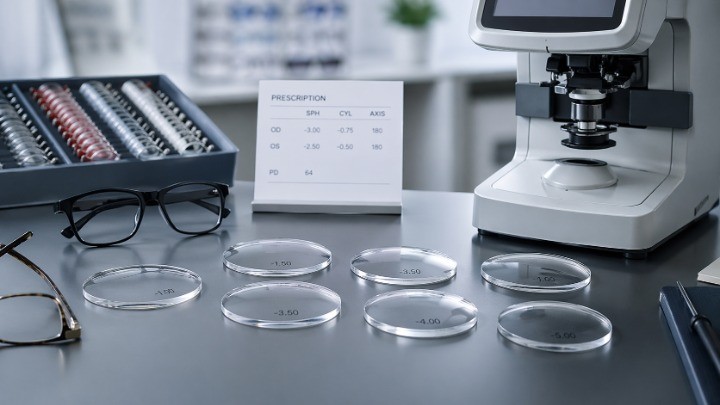
For most people with myopia, single vision minus lenses are the standard choice for clear distance vision. For moderate or high myopia, high-index lenses can reduce thickness. For children, sports use, or impact-sensitive eyewear, polycarbonate lenses may be more suitable. For outdoor use, photochromic lenses add convenience.
The National Eye Institute explains that eyeglasses and contact lenses are common treatments for nearsightedness, and an eye doctor prescribes the right lenses to help the wearer see clearly. ()
However, the “best” lens depends on the wearer. A student, a driver, a child with progressing myopia, and an adult with -7.00D myopia may all need different lens choices.
For optical businesses, this means myopia lenses should not be treated as one simple product. A stronger product range should include basic correction lenses, high-index options, impact-resistant lenses, and functional lens solutions.
Best Overall Lens Choice for Most Myopia Wearers
For general myopia correction, single vision prescription lenses remain the most common and practical option. They correct blurry distance vision by using minus power to focus light more accurately.
For low or moderate myopia, 1.56 resin lenses often offer a good balance of cost, comfort, and optical performance. For stronger prescriptions, 1.60, 1.67, or 1.74 high-index lenses may help reduce edge thickness.
Best Lens Choice by Prescription Strength
Lens index becomes more important as prescription strength increases. Stronger minus lenses usually have thicker edges, especially when the wearer chooses a large frame.
| Myopia Level | Common Prescription Range | Practical Lens Choice |
|---|---|---|
| Low myopia | Up to around -2.00D | CR-39 or 1.56 resin lenses |
| Moderate myopia | Around -2.00D to -4.00D | 1.56 or 1.60 resin lenses |
| High myopia | Around -4.00D to -6.00D | 1.60 or 1.67 high-index lenses |
| Very high myopia | Above -6.00D | 1.67 or 1.74 high-index lenses |
This table gives a practical starting point. The final choice should also consider frame size, coating quality, budget, and daily use.
Best Lens Choice by Age Group
Adults often focus on clarity, lens thickness, appearance, and wearing comfort. Children need extra attention to impact resistance, fit, wearing habits, and professional eye-care follow-up.
For children with progressing myopia, regular single vision glasses can correct vision, but they may not manage myopia progression. The National Eye Institute notes that single vision glasses and contact lenses correct myopic vision, but they do not address the underlying issue of the eye continuing to grow longer than normal. ()
Best Lens Choice by Daily Use Scenario
Daily use changes lens choice. Office workers may prefer anti-reflective and blue light protection coatings. Outdoor users may prefer photochromic lenses. Sports users may need polycarbonate lenses for better impact resistance.
For optical businesses, this point matters because one myopia lens product cannot serve every customer. A complete product line should match different prescription levels, age groups, and lifestyle needs.
Correction vs Myopia Control: A Key Difference Many People Miss
Myopia correction and myopia control are not the same. Standard lenses help the wearer see clearly. Myopia control solutions aim to slow myopia progression, usually in children.
This difference matters for product communication. A regular blue light lens or standard single vision lens should not be promoted as a myopia control lens unless it has a clinically supported and approved design for that purpose.
What Is Myopia and Why Does Lens Choice Matter?
Myopia, also called nearsightedness, is a refractive error that makes distant objects look blurry while near objects may remain clear. Lens choice matters because prescription strength, material, index, coating, and frame size affect thickness, comfort, appearance, and daily wearability.
In myopia, light focuses in front of the retina instead of directly on it. A minus-power lens changes how light enters the eye, helping the wearer see distant objects more clearly.
How Myopia Affects Distance Vision
People with myopia often struggle to see road signs, classroom boards, presentation screens, or distant faces clearly. They may squint or move closer to objects to improve clarity.
A properly prescribed myopia lens helps restore distance vision. However, the lens also needs to fit the wearer’s daily routine. A clear lens with poor coating, heavy weight, or thick edges may still create dissatisfaction.
Why Stronger Myopia Usually Creates Thicker Lens Edges
Minus lenses are thinner in the center and thicker at the edge. As the prescription increases, the lens edge usually becomes thicker.
Frame size also plays a major role. A large frame uses more of the thick outer lens area. A smaller frame can often reduce visible edge thickness without changing the prescription.
Why the “Best Lens” Is Not the Same for Every Wearer
A low myopia wearer may not need high-index lenses. A child may need impact-resistant lenses more than ultra-thin lenses. A high-prescription wearer may prioritize edge thickness and premium anti-reflective coating.
This is why a good recommendation should not begin with one product. It should begin with prescription strength, frame design, age, lifestyle, and budget.
When Myopia Becomes High Myopia
High myopia is often discussed around -5.00D or -6.00D, although definitions can vary by clinical context. A medical review notes that high myopia increases the risk of several eye-health complications, even when refractive error is corrected. ()
Lens selection cannot replace professional eye care. High myopia wearers should choose suitable lenses, but they should also follow regular eye examinations.
Single Vision Lenses for Myopia: The Standard Correction Option
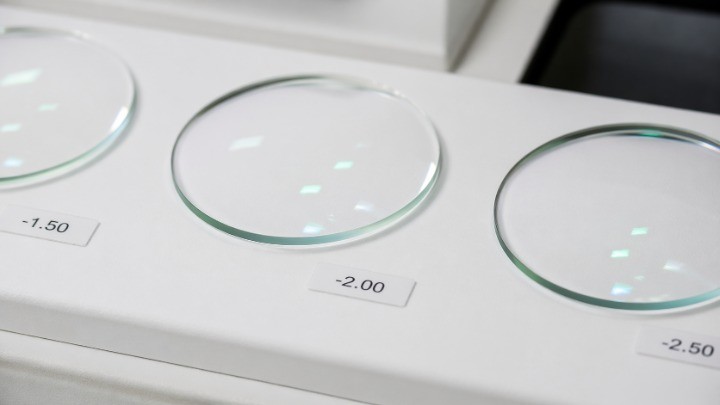 Single vision minus lenses are the standard eyeglass lenses for correcting myopia. They have one prescription power across the lens and help the wearer see distant objects more clearly.
For most myopia wearers, single vision lenses offer the most direct and cost-effective correction. They also form the foundation of most optical lens product lines.
How Single Vision Minus Lenses Correct Myopia
Single vision myopia lenses use minus power to move the focal point backward onto the retina. This helps sharpen distance vision.
The lens does not change the structure of the eye. It corrects the optical focus while the wearer uses the glasses.
Who Should Choose Standard Single Vision Lenses?
Standard single vision lenses suit many adults and teenagers with stable myopia. They also work well for customers who need a simple daily-use prescription lens.
For professional optical channels, single vision lenses usually remain a high-volume category. They support basic prescriptions, replacement demand, and broad market coverage.
Why Single Vision Lenses Are Still Widely Used
Single vision lenses are easy to understand, easy to fit, and widely available. They can also combine with different materials, indexes, and coatings.
For example, a customer can choose a 1.56 single vision lens with green HMC coating, or a 1.67 high-index single vision lens with super hydrophobic coating.
Limitations of Single Vision Lenses for Children with Progressive Myopia
Regular single vision glasses correct distance blur, but they do not act as a complete myopia management solution for every child. Children whose prescription increases quickly may need professional evaluation for specialized myopia control options.
This does not make single vision lenses a poor choice. It simply means they solve a different problem.
Best Lens Materials for Myopia
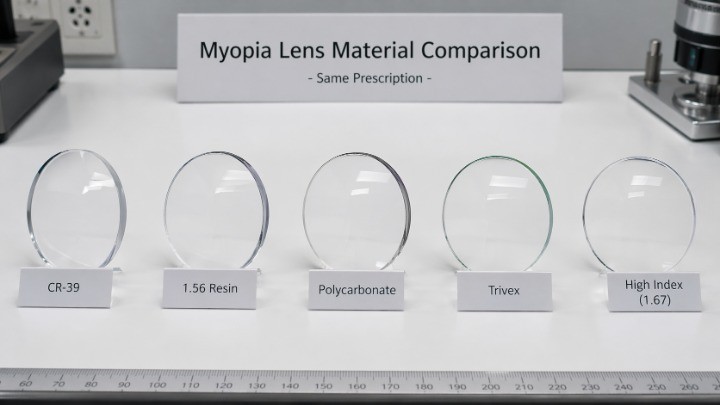 The best lens material for myopia depends on prescription strength, impact needs, optical clarity, thickness, weight, and price positioning. Common options include CR-39, 1.56 resin, polycarbonate, Trivex, and high-index materials.
For manufacturers and optical businesses, material choice also affects product segmentation. A well-planned myopia lens range should offer both entry-level and premium options.
CR-39 Lenses: Good Optical Clarity for Low Prescriptions
CR-39 lenses offer good optical clarity and remain useful for low prescriptions. They can serve markets that value affordable and traditional plastic lenses.
However, CR-39 lenses are thicker than many higher-index materials. They may not be the best option for stronger myopia or customers who want thinner lenses.
1.56 Resin Lenses: A Balanced Option for Daily Myopia Correction
1.56 resin lenses often provide a practical balance between cost, comfort, and appearance. Many optical businesses use 1.56 lenses as a mainstream daily-use option.
They work especially well for low to moderate myopia. They also support common coatings such as HC, HMC, SHMC, blue cut, and photochromic options.
Polycarbonate Lenses: Better for Children, Sports, and Impact Resistance
Polycarbonate lenses are lightweight and impact-resistant. They suit children’s glasses, sports eyewear, and safety-related applications.
In the U.S., spectacle lenses and sunglasses generally need to meet impact-resistance requirements under 21 CFR 801.410. FDA guidance also explains that spectacle lenses entering the U.S. should be accompanied by a compliance certificate for each lot. ()
Trivex Lenses: Lightweight Comfort with Good Impact Resistance
Trivex lenses can offer lightweight comfort, good impact resistance, and strong optical performance. They may suit users who want comfort and safety in one lens material.
However, Trivex may cost more than standard resin lenses. Optical businesses should position it carefully based on local market demand.
High-Index Lenses: Better Appearance for Moderate to High Myopia
High-index lenses bend light more efficiently than standard plastic lenses. This allows stronger prescriptions to use thinner lens designs.
For moderate to high myopia, high-index lenses can improve appearance and comfort. They often need good anti-reflective coating because high-index materials may show more surface reflections.
Best Lens Index for Myopia: 1.56, 1.60, 1.67, or 1.74?
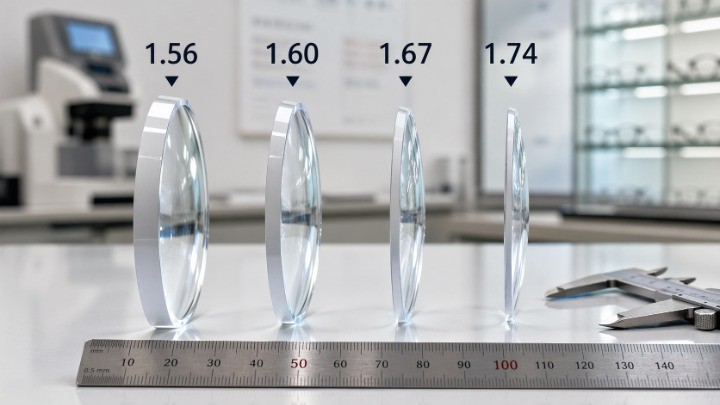 Lens index tells you how efficiently a lens material bends light. For myopia, a higher index can reduce edge thickness, but it does not automatically make the lens better for every wearer.
A low prescription may not gain much from 1.67 or 1.74 lenses. A strong prescription, however, can benefit from thinner and better-looking high-index options.
Best Index for Low Myopia
For low myopia, 1.56 resin or CR-39 may be enough. The lens edges usually remain manageable, especially with a suitable frame size.
Customers in this range often care more about price, coating, and everyday durability than ultra-thin appearance.
Best Index for Moderate Myopia
For moderate myopia, 1.56 or 1.60 lenses usually make sense. A 1.60 lens can offer a thinner look without moving too quickly into premium pricing.
This range is important for optical businesses because many wearers fall into moderate prescriptions. A strong 1.60 product line can serve both daily-use and upgraded lens demand.
Best Index for High Myopia
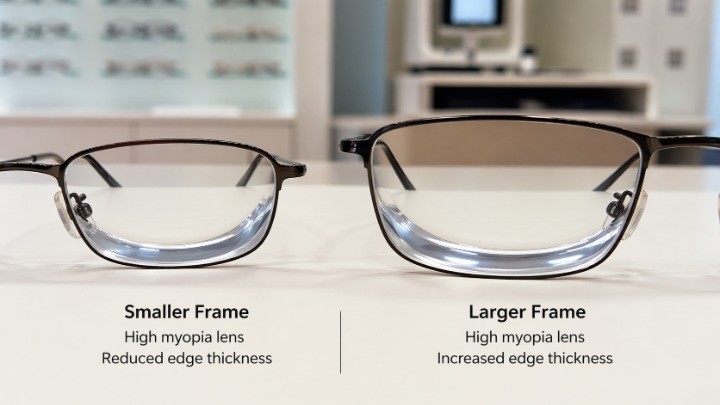 For high myopia, 1.60 and 1.67 lenses often become more practical. These lenses can reduce edge thickness and make the glasses look more refined.
A good frame recommendation also matters. A high-index lens in an oversized frame may still look thick at the edge.
When 1.67 or 1.74 High-Index Lenses Are Worth Choosing
1.67 and 1.74 lenses are most useful for strong prescriptions and customers who care about appearance. They can help reduce thick edges and improve the final look of the glasses.
However, these lenses should usually pair with high-quality anti-reflective coating. Without it, surface reflections may reduce visual comfort and premium appeal.
Why Higher Index Does Not Always Mean Better
Higher index lenses usually cost more. They may also have different optical and processing characteristics. For low prescriptions, the visible benefit may be limited.
The best index is the one that balances prescription strength, frame size, wearing comfort, and market price.
Best Lenses for High Myopia
The best lenses for high myopia are usually high-index lenses with suitable frame selection, aspheric design when available, and strong anti-reflective coating. This combination helps reduce thickness, improve appearance, and support visual comfort.
High myopia wearers often judge lenses by how they look in real glasses, not only by optical specifications. Edge thickness, frame match, and coating quality all influence satisfaction.
Why High Myopia Lenses Look Thicker at the Edge
Minus lenses thicken toward the edge. Stronger prescriptions increase this effect. Large frames make it more visible because they use more lens area.
This is why high myopia lens recommendation should always include frame guidance. Lens material alone cannot solve every thickness problem.
How High-Index Materials Reduce Lens Thickness
High-index materials reduce lens thickness by bending light more efficiently. A 1.67 lens, for example, can often look thinner than a 1.56 lens in the same prescription and frame.
For very high prescriptions, 1.74 lenses may offer further thickness reduction. The actual result depends on frame size, lens diameter, prescription, and fitting parameters.
Why Smaller Frames Can Improve Lens Appearance
A smaller, rounder frame can reduce edge thickness in myopia lenses. It also keeps the optical center closer to the frame shape.
This practical detail can make a major difference for high-prescription wearers. Optical retailers should explain it early during frame selection.
Why Aspheric Lens Design Matters
Aspheric lens designs can improve the appearance and optical performance of certain prescriptions. They may help reduce lens bulge and create a slimmer profile.
For high myopia, aspheric design can add value when combined with a suitable index and frame.
Why Coating Quality Matters More for High-Index Lenses
High-index lenses often need better anti-reflective coating because surface reflections can become more noticeable. Premium coating also improves the customer’s perception of lens quality.
For wholesalers and brands, coating consistency matters across repeat orders. A high-index lens with unstable coating can create more complaints than a basic lens with stable quality.
Functional Lens Options for Myopia
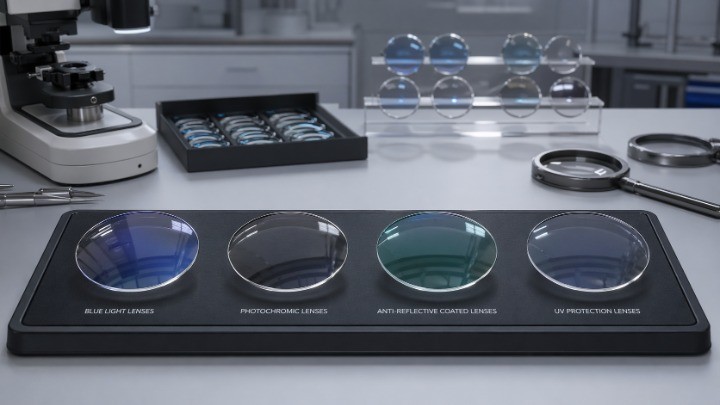 Functional myopia lenses add specific benefits beyond basic distance correction. Common options include blue light protection, photochromic performance, anti-reflective coating, UV protection, hydrophobic coating, and scratch-resistant coating.
These functions do not replace accurate prescription power. They improve comfort, convenience, durability, or market positioning.
Blue Light Lenses for Myopia: What They Can and Cannot Do
Blue light lenses can reduce part of the blue-violet light transmission depending on the lens design and coating. Many screen users choose them for office, study, and digital-device environments.
However, blue light lenses do not correct myopia by themselves and should not be marketed as myopia control lenses. They are a functional add-on to prescription lenses.
Photochromic Lenses for Myopia: Indoor and Outdoor Convenience
Photochromic lenses darken outdoors and become clearer indoors. They suit users who move between indoor and outdoor environments throughout the day.
For myopia wearers, photochromic lenses can reduce the need to switch between prescription glasses and sunglasses. They also create an attractive product category for optical retailers.
Anti-Reflective Coating for Myopia Lenses
Anti-reflective coating reduces unwanted reflections from the lens surface. It can improve visual comfort, lens appearance, and clarity in daily use.
For high-index myopia lenses, AR coating becomes especially important. A thinner lens still needs a clean visual experience.
UV Protection for Daily Eye Safety
UV protection helps reduce exposure to ultraviolet radiation. Many modern optical lenses can include UV-blocking properties through material or coating design.
For outdoor users, UV protection works well with photochromic or sun lens options. Optical businesses can position this as a daily eye-protection feature rather than a luxury add-on.
Hydrophobic and Scratch-Resistant Coatings for Long-Term Use
Hydrophobic coating helps lenses resist water and smudges. Scratch-resistant coating improves everyday durability.
For repeat customers, these coatings can reduce complaints and improve perceived value. For repeat wholesale supply, coating stability also supports brand trust.
Myopia Control Lenses for Children: What Makes Them Different?
Myopia control lenses are designed to help slow myopia progression in children, not just correct blurry distance vision. They use specialized optical designs and should be recommended through professional eye-care evaluation.
This section needs careful wording because myopia control is a clinical topic. Regular single vision lenses correct vision, while myopia management products aim to influence progression.
Standard Correction vs Myopia Management
Standard myopia lenses correct distance vision. Myopia management solutions aim to slow worsening myopia, often by using optical defocus or other professional treatment strategies.
The FDA authorized the first eyeglass lenses to slow progression of pediatric myopia in September 2025. The FDA described Essilor Stellest lenses as having a central clear zone with surrounding rings of tiny raised dots that provide peripheral light defocus. ()
How Specialized Myopia Control Glasses Work
Specialized myopia control glasses usually combine clear central vision with a design that changes peripheral light focus. The goal is to manage eye growth signals linked to myopia progression.
This differs from standard single vision lenses. A normal minus lens corrects focus, but it does not use a dedicated myopia-control design.
Examples of Myopia Control Spectacle Lens Technologies
Modern myopia control spectacle lenses may use lenslets, peripheral defocus zones, or other special optical structures. These designs need clinical support and regulatory clarity in target markets.
Manufacturers and optical businesses should avoid casual claims. They should separate regular myopia correction lenses from clinically supported myopia management products.
When Children May Need Myopia Control Instead of Regular Glasses
Children may need myopia management when their prescription increases quickly, when family history suggests higher risk, or when an eye-care professional recommends intervention.
Parents should not choose a myopia control option based only on online articles. A professional eye exam remains necessary.
Why Professional Eye Examination Is Necessary
Children’s myopia can change quickly. Eye-care professionals can evaluate prescription change, eye health, age, lifestyle, and treatment suitability.
For optical businesses, this means product content should educate, not overpromise. Trust grows when the article respects clinical boundaries.
Myopia Control Glasses vs Contact Lenses vs Ortho-K
Myopia control options include specialized glasses, soft contact lenses, ortho-k lenses, and sometimes atropine eye drops, but each option fits different children and families. The best choice depends on age, comfort, compliance, safety, lifestyle, and professional recommendation.
A practical comparison helps parents and optical businesses understand the difference.
| Option | Main Use | Key Advantage | Important Limitation |
|---|---|---|---|
| Myopia control glasses | Daily spectacle wear | Easy for many children | Needs correct fitting and monitoring |
| Soft contact lenses | Active children or teens | Can correct and manage myopia | Requires hygiene and maturity |
| Ortho-K | Overnight lens wear | Clear daytime vision without glasses | Needs strict care routine |
| Atropine drops | Myopia progression management | Can support treatment plans | Does not correct vision by itself |
Myopia Control Glasses: Simple Daily Wear for Younger Children
Myopia control glasses may suit children who cannot manage contact lenses. They feel familiar because the child wears them like normal glasses.
However, fitting accuracy and regular follow-up still matter. These are not ordinary fashion glasses.
Soft Contact Lenses: Useful for Older Children and Active Teens
Soft multifocal contact lenses can correct myopic vision and help slow progression in children, according to the National Eye Institute. ()
They may suit older children or active teens, but they require hygiene, maturity, and parental support.
Ortho-K Lenses: Overnight Correction with Daytime Freedom
Ortho-K lenses are worn overnight to reshape the cornea temporarily. The child can often see clearly during the day without glasses.
This option may suit some active children, but it requires strict cleaning and professional monitoring.
Atropine Eye Drops: Helpful but Not a Vision Correction Lens
Atropine eye drops may support myopia management plans, but they do not correct vision like eyeglasses or contact lenses.
Children using atropine may still need prescription lenses for clear daily vision.
How Parents Should Compare Comfort, Safety, Compliance, and Lifestyle
Parents should compare more than clinical effect. They should also consider whether the child can follow the routine every day.
A treatment that works on paper may fail in real life if the child refuses to wear it or cannot maintain proper care.
Best Lenses for Myopia by User Scenario
 The best myopia lens changes by user scenario because daily habits affect comfort, safety, and lens performance. Students, office workers, drivers, outdoor users, athletes, and high-prescription wearers all have different priorities.
This is also where optical businesses can create clearer product categories.
Best Lenses for Students
Students need clear distance vision for classrooms and comfortable near vision for reading and screens. A 1.56 or 1.60 lens with anti-reflective coating often works well for many prescriptions.
For children with fast-progressing myopia, parents should ask an eye-care professional about myopia management options.
Best Lenses for Office Workers
Office workers often need anti-reflective coating and may choose blue light protection. These features can support long screen-use comfort.
A thin and clean-looking lens also improves daily confidence, especially for professionals who wear glasses all day.
Best Lenses for Drivers
Drivers need clear distance vision, low reflections, and good night visibility. Anti-reflective coating can reduce distracting reflections from headlights and road lighting.
Photochromic lenses may help with outdoor light changes, but wearers should understand how different photochromic technologies perform behind car windshields.
Best Lenses for Outdoor Users
Outdoor users may benefit from photochromic lenses, UV protection, and durable coatings. These features support convenience and daily eye comfort.
For sunny markets, optical businesses can position photochromic myopia lenses as an upgraded everyday solution.
Best Lenses for Sports and Active Use
Sports users often need lightweight and impact-resistant lenses. Polycarbonate lenses can be a practical choice for this category.
Frame stability also matters. A strong lens in a poorly fitted frame will not perform well during movement.
Best Lenses for High-Prescription Wearers
High-prescription wearers usually need high-index lenses, smaller frames, and premium anti-reflective coating. They may also benefit from aspheric designs.
The goal is not only thinner lenses. The goal is better overall appearance, comfort, and visual quality.
Best Lenses for Children with Progressive Myopia
Children with progressive myopia need professional eye-care guidance. Regular lenses can correct vision, but specialized myopia control options may be needed when progression becomes a concern.
Optical businesses should present these products responsibly and avoid exaggerated claims.
Common Mistakes When Choosing Lenses for Myopia
The most common mistakes include choosing lens index only by price, ignoring frame size, misunderstanding blue light lenses, and overlooking coating quality. These mistakes can lead to thick lenses, poor comfort, weak durability, and customer dissatisfaction.
A good lens recommendation should prevent these problems before the order is placed.
Choosing Lens Index Only by Price
Some buyers choose the cheapest index without considering prescription strength. This can create thick lenses for high myopia wearers.
Others choose the highest index when they do not need it. This can increase cost without a clear benefit.
Ignoring Frame Size and Shape
Frame size strongly affects myopia lens thickness. Large frames make minus lens edges more visible.
Optical retailers should guide high-myopia customers toward smaller, better-centered frames when possible.
Assuming Blue Light Lenses Can Control Myopia
Blue light lenses are not myopia control lenses. They can be useful for screen-use positioning, but they should not replace proper prescription correction or professional myopia management.
This distinction protects both customers and brand credibility.
Choosing High-Index Lenses Without Good Anti-Reflective Coating
High-index lenses often need high-quality AR coating. Without it, reflections may reduce visual comfort and make the lens look less premium.
For procurement teams, this means high-index product planning should always include coating planning.
Using Regular Single Vision Lenses for Fast-Progressing Children Without Follow-Up
Regular lenses may help children see clearly, but fast progression needs professional monitoring. Parents should not rely only on standard correction if the prescription changes quickly.
An eye-care professional can recommend whether myopia management is appropriate.
Overlooking Coating Quality and Batch Consistency
Coating problems can damage customer trust. Peeling, inconsistent reflection color, poor hydrophobic performance, and weak scratch resistance can create after-sales complaints.
For wholesalers and brands, stable coating quality matters as much as lens material.
How Optical Businesses Can Build a Myopia Lens Product Line
Optical businesses should build a myopia lens product line with clear levels: entry-level, daily-use, premium high-index, children’s options, photochromic options, and blue light protection options. This structure helps customers choose more easily and supports better sales conversion.
For manufacturers, wholesalers, and optical brands, product line planning also reduces confusion. Each lens should have a clear purpose.
Entry-Level Myopia Lenses for Price-Sensitive Markets
Entry-level myopia lenses can use CR-39 or 1.56 resin with basic coating. They suit markets that prioritize affordability.
However, entry-level does not mean unstable quality. Even budget lenses need consistent power, clean appearance, and reliable coating.
Mid-Range 1.56 and 1.60 Lenses for Daily Use
Mid-range myopia lenses often become the core sales category. They can combine daily comfort, reasonable thickness, and better coating options.
This range works well for optical shops, wholesalers, and regional agents that need repeat-order stability.
Premium High-Index Lenses for Strong Prescriptions
Premium high-index lenses serve customers with stronger prescriptions and higher expectations. 1.67 and 1.74 products can support a more advanced product position.
These lenses should pair with premium AR, hydrophobic, and scratch-resistant coatings.
Children’s Myopia Lens Options
Children’s myopia lens options may include impact-resistant materials, durable coatings, and specialized myopia management products where legally and clinically appropriate.
For regular children’s correction, polycarbonate lenses can be a practical choice because of impact resistance.
Photochromic Myopia Lens Series
Photochromic myopia lenses can target students, drivers, outdoor workers, and general users who want convenience.
For private-label programs, photochromic lenses can create a clear product story: indoor clarity, outdoor comfort, and daily-use flexibility.
Blue Light Protection Myopia Lens Series
Blue light protection myopia lenses can target screen-heavy users. They work well for students, office workers, and online eyewear brands.
The product message should stay accurate. Blue light protection supports functional use, but it does not treat myopia progression.
OEM Packaging and Private Label Opportunities
OEM packaging helps optical businesses build brand identity. Lens envelopes, middle boxes, barcode labels, and product series names can make the product look more professional.
For example, a distributor can separate products into standard myopia, blue protection, photochromic, and premium high-index series.
Buyer’s Checklist: How to Choose the Best Lenses for Myopia
A practical myopia lens checklist should review prescription strength, lens index, material, frame size, coating type, age group, daily use, budget, and supplier quality control. This helps buyers avoid mismatched products and weak supply decisions.
Use the checklist before placing sample or bulk orders.
| Checkpoint | Why It Matters |
|---|---|
| Prescription strength | Determines thickness and index needs |
| Lens index | Affects thickness, weight, and price |
| Lens material | Affects clarity, impact resistance, and comfort |
| Frame size | Strongly affects visible edge thickness |
| Coating type | Improves durability and visual comfort |
| Age group | Children and adults need different priorities |
| Daily use | Screen, outdoor, sport, and driving needs differ |
| Budget | Helps position the product correctly |
| Supplier QC | Protects repeat-order consistency |
Prescription Strength
Start with the prescription. A low prescription does not need the same solution as -8.00D myopia.
Stronger prescriptions require more attention to lens index, frame size, and coating.
Lens Index
Choose the lens index based on real need. 1.56 works for many daily prescriptions, while 1.60, 1.67, and 1.74 support stronger myopia.
Do not recommend the highest index automatically.
Lens Material
Choose material based on optical performance, impact needs, price, and market positioning.
For children and active users, impact resistance may matter more than the thinnest appearance.
Frame Size
Frame choice can make or break the final result. A smaller frame can reduce edge thickness in high myopia.
This advice is simple, but it often improves customer satisfaction.
Coating Type
Anti-reflective, hydrophobic, scratch-resistant, blue cut, and photochromic coatings all serve different purposes.
A good coating plan turns a basic prescription lens into a stronger product.
Age Group
Adults usually focus on appearance, comfort, and function. Children need fit, durability, safety, and professional monitoring.
This difference should guide both product choice and sales communication.
Daily Use Scenario
Office, outdoor, driving, sports, and school use each create different requirements.
Optical businesses should match lens functions to real daily habits, not only to prescription power.
Budget and Market Positioning
Budget affects product selection, but it should not erase quality standards. A price-sensitive product still needs reliable performance.
A premium product needs clear benefits that customers can understand.
Supplier Quality Control
Supplier quality control affects every order. Buyers should check power accuracy, coating stability, surface quality, packaging, and batch traceability.
For export markets, documentation and compliance support can also matter.
How Vena Optics Supports Myopia Lens Supply
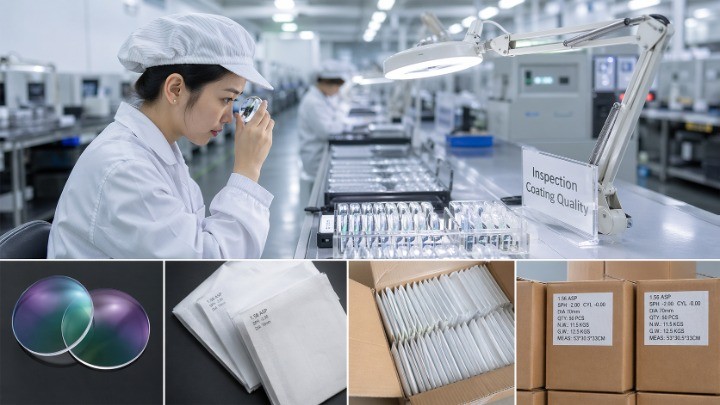 Vena Optics supports myopia lens supply with single vision lenses, high-index lenses, PC lenses, blue light protection lenses, photochromic lenses, coating customization, OEM/ODM packaging, and stable production support. We focus on professional customers who need reliable supply and repeat-order consistency.
As a Danyang-based optical lens manufacturer, we understand that myopia lens products must balance quality, cost, delivery, and market positioning.
Single Vision Myopia Lens Manufacturing
Single vision myopia lenses remain one of the core categories for optical businesses. We support standard daily-use lens options for different prescription ranges and market needs.
These products can serve wholesalers, optical chains, regional agents, and online eyewear brands.
High-Index Lens Options for Strong Prescriptions
We support high-index lens options for customers who need thinner and better-looking myopia lenses.
For stronger prescriptions, we can help customers consider index, coating, and packaging combinations based on target market positioning.
PC, Blue Light, and Photochromic Lens Solutions
We supply functional lens solutions such as PC lenses, blue light protection lenses, and photochromic lenses.
These categories help optical businesses build more complete product lines for children, screen users, outdoor users, and upgraded prescription lens demand.
Coating Customization for Different Market Needs
Different markets may prefer different coating colors and performance levels. We can support coating options such as hard coating, multi coating, super hydrophobic coating, blue cut coating, and other customized coating solutions.
Stable coating quality helps reduce complaints and protect long-term customer relationships.
OEM/ODM Packaging and Private Label Support
We can support lens envelopes, middle boxes, labels, barcode stickers, and private-label product series planning.
This helps customers build a more professional local brand image and separate different product levels clearly.
Stable Supply for Wholesalers, Brands, Agents, and Optical Channels
Professional optical customers need more than one shipment. They need stable supply, repeatable specifications, clear communication, and practical quality support.
Vena Optics focuses on long-term cooperation with eyewear brands, lens wholesalers, regional agents, and optical fitting channels.
Build a Reliable Myopia Lens Product Line with Vena Optics
Vena Optics helps professional customers source and customize myopia lenses with stable manufacturing, practical coating options, OEM/ODM packaging, and long-term supply support. Whether you need single vision lenses, high-index lenses, PC lenses, blue light protection lenses, or photochromic myopia lenses, we can help you build a product range that fits your market.