


AR coating helps optical lenses reduce reflections and deliver clearer vision.
Many clear lenses still reflect light from their front and back surfaces. These reflections can create glare, make lenses look less transparent, and lower the comfort of daily wear. For optical brands, wholesalers, labs, and retail chains, poor AR coating can also cause cleaning complaints, color mismatch, and repeat-order risks.
This guide explains how AR coating works, how manufacturers apply it, and how buyers can judge coating quality before bulk orders.
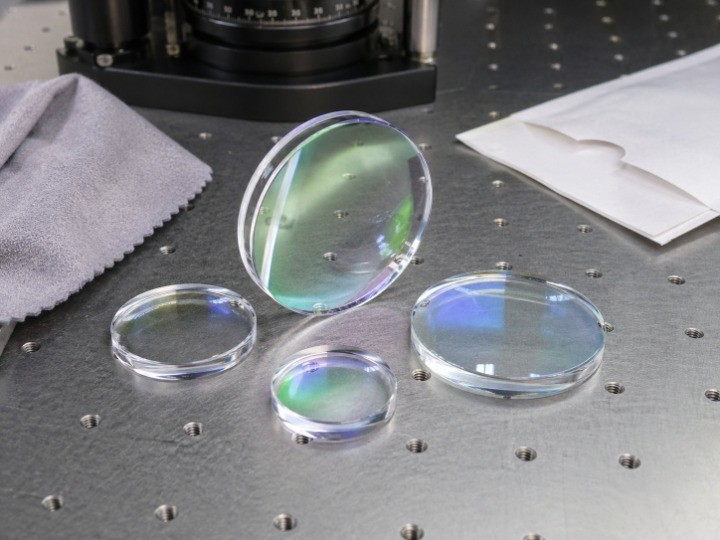 How Does AR Coating Work on Optical Lenses?
AR coating works by using very thin transparent layers to reduce reflected light on the lens surface. These layers control how reflected light waves meet each other. When the design works well, part of the reflected light cancels out, and more light passes through the lens.
This process helps the wearer see through a cleaner, clearer lens. It also makes the lens look more transparent from the outside, which improves the finished appearance of eyeglasses.
RP Photonics explains that anti-reflection coatings reduce reflection from optical surfaces through thin-film interference. This principle applies to many optical products, including spectacle lenses, camera lenses, optical windows, and display systems.
In simple terms, AR coating does not darken the lens like a tint. It changes how light behaves on the lens surface. That is why a clear AR-coated lens can still look transparent while reducing visible reflections.
A basic AR coating can work within a limited light range. A better multi-layer AR coating can reduce reflections across a wider part of the visible spectrum. This matters for office lighting, night driving, video calls, and daily face-to-face communication.
What Is AR Coating on Optical Lenses?
AR coating, also called anti-reflective coating, is a transparent surface treatment that reduces reflections on optical lenses. It is not the lens material itself. Manufacturers apply it to the lens surface after lens forming, surfacing, cleaning, and hard coating.
Clear lens materials reflect part of incoming light. This reflection happens when light moves from air into the lens material. Since a lens has both front and back surfaces, both sides can create reflections.
The phrase “anti-glare” can confuse buyers. In lens sourcing, some suppliers use “anti-glare” to describe AR coating, while others use it as a general sales term. Buyers should ask what coating structure the lens actually uses.
| Term | Main Function | Common Use |
|---|---|---|
| AR coating | Reduces surface reflections | Prescription lenses and optical surfaces |
| Anti-glare surface | Reduces visible glare in a broader sense | Screens and display surfaces |
| Hard coating | Improves scratch resistance | Resin and plastic lenses |
| Hydrophobic coating | Repels water | Easy-clean premium lenses |
| Oleophobic coating | Reduces oil and fingerprints | Premium lens surfaces |
For professional buyers, this distinction matters. A supplier may say “premium coating,” but that phrase alone does not prove stable quality.
The better question is not only “Does this lens have AR coating?” The better question is “What AR coating system does the factory use, and how does it control the result?”
Why Do Optical Lenses Reflect Light?
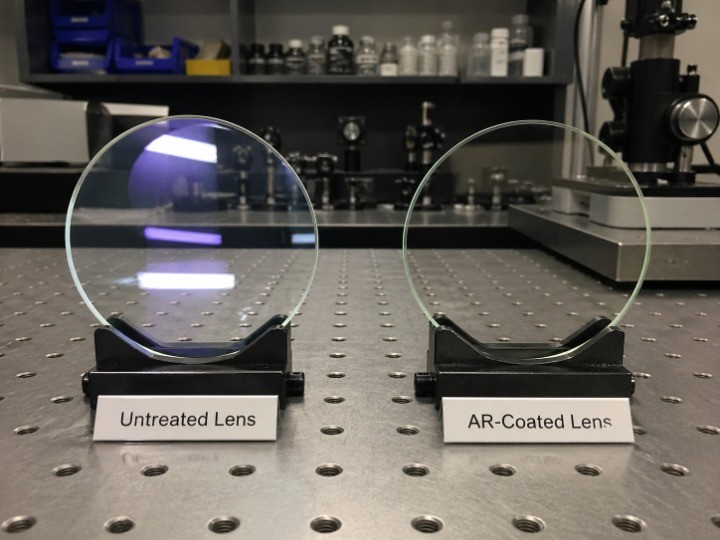 Optical lenses reflect light because light meets a boundary between air and a lens material with a different refractive index. Some light enters the lens, and some light reflects from the surface.
This reflection becomes more noticeable when the material has a higher refractive index. High-index lenses help reduce thickness for stronger prescriptions, but they also need better reflection control to keep a clean appearance.
Front-surface reflection affects how the lens looks to other people. Back-surface reflection can disturb the wearer because light from behind may bounce from the inner lens surface toward the eye.
Professional buyers should not treat reflection as a small cosmetic issue. In real use, visible reflections affect driving comfort, office work, screen use, and product value.
How AR Coating Reduces Reflections
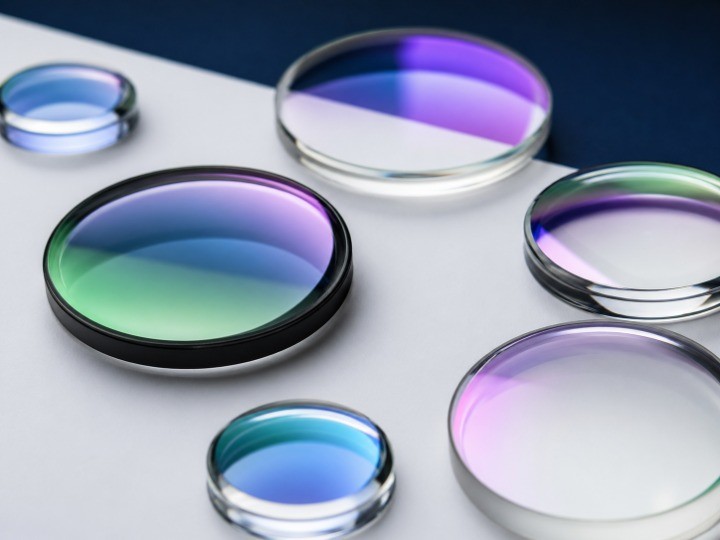 AR coating reduces reflections through thin-film interference. The coating creates controlled layers on the lens surface. Reflected light waves from different layer boundaries meet each other, and some of those reflections cancel out.
The coating designer must control layer thickness, refractive index, wavelength response, and viewing angle. These details decide how well the coating reduces reflection under different lighting conditions.
A simple single-layer AR coating can reduce reflection near one target wavelength. However, eyeglass lenses need better performance across visible light, not only at one wavelength. For this reason, many modern lenses use multi-layer AR coating.
Multi-layer AR coating uses several transparent layers with controlled optical thickness. RP Photonics explains that dielectric coating designs use different layer materials and thickness values to control reflectivity for optical applications.
The residual reflection color also comes from the coating design. Green, blue, purple, or gold reflections do not automatically prove good or poor quality. Buyers should evaluate color consistency, transmittance, adhesion, cleaning performance, and durability together.
Main Benefits of AR Coating for Optical Lenses
AR coating improves lens clarity, appearance, and comfort by reducing distracting surface reflections. It allows more usable light to pass through the lens and gives the finished eyewear a cleaner look.
For wearers, the most visible benefit is a more transparent lens. People can see the wearer’s eyes more clearly during conversations, photos, video meetings, and daily communication.
For professional buyers, AR coating also creates commercial value. It supports premium product positioning, helps reduce glare-related complaints, and improves the perceived quality of finished eyewear.
Key benefits include:
• Clearer vision through fewer surface reflections • Better light transmission for a more transparent lens appearance • Less glare from headlights, screens, and indoor lighting • Cleaner product presentation for premium eyewear lines • Higher perceived value for branded or private-label lenses
AR coating becomes more important when the lens already carries higher value. Examples include high-index thinning, blue light protection, progressive design, photochromic performance, and premium easy-clean coating packages.
AR Coating vs Other Lens Coatings: What Is the Difference?
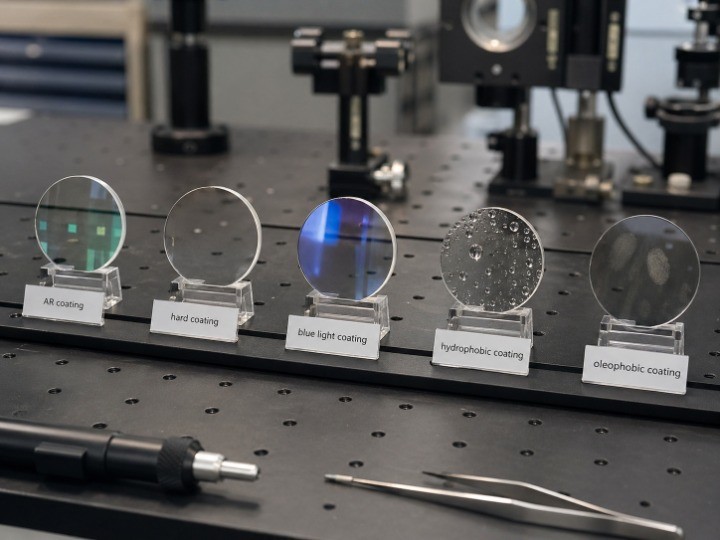 AR coating mainly reduces reflections, while other lens coatings solve different surface or functional problems. Most modern optical lenses use a coating stack, not one single layer.
Hard coating improves scratch resistance. UV protection helps manage ultraviolet transmission. Blue light coating or blue cut material targets part of the blue-violet light range. Hydrophobic and oleophobic top layers improve cleaning comfort.
| Coating Type | Main Purpose | Buyer Question |
|---|---|---|
| AR coating | Reduces reflections | What reflection color and transmittance level can you provide? |
| Hard coating | Improves surface hardness | What abrasion test do you use? |
| Blue light coating | Manages blue-violet light | Is the function material-based, coating-based, or both? |
| UV protection | Reduces UV transmission | Can you provide UV test data? |
| Hydrophobic coating | Repels water | What water contact-angle result can you support? |
| Oleophobic coating | Reduces fingerprints | How easy is the lens to clean after handling? |
This comparison helps buyers avoid a common sourcing mistake. Some buyers focus only on coating names such as HMC or SHMC. However, those names mean little if the supplier cannot explain the layers and test methods behind them.
A coating name has value only when the supplier can explain the coating structure and repeat the result in bulk production.
What Layers Are Usually Included in an AR Coating System?
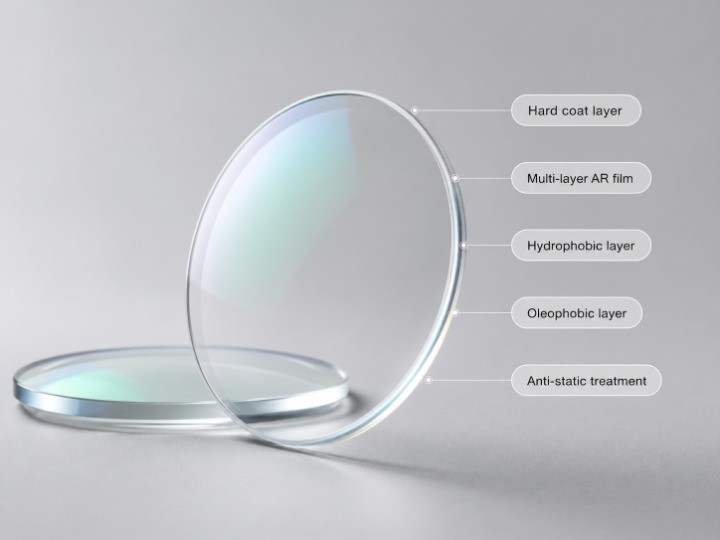 A complete AR coating system often includes a hard coat, adhesion support, multi-layer AR film, and easy-clean top layers. These layers work together to improve optical performance, durability, and daily usability.
A hard coat layer usually comes before AR coating on resin and plastic lenses. It creates a stronger surface foundation. The AR film then reduces reflection, while top layers improve water resistance, oil resistance, dust reduction, and cleaning comfort.
RP Photonics notes that dielectric coatings often use thin transparent layers deposited on a substrate. The final film properties can depend on coating material, deposition method, and process control.
A practical lens coating stack may include:
-
Lens substrate The base lens material, such as CR-39, 1.56 resin, 1.60, 1.67, 1.74, or PC.
-
Hard coat layer A scratch-resistant layer that supports daily handling and cleaning.
-
Adhesion or primer support A compatibility layer that helps the coating bond to the lens surface.
-
Multi-layer AR film Thin optical layers that reduce reflections through interference.
-
Hydrophobic and oleophobic top coat Easy-clean layers that resist water, oil, and fingerprints.
-
Anti-static treatment A surface function that helps reduce dust attraction in some premium packages.
For wholesale orders, the coating stack should match the target market. A cost-sensitive wholesale program may need stable HMC. A premium private-label line may need SHMC, super hydrophobic coating, oleophobic performance, and tighter color consistency.
How AR Coating Is Applied During Optical Lens Manufacturing
 Manufacturers apply AR coating through a controlled process that includes cleaning, surface preparation, hard coating, vacuum deposition, top coating, and inspection. Each step affects coating adhesion and long-term durability.
Lens cleaning comes first. Dust, oil, water marks, or polishing residue can create visible coating defects. A clean surface helps the hard coat and AR film bond evenly.
After cleaning, many resin lenses receive hard coating and curing. This step creates a stronger foundation for later AR layers. The lens then enters a vacuum coating process, where the machine deposits thin films layer by layer.
RP Photonics lists common dielectric coating fabrication methods such as electron beam deposition, ion-assisted deposition, and ion beam sputtering. It also explains that the fabrication method can affect film density, refractive index, and environmental stability.
| Step | Process | Quality Risk |
|---|---|---|
| 1 | Surface cleaning | Dust, oil, stains, poor adhesion |
| 2 | Hard coating | Uneven hard coat or weak curing |
| 3 | Rack loading | Handling marks or edge contamination |
| 4 | Vacuum preparation | Unstable chamber conditions |
| 5 | Thin-film deposition | Color variation or weak optical performance |
| 6 | Top coating | Poor hydrophobic or oleophobic effect |
| 7 | Final inspection | Missed defects or mixed batches |
This process explains why two lenses with the same coating name can perform differently. The price list may show similar terms, but the production control behind those terms may be very different.
Common AR Coating Problems and Their Causes
Poor AR coating can cause peeling, crazing, uneven reflection color, easy smudging, and short service life. These issues usually come from weak surface preparation, poor material compatibility, unstable coating parameters, or weak inspection.
Peeling and delamination often point to adhesion problems. If the coating does not bond well to the lens surface or hard coat layer, the film may fail during cleaning, edging, or long-term use.
Crazing appears as fine cracks or stress marks in the coating. Heat, chemical exposure, coating-substrate mismatch, or poor process control can contribute to this issue.
Uneven reflection color creates another problem for wholesalers and optical chains. A consumer may not understand coating design, but they can notice when two lenses in the same pair look different.
Common coating complaints include:
• Peeling at the edge or surface • Cracked coating after heat exposure • Different reflection colors between right and left lenses • Water marks or cleaning marks after wiping • Fingerprints that spread instead of lifting cleanly • Coating damage during edging or mounting
For buyers, these problems are not only technical defects. They create remake costs, customer complaints, shipment disputes, and pressure on local distributors or optical labs.
How Manufacturers Test AR Coating Quality
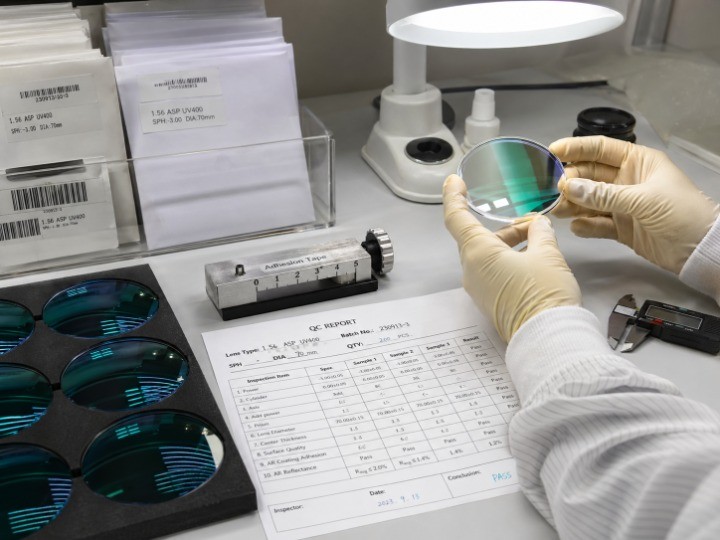 Manufacturers test AR coating quality by checking adhesion, abrasion resistance, durability, transmittance, reflection appearance, surface cleanliness, and batch traceability. These checks help confirm that the coating can handle real cleaning, mounting, shipping, and daily wear.
ISO 8980-4 covers optical and non-optical requirements, including durability and test methods for anti-reflective coatings on spectacle lenses. ISO also notes that the 2006 version does not cover transmittance, absorptance, or reflected-light color, so manufacturers often add internal checks for those items.
A practical QC system should not rely on one visual inspection. It should combine lab testing, production sampling, cosmetic inspection, and batch records.
| Test Area | What It Checks | Why It Matters |
|---|---|---|
| Adhesion testing | Coating bonding strength | Reduces peeling risk |
| Abrasion testing | Surface wear resistance | Supports cleaning durability |
| Salt spray testing | Environmental resistance | Useful for humid or coastal markets |
| Thermal stability testing | Heat and stress response | Helps detect crazing risk |
| Transmittance testing | Optical performance | Confirms clarity and light passage |
| Reflection color inspection | Batch appearance | Avoids mixed-color complaints |
| Surface inspection | Spots, dust, marks, scratches | Protects finished product quality |
| Batch traceability | Lot and inspection records | Supports after-sales analysis |
Professional buyers should ask whether the supplier can provide inspection reports, lot references, and clear acceptance criteria.
supports optical lens production with quality control, coating options, batch supply, and OEM/ODM service for professional customers.
How AR Coating Performance Differs by Lens Material and Index
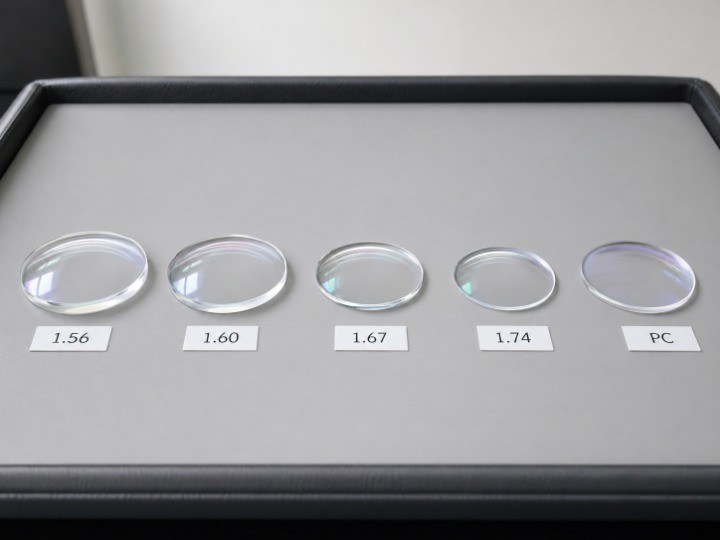 AR coating performance depends on lens material, refractive index, surface preparation, and coating compatibility. The same coating formula may not perform equally on every substrate.
CR-39 and 1.499 lenses often serve standard prescription markets. They still benefit from AR coating, but buyers may focus more on cost, stable appearance, and basic durability.
1.56 resin lenses are common in volume programs. They need balanced coating quality because wholesalers and optical chains often order them in large quantities.
1.60 and 1.67 high-index lenses require stronger reflection control. These lenses help reduce thickness, but they also need a cleaner surface appearance to match their higher value.
1.74 ultra-high-index lenses usually target strong-prescription or premium users. A weak coating package can damage the perceived value of this category.
PC lenses need careful coating compatibility because polycarbonate behaves differently from standard resin lenses. Buyers should confirm that the supplier has experience with PC hard coating, AR coating, and impact-oriented lens applications.
| Lens Material / Index | Common Positioning | AR Coating Priority |
|---|---|---|
| CR-39 / 1.499 | Standard clear lenses | Stable basic AR and cost control |
| 1.56 resin | High-volume wholesale lenses | Consistent HMC or SHMC quality |
| 1.60 | Thin and balanced lens option | Good clarity and reflection control |
| 1.67 | High-index prescription lenses | Strong AR performance and clean appearance |
| 1.74 | Ultra-thin premium lenses | Premium AR and strict quality inspection |
| PC | Sports, children, safety, rimless | Coating compatibility and durability |
Vena Optics provides optical lens options across common refractive indexes, including 1.56, 1.60, 1.67, and 1.74, with coating options such as UC, HC, HMC, and SHMC.
Which Lens Products Benefit Most from AR Coating?
Single vision, progressive, high-index, blue light, photochromic, and sunglass lenses all benefit from AR coating when the coating matches the use case. The value becomes stronger when the lens has a higher retail position or more demanding visual use.
Single vision lenses benefit because users wear them daily. A stable AR coating can make even a standard prescription lens feel clearer and more comfortable.
Progressive lenses benefit because wearers need smooth vision across distance, intermediate, and near zones. Reflections can make adaptation harder, especially in office and night environments.
High-index lenses benefit because their material and premium price point make AR coating almost necessary for a clean finished appearance.
Blue light lenses benefit because many users wear them under screen and office lighting. A balanced AR coating helps reduce surface reflections while the blue light function targets wavelength control.
Photochromic lenses benefit because users move between indoor and outdoor conditions. AR coating improves indoor clarity, while the photochromic function manages changing light.
Sunglasses often benefit from back-surface AR coating. This helps reduce reflections from light entering behind the wearer and bouncing from the inner surface.
supplies single vision lenses, progressive lenses, photochromic lenses, blue light blocking lenses, bifocal lenses, high-index lenses, and coating solutions for professional optical customers.
How to Choose the Right AR Coating for Different Markets
The right AR coating depends on the market segment, price level, lens category, and customer expectations. Buyers should not choose coating only by the lowest unit price.
A cost-sensitive market may need standard AR or HMC with stable appearance and acceptable durability. The goal is not the most advanced coating. The goal is fewer complaints at a competitive price.
A premium market may require super hydrophobic, oleophobic, anti-static, and stronger easy-clean performance. The buyer may also need private-label packaging and consistent coating color across repeat orders.
A digital lens program may use blue residual reflection as part of product positioning. However, the supplier still needs to control coating quality, not only coating color.
| Market Need | Suitable Coating Direction | Buyer Focus |
|---|---|---|
| Budget wholesale | Standard AR / HMC | Stable quality and price control |
| Optical chain | HMC / SHMC | Batch consistency and repeat supply |
| Digital office lens | Blue AR or balanced AR | Screen-use positioning and appearance |
| Premium brand line | Super hydrophobic SHMC | Easy cleaning and premium feel |
| High-index lens line | High-quality multi-layer AR | Clear appearance and lower reflection |
| Private-label program | Customized coating package | Brand consistency and packaging support |
A good supplier should help buyers match coating level to market demand. Over-specifying coating raises cost. Under-specifying coating raises complaint risk.
AR Coating Quality Checklist for Professional Lens Buyers
Professional buyers should evaluate AR coating by coating type, layer design, test reports, material compatibility, reflection consistency, cleaning performance, packaging, and supplier experience. This approach reduces the risk of choosing a coating that looks acceptable in samples but fails in bulk orders.
The most common sourcing mistake is sample-only judgment. A few clean samples do not prove that a supplier can maintain stable coating quality across repeat production.
Use this checklist before confirming an AR-coated lens order:
-
Check the coating stack Ask whether the lens uses UC, HC, HMC, SHMC, hydrophobic, oleophobic, or anti-static layers.
-
Ask for test reports Request adhesion, abrasion, salt spray, thermal stability, UV, or transmittance data when relevant.
-
Confirm material compatibility Ask whether the process differs for CR-39, 1.56, 1.60, 1.67, 1.74, and PC.
-
Review reflection color consistency Check whether right and left lenses match visually and whether repeat batches stay consistent.
-
Check cleaning performance Test fingerprints, water marks, cloth wiping, and lens-cleaning fluid compatibility.
-
Confirm packaging protection Poor packaging can damage even a well-coated lens during bulk shipment.
-
Review repeat-order support A supplier should keep lot records, coating recipes, and inspection standards stable.
-
Confirm OEM and private-label capability Packaging, labels, barcodes, product names, and coating descriptions should match the buyer’s market.
For broader supplier evaluation, you can also connect this checklist with Vena’s guide on , which covers manufacturing capability, quality control, lead time, compliance, and supplier reliability.
Common Myths About AR Coating
Many AR coating problems come from misunderstanding what the coating can and cannot do. Buyers should separate optical function, surface durability, and market positioning before comparing suppliers.
| Myth | Reality |
|---|---|
| AR coating and blue light coating are the same | AR coating reduces reflections; blue light features manage part of the blue-violet spectrum. |
| AR coating is only useful for high prescriptions | Daily single vision, progressive, office, and sunglass lenses also benefit. |
| All AR coatings have the same durability | Coating stack, material compatibility, and process control create major differences. |
| AR coating always scratches easily | Weak coating scratches easily; a proper system includes hard coat and top-layer protection. |
| The cheapest AR coating fits every market | Low-cost coating may work for basic markets but may fail premium expectations. |
The better question is not whether AR coating is good. The better question is whether the selected AR coating fits the lens material, market price point, and quality expectations.
AR coating works on optical lenses by reducing surface reflections through carefully designed thin-film layers. It improves clarity, lens appearance, visual comfort, and product value. However, the final result depends on more than optical theory. It also depends on material matching, hard coating, vacuum deposition, top-layer performance, inspection standards, and batch control.
Professional lens buyers should evaluate AR coating as part of the full lens supply system. When a supplier can support stable coating quality, clear test records, product customization, and repeat-order consistency, AR-coated lenses can become a stronger product line for eyewear brands, wholesalers, optical labs, and optical chains.
Work with Vena Optics for AR-Coated Optical Lenses
supports AR-coated optical lens programs across single vision, progressive, bifocal, photochromic, blue light, high-index, and PC lens categories. The company provides OEM/ODM support, private-label packaging, coating customization, quality inspection, and batch-based supply for professional customers that need stable production and long-term cooperation.
For eyewear brands, lens wholesalers, regional agents, and optical fitting channels, the right AR-coated lens supplier should help reduce sourcing risk while improving product value.