


An optical lens supplier guide helps you choose reliable lens partners.
Many eyewear brands, lens wholesalers, optical labs, and fitting channels compare suppliers mainly by price. However, lens sourcing also depends on coating stability, optical accuracy, production capacity, packaging control, delivery reliability, and after-sales support.
This guide explains how to evaluate an optical lens supplier from both technical and purchasing perspectives, so you can reduce sourcing risk and build a more stable supply chain.
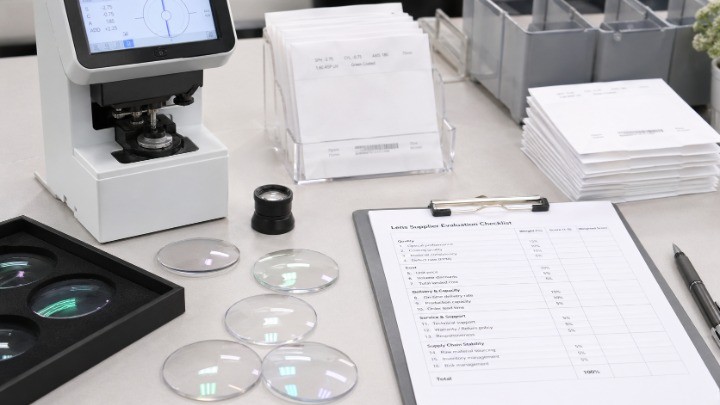
What Is an Optical Lens Supplier?
An optical lens supplier provides ophthalmic lenses for eyewear brands, wholesalers, optical labs, retailers, and fitting channels. A supplier may be a direct manufacturer, wholesaler, distributor, trading company, or optical lab.
The supplier type matters because it affects price control, customization ability, production lead time, technical support, and quality feedback. A buyer should first understand who actually controls production before comparing quotations.
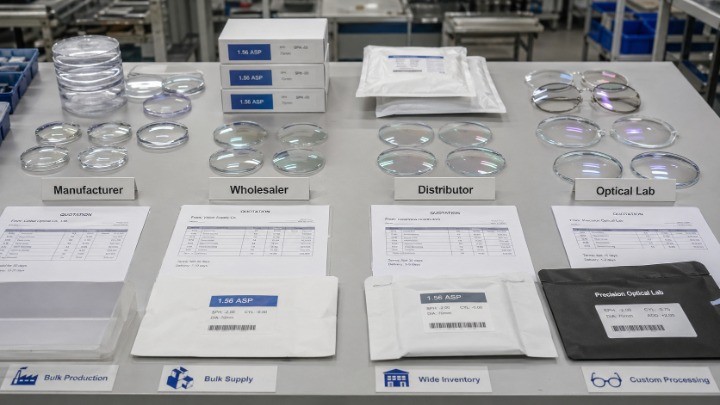 Optical lens supplier vs optical lens manufacturer
An optical lens manufacturer produces lenses directly. A general supplier may provide lenses, but it may not own the production process.
A direct manufacturer usually gives buyers stronger control over:
• Lens materials and index options • Coating configuration • Production planning • OEM/ODM customization • Batch traceability • Quality inspection feedback
For example, positions itself as a large-scale optical lens manufacturer in Danyang, China, serving eyewear brands, distributors, and optical retailers with OEM/ODM and quality control support.
Optical lens supplier vs wholesaler or distributor
A wholesaler usually focuses on stock availability and fast shipment. This model can work well for standard finished lenses, repeat SKUs, and small-to-medium stock orders.
However, wholesalers may offer limited control over coating design, product parameters, packaging, or long-term customization. If you need private label packaging or stable technical specifications, a manufacturer-backed supplier is often more suitable.
Optical lens supplier vs optical lab
An optical lab focuses on Rx processing, edging, surfacing, mounting support, and prescription fulfillment. An optical lens supplier focuses more on lens production and bulk supply.
Some buyers need both models. For example, an optical chain may buy finished or semi-finished lenses from a supplier and use a local lab for edging and final fitting.
The best supplier type depends on your order volume, product positioning, customization needs, and quality control expectations.
Why Choosing the Right Optical Lens Supplier Matters
Choosing the right optical lens supplier matters because lens quality affects visual performance, customer satisfaction, return rates, and long-term brand trust. A low-cost supplier can become expensive if poor coating, unstable power accuracy, or delayed delivery creates hidden losses.
Spectacle lenses must meet fundamental product requirements, not only appearance expectations. ISO 14889:2025 specifies fundamental requirements for uncut finished spectacle lenses, which makes it a useful reference when buyers discuss baseline lens quality with suppliers. ()
Poor supplier selection increases hidden purchasing costs
A low unit price does not always reduce total cost. Buyers should also calculate rework, returns, delayed shipment, extra inspection, customer complaints, and lost repeat orders.
For example, a lens that saves a small amount per pair may still cost more if its coating scratches easily or if the packaging label does not match the actual product.
Inconsistent lens quality can damage customer trust
Eyewear products depend on repeat confidence. If one batch has clean AR coating but the next batch shows reflection color variation, customers may question the entire product line.
This problem becomes more serious with high-index lenses, progressive lenses, photochromic lenses, and blue light lenses because these products usually carry higher customer expectations.
Delayed delivery affects inventory planning
Lens buyers often plan inventory around retail campaigns, seasonal demand, or customer order cycles. Late delivery can create stock shortages and missed sales.
A reliable supplier should provide realistic production lead times, not only attractive promises during quotation.
A reliable supplier supports long-term growth
A strong optical lens supplier does more than ship products. It helps buyers plan lens categories, choose materials, confirm coatings, improve packaging, and control quality across repeat orders.
For professional buyers, supplier selection is not only a purchase decision. It is a supply chain decision.
Common Problems When Working With the Wrong Optical Lens Supplier
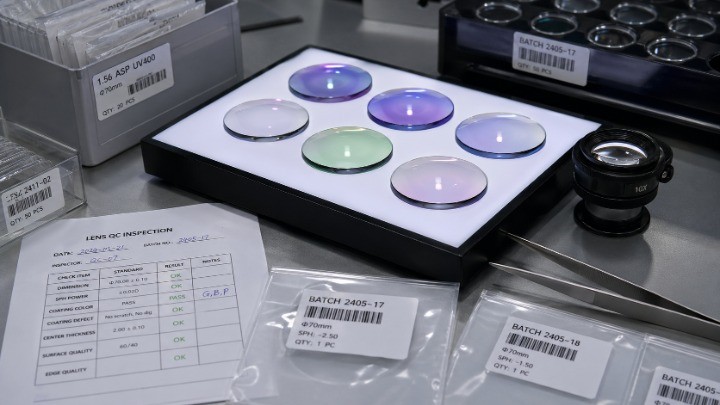 The wrong optical lens supplier can create problems in coating quality, optical accuracy, packaging, delivery, and after-sales support. These issues often appear after bulk production starts.
That is why buyers should evaluate suppliers before placing large orders, not after complaints happen.
| Common Problem | Business Impact | What Buyers Should Check |
|---|---|---|
| Unstable coating quality | Higher complaints and returns | Coating test methods and batch samples |
| Inconsistent power or thickness | Fitting issues and rework | Inspection tolerance and QC records |
| Unclear documentation | Harder product verification | Test reports and product specifications |
| Packaging mistakes | Inventory and barcode errors | Label proofing and packing standards |
| Slow delivery | Stock shortage | Capacity and production planning |
| Weak after-sales support | Higher dispute cost | Complaint handling process |
| No traceability | Difficult batch follow-up | Lot number and batch record system |
Unstable coating quality and surface defects
Coating problems often create fast complaints. Common issues include peeling, crazing, scratches, water marks, dust points, and reflection color inconsistency.
A reliable supplier should explain how it controls coating adhesion, coating cleanliness, surface inspection, and batch-to-batch color stability.
Inconsistent lens power, thickness, or optical performance
Lens power accuracy affects fitting quality and wearer satisfaction. Buyers should ask how suppliers check sphere, cylinder, axis, prism, add power, center thickness, and surface quality.
For supplier evaluation, buyers should request inspection methods, measuring equipment details, tolerance references, and sample records. A supplier that cannot explain these basics may create risk in repeat orders.
Packaging errors and barcode problems
Packaging errors can create serious warehouse and customer-service problems. A wrong index label, coating name, barcode, or power mark can disrupt inventory control.
A good supplier should confirm packaging artwork, label rules, barcode format, carton marks, and SKU naming before mass production.
Basic Optical Lens Knowledge Buyers Should Understand First
A supplier that cannot clearly explain material, index, coating, tolerance, and lens type may not be ready for long-term cooperation.
Why basic optical performance matters in supplier evaluation
Optical lenses correct vision by controlling how light enters the eye. In sourcing terms, this means a lens is not just a transparent plastic product.
A spectacle lens must match optical power, geometry, surface quality, material requirements, and coating expectations. Buyers should treat lens specifications as production standards, not as catalog descriptions.
How refractive index affects lens thickness and material choice
Refractive index describes how efficiently a material bends light. A higher index can make lenses thinner for stronger prescriptions.
However, higher index does not automatically mean better for every order. Buyers should match index with prescription range, target price, frame type, market level, and customer expectations.
How Abbe value affects clarity and material selection
Abbe value relates to chromatic dispersion. A lower Abbe value may create more color fringing in certain viewing conditions.
This point matters when comparing PC lenses, high-index lenses, and standard resin lenses. Buyers should not choose material only by thinness. They should also consider visual comfort.
How lens design affects wearer comfort
Lens design matters most in progressive lenses, aspheric lenses, and customized prescription products. Poor design control can create distortion, narrow viewing zones, or adaptation problems.
A capable supplier should explain design options, corridor choices, fitting-height requirements, and product positioning.
Why coatings are as important as lens material
The base material gives the lens structure. The coating gives the lens daily-use performance.
Anti-reflective, hard, hydrophobic, oleophobic, blue cut, and mirror coatings can change how lenses look, feel, and perform in real use.
Main Types of Optical Lenses a Professional Supplier Should Offer
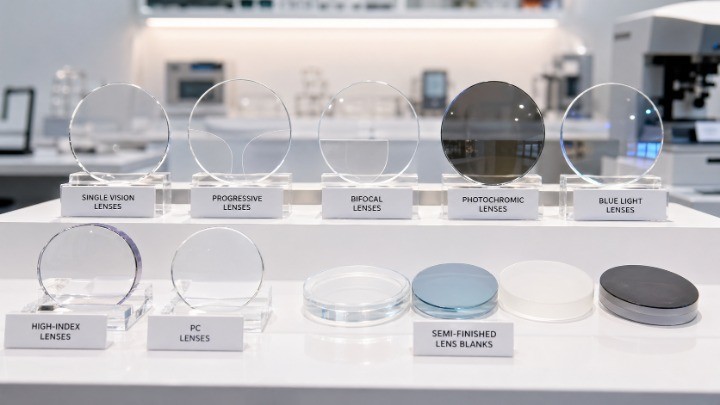 A professional optical lens supplier should offer mainstream prescription lenses and functional lenses that match different market needs. A broad product range helps buyers build complete product lines and reduce sourcing complexity.
However, buyers should not judge suppliers only by catalog size. They should confirm which products the supplier produces regularly and which products require special lead time.
| Lens Type | Main Use | Buyer’s Evaluation Focus |
|---|---|---|
| Single vision lenses | High-volume prescription supply | Price, consistency, coating stability |
| Progressive lenses | Distance, intermediate, and near vision | Design, corridor, adaptation support |
| Bifocal lenses | Distance and reading correction | Segment type and production stability |
| Photochromic lenses | Indoor-outdoor use | Activation, fading, color stability |
| Blue light lenses | Office and digital device users | Blue cut method and transmittance |
| High-index lenses | Thinner lenses for stronger prescriptions | Index, thickness, Abbe value |
| PC lenses | Lightweight and impact-resistant needs | Impact performance and coating quality |
| Semi-finished lenses | Lab processing | Base curve, diameter, Rx range |
Single vision lenses for high-volume prescription demand
Single vision lenses usually form the foundation of optical lens supply. They support large-volume demand and cover many daily prescriptions.
Buyers should check power range, index options, coating types, packaging accuracy, and shipment stability.
Progressive lenses for multifocal correction markets
Progressive lenses need stronger technical support than basic single vision lenses. Buyers should ask about corridor length, fitting height, design type, and adaptation feedback.
A supplier should provide clear product positioning, not only a generic “progressive lens” name.
Functional lenses for higher-value product lines
Photochromic, blue light, high-index, and PC lenses help buyers build higher-value product lines. However, each product needs clear performance control.
For example, photochromic lenses need stable activation and fading performance. Blue light lenses need clear transmittance data. PC lenses need reliable coating because surface durability can affect customer experience.
Lens Materials and Index Options to Confirm With a Supplier
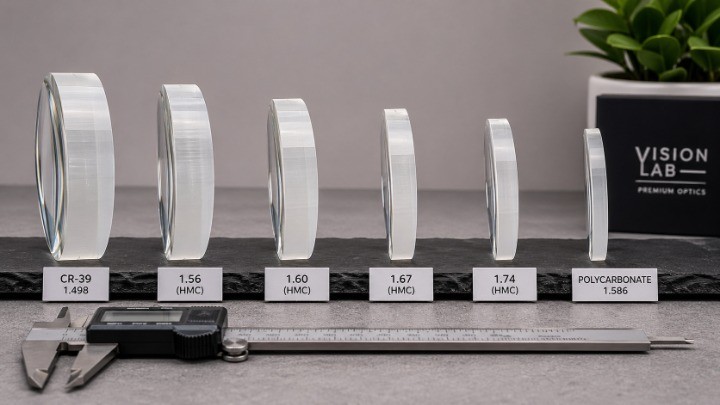 Buyers should confirm lens materials and refractive index options before comparing quotations. Material choice affects lens thickness, clarity, weight, impact resistance, coating compatibility, and price.
A good supplier should help you choose materials based on your target market instead of simply quoting every available index.
CR-39 and standard resin lenses
CR-39 and standard resin lenses remain common because they offer good optical clarity and cost control. They fit many basic prescription markets.
These lenses work well when buyers need stable quality, competitive pricing, and broad prescription coverage.
1.56 lenses for cost-effective mainstream supply
1.56 lenses are widely used in price-sensitive and mainstream markets. They support large-volume sales and common prescription needs.
Buyers should check coating stability and power range because these lenses often move in high volume.
1.60 lenses for balanced thinness and performance
1.60 lenses offer a useful balance between thinner appearance and optical performance. Many mid-range product lines use 1.60 as an upgrade from 1.56.
This index works well when buyers want better product value without moving directly to premium high-index lenses.
1.67 and 1.74 lenses for stronger prescriptions
1.67 and 1.74 lenses help reduce thickness for stronger prescriptions. These lenses usually need better process control because customers expect a more premium result.
Buyers should compare thickness, coating quality, Abbe value, price, and target prescription range before deciding.
Polycarbonate lenses for lightweight and impact-resistant applications
Polycarbonate lenses are commonly used when lightweight and impact resistance matter. For the U.S. market, the FDA explains that spectacle and sunglass lenses generally must meet impact-resistance requirements under 21 CFR 801.410. ()
However, impact-resistant does not mean unbreakable. Buyers should still check coating quality, lens use case, and market requirements before positioning PC lenses.
Coating Capability: A Key Factor Many Supplier Guides Underestimate
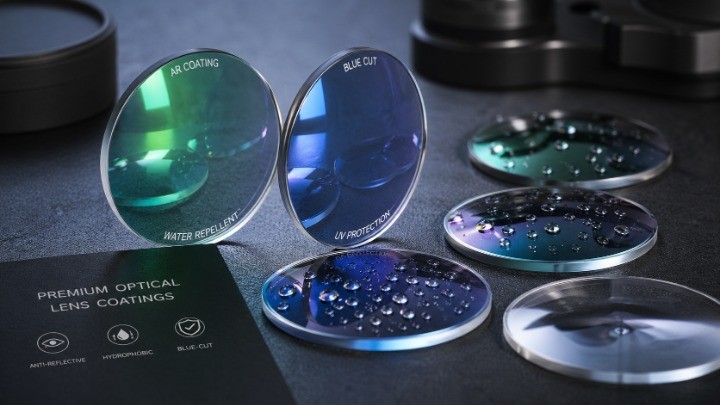 Coating capability is one of the most important factors when choosing an optical lens supplier. Coatings affect scratch resistance, reflection, cleaning performance, UV protection, blue light filtering, and product appearance.
Many buyers focus on material and index first. However, coating instability often creates more customer complaints than material selection.
Hard coating and scratch resistance
Hard coating helps improve surface durability, especially for resin and PC lenses. Buyers should ask how the supplier tests abrasion resistance and coating adhesion.
A beautiful sample is not enough. Buyers need to know whether the supplier can repeat the same coating performance in mass production.
Anti-reflective coating for clearer appearance
Anti-reflective coating reduces surface reflection and improves lens appearance. It also helps lenses look cleaner in retail displays and product photography.
Buyers should check reflection color, coating uniformity, surface cleanliness, and batch-to-batch consistency.
Hydrophobic and oleophobic coatings
Hydrophobic and oleophobic coatings improve water and oil resistance. These coatings help users clean lenses more easily and improve perceived product quality.
Buyers should ask whether the supplier can keep the same easy-cleaning performance across repeat orders.
Blue cut coating and material-level protection
Blue light protection can come from coating, material absorption, or a combination of both. Buyers should request clear transmittance data instead of relying only on a simple blue-light pen demonstration.
For coating evaluation, ISO 8980-4 is a useful reference because it covers optical and non-optical requirements, durability, and test methods for anti-reflective coatings on spectacle lenses. ()
Common coating problems buyers should watch
• Peeling after use • Fine scratches during cleaning • Crazing under heat or stress • Reflection color variation • Poor hydrophobic performance • Dust spots or coating marks • Weak adhesion on PC or high-index lenses
A supplier with strong coating control should provide testing methods, quality standards, and batch consistency records, not only coating names.
How to Evaluate Optical Lens Quality Before Choosing a Supplier
Buyers should evaluate optical lens quality through power accuracy, surface inspection, coating durability, transmittance, thickness control, and batch traceability. Quality control should happen before shipment, not only after complaints.
A professional supplier should explain what it checks, how it checks, and how it records inspection results.
Power accuracy and prescription tolerance
Power accuracy is the base of optical lens quality. Buyers should ask how the supplier measures sphere, cylinder, axis, prism, and add power.
For mixed-SKU orders, random inspection may not be enough. The supplier needs a clear inspection plan for different powers, coatings, and indexes.
Surface inspection and cosmetic defect control
Surface quality affects both optical performance and customer perception. Buyers should define acceptable standards for scratches, bubbles, dots, coating marks, and edge defects.
This step is especially important for clear lenses with premium AR coating.
Thickness consistency
Center thickness and edge thickness affect lens appearance, fitting, and customer satisfaction. Buyers should confirm thickness standards, diameter, curve, and tolerance.
For high-index and stronger prescription lenses, small thickness differences can affect the final appearance.
Coating adhesion, abrasion, and salt spray testing
Coating tests help buyers understand durability. Adhesion tests can show whether the coating bonds well. Abrasion tests can indicate scratch resistance. Salt spray testing can help evaluate coating resistance in difficult environments.
These tests are useful when buyers sell into humid, coastal, or high-wear markets.
UV protection and transmittance testing
UV protection and transmittance data can support product claims. Buyers should request test reports if they plan to market UV protection, blue cut, or photochromic functions.
A supplier should avoid vague claims that cannot be supported by data.
Batch traceability
Traceability helps buyers identify quality issues quickly. A supplier should record production batch, coating batch, inspection result, and shipment details.
Traceability does not prevent every problem, but it makes problem-solving faster and more professional.
Sample Testing Before Bulk Optical Lens Orders
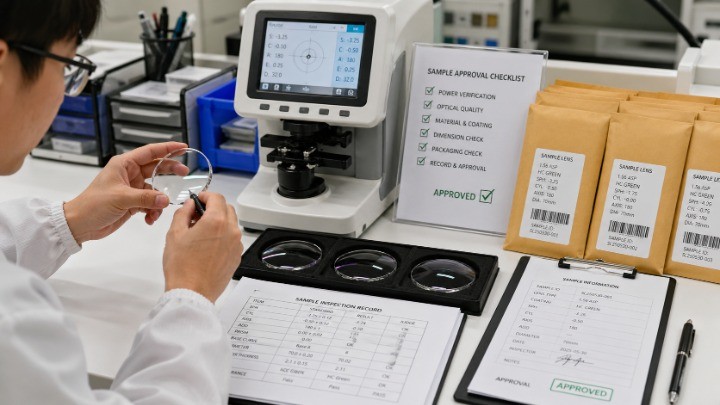 Sample testing helps buyers confirm lens quality, coating appearance, packaging details, and specification accuracy before mass production. It reduces the risk of ordering thousands of lenses based on a quotation alone.
A sample should represent the actual production standard, not a special display sample.
What to check in optical lens samples
-
Lens power and prescription accuracy
-
Surface cleanliness and cosmetic defects
-
Coating reflection color and uniformity
-
Scratch resistance and cleaning feel
-
Lens thickness and curve
-
Packaging artwork and labeling
-
Barcode and SKU format
-
Product documentation
How to inspect coating appearance
Buyers can check coating appearance under white light, dark background, and normal retail lighting. They should look for uneven color, dust points, water marks, and reflection differences.
For durability, buyers should ask the supplier what internal tests it performs. Casual hand wiping or simple scratch demonstrations are not enough.
When to request revised samples
Request revised samples when the first sample shows unclear labeling, unstable coating color, wrong packaging, weak surface quality, or incomplete specifications.
It is better to delay sample approval than to solve the same problem after mass production.
Supplier Selection Criteria for Professional Optical Lens Buyers
Professional buyers should evaluate an optical lens supplier through production capacity, product range, technical support, quality control, lead time, MOQ, export experience, communication, and after-sales response.
A good supplier should prove capability through process, documentation, and repeat performance, not only through catalog claims.
| Criteria | What to Check | Why It Matters |
|---|---|---|
| Production capacity | Daily output and regular SKUs | Supports stable supply |
| Product range | Lens types, indexes, coatings | Reduces sourcing complexity |
| Technical support | Specs, Rx range, coating advice | Helps product planning |
| Quality control | Inspection process and records | Reduces complaint risk |
| Lead time | Normal and peak-season delivery | Protects inventory planning |
| MOQ and pricing | Flexible order model | Improves cost control |
| Export experience | Documents and market familiarity | Reduces shipment risk |
| Communication | Response speed and clarity | Improves cooperation |
| After-sales | Complaint handling process | Supports long-term trust |
Production capacity and stable output
Production capacity should match your order model. A supplier may look suitable for small trial orders but struggle with repeat monthly demand.
Ask about regular SKUs, monthly output, coating capacity, peak-season lead time, and backup production plans.
Product range and prescription coverage
A broad product range can reduce sourcing complexity. However, buyers should ask which products the supplier produces regularly.
A rarely produced product may require longer lead time, higher MOQ, or special process control.
Technical support and specification clarity
A serious supplier should help you understand lens parameters, index selection, coating choices, packaging rules, and market positioning.
If a supplier cannot provide clear specifications, your sales team may struggle to explain the product later.
Quality control process and testing documentation
Quality control should include incoming material checks, process inspection, finished lens inspection, coating evaluation, packaging review, and shipment records.
For general quality management, ISO 9001 is a recognized framework that helps organizations improve performance and meet customer expectations through a structured quality management system. ()
Communication efficiency and after-sales response
Good communication reduces errors before they become expensive. Buyers should notice how quickly a supplier confirms specifications, packaging details, shipment plans, and quality questions.
A supplier’s response during sampling often predicts its response after bulk orders.
How to Compare Optical Lens Supplier Quotations
Buyers should compare optical lens quotations by product specification, material, index, coating, quantity, packaging, inspection level, lead time, and after-sales terms. The lowest price may not offer the best value.
A professional quotation should make product details clear enough for fair comparison.
What should be included in a professional lens quotation
• Lens type • Material and refractive index • Power range or Rx range • Diameter and base curve if needed • Coating type • Functional features • Quantity and MOQ • Packaging method • Lead time • Payment terms • Shipping terms • Customization fees if any
Hidden costs buyers should check
• Mold or setup costs • Packaging design charges • Sample fees • Rework terms • Inspection fees • Bank charges • Import costs • Delay costs • Minimum reorder requirements
A transparent supplier helps buyers understand the full cost before production starts.
OEM, ODM, and Private Label Support
OEM, ODM, and private label support help buyers build stronger product lines with customized packaging, coating names, specifications, and market positioning. This service is especially useful for eyewear brands, distributors, agents, and optical chains.
Customization should be practical, not only cosmetic. It should support easier selling, clearer inventory control, and stronger brand recognition.
Packaging and labeling support
A supplier should help buyers prepare lens envelopes, boxes, sleeves, labels, carton marks, and barcode systems.
Before mass production, buyers should confirm artwork files, printing color, barcode format, power marking rules, and label placement.
Customized coating names and product positioning
Some buyers need different coating names for different product levels. For example, basic AR coating, premium hydrophobic coating, and blue cut coating may need separate product names.
The supplier should help match each product name with actual performance, so the claim remains clear and responsible.
Parameter customization for different markets
Different markets may prefer different indexes, diameters, coatings, or packaging styles. A supplier with flexible customization can help buyers adjust product lines without changing suppliers frequently.
This creates better long-term efficiency.
Questions to Ask an Optical Lens Supplier Before Ordering
Buyers should ask direct questions before confirming an optical lens supplier. These questions reveal whether the supplier understands production, quality control, customization, and after-sales responsibility.
A supplier that answers clearly will usually be easier to work with.
Key questions for supplier evaluation
-
What lens materials and indexes do you produce regularly?
-
What coating options can you provide?
-
What products do you keep stable in repeat production?
-
What quality tests do you perform before shipment?
-
Can you provide batch inspection records or test reports?
-
What is your normal production lead time?
-
How does lead time change during peak seasons?
-
Can you support OEM packaging and private label projects?
-
How do you confirm artwork, barcode, and labeling details?
-
How do you handle quality complaints or remake issues?
-
Can you provide samples from regular production batches?
-
What markets do you normally export to?
How to read the supplier’s answers
Do not only listen for “yes.” Look for specific answers.
For example, “we can make blue cut lenses” is not enough. A stronger answer should explain blue cut method, coating option, transmittance data, index availability, and recommended market use.
Optical Lens Supplier Evaluation Matrix
An optical lens supplier evaluation matrix helps buyers compare suppliers in a structured way. It turns subjective impressions into measurable selection criteria.
This matrix works well when your team compares several suppliers at the same time.
| Evaluation Area | Weight | Supplier A | Supplier B | Supplier C |
|---|---|---|---|---|
| Product range and technical capability | 15% | |||
| Quality control and testing standards | 20% | |||
| Coating stability and batch consistency | 15% | |||
| Customization and packaging support | 10% | |||
| Delivery capacity and supply reliability | 15% | |||
| Price competitiveness and long-term value | 15% | |||
| Communication and after-sales support | 10% |
How to use the matrix
Score each supplier from 1 to 5 for every area. Then multiply the score by the weight.
This method helps buyers avoid choosing a supplier only because one price looks attractive. It also helps teams explain the final decision internally.
What deserves extra attention
For optical lenses, I recommend giving extra attention to quality control, coating stability, and delivery reliability.
These three areas usually affect repeat cooperation more than small differences in unit price.
Why China Remains an Important Optical Lens Supply Base
China remains an important optical lens supply base because it combines mature manufacturing clusters, large-scale production, broad product coverage, and flexible OEM/ODM support. For many buyers, this creates a practical balance between cost, capacity, and customization.
However, buyers still need to choose carefully. A strong manufacturing region does not mean every supplier has the same capability.
Large-scale production and cost efficiency
China’s optical lens industry benefits from concentrated supply chains, skilled labor, coating resources, packaging suppliers, and export service experience.
This helps professional buyers source mainstream and functional lenses with competitive cost structures.
Mature optical lens manufacturing clusters
Danyang is one of China’s well-known optical manufacturing areas. Many suppliers, material providers, coating factories, packaging vendors, and export service teams work within the same regional ecosystem.
This type of cluster can improve response speed and sourcing flexibility.
Flexible OEM and ODM cooperation
Many professional buyers need different packaging, coating names, barcode systems, and market-specific product combinations. China-based manufacturers often provide flexible OEM and ODM support for these needs.
The key is to confirm details early and approve samples before mass production.
Compliance awareness for export markets
Export buyers should confirm whether the supplier understands the requirements of the target market. For example, EU medical devices are regulated under Regulation (EU) 2017/745, so buyers selling into Europe should review classification, documentation, labeling, and conformity responsibilities with professional guidance. ()
A supplier does not need to solve every regulatory issue for you, but it should support the product documents, batch records, and technical files needed for your local compliance review.
How Vena Optics Supports Professional Optical Lens Buyers
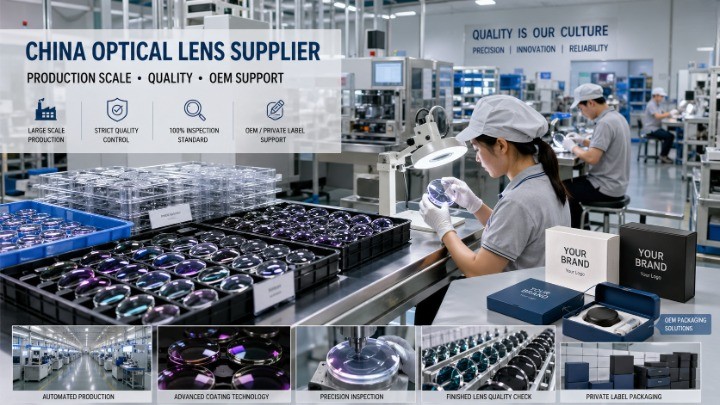 Vena Optics supports professional optical lens buyers with large-scale production, broad product coverage, coating solutions, OEM/ODM service, private-label packaging, quality inspection, and supply chain cooperation from Danyang, China.
For buyers who need stable supply, Vena Optics focuses on practical cooperation rather than one-time transactions.
Large-scale optical lens production in Danyang, China
Vena Optics is based in Danyang, an important optical lens manufacturing area in China. This location supports efficient production coordination, material sourcing, packaging customization, and export service.
Buyers can use this manufacturing base to develop cost-effective and stable lens supply plans.
Full product range for mainstream and functional lenses
Vena Optics provides single vision lenses, progressive lenses, bifocal lenses, photochromic lenses, blue light protection lenses, high-index lenses, PC lenses, and other mainstream optical lens products.
This broad range helps buyers reduce supplier complexity and build more complete product lines.
Coating solutions for different market needs
Vena Optics can support coating options such as hard coating, anti-reflective coating, blue cut coating, hydrophobic coating, mirror coating, and other surface solutions.
This helps buyers match products with different price levels, retail channels, and customer expectations.
OEM/ODM and private label packaging support
Vena Optics can support brand labeling, lens envelopes, boxes, sleeves, labels, barcodes, and customized packaging solutions.
This service helps eyewear brands, wholesalers, agents, labs, and optical fitting channels build clearer product identities in their local markets.
Quality inspection and supply chain cooperation
Vena Optics supports quality inspection, specification confirmation, and supply chain coordination for repeat orders.
For professional buyers, this means fewer communication gaps, more stable production planning, and better long-term cooperation.
Partner With Vena Optics for Stable Optical Lens Supply
If you need a supplier that can support stable quality, flexible customization, and long-term production planning, Vena Optics can help you build a practical optical lens supply solution. We support single vision, progressive, bifocal, photochromic, blue light, high-index, and PC lenses, with OEM/ODM packaging, coating options, quality inspection, and supply chain coordination from Danyang, China.
today to discuss your lens requirements, target market, packaging needs, and long-term cooperation plan.
Choose a Supplier That Supports Long-Term Growth
A strong optical lens supplier should balance quality, cost, delivery, technical support, and customization. Buyers should not judge suppliers only by unit price. They should check product range, coating stability, inspection process, sample quality, quotation clarity, packaging ability, and after-sales response.
If you need a reliable optical lens manufacturer for stable bulk supply, OEM/ODM projects, private label packaging, or customized coating solutions, can help you build a practical lens supply plan for your market. to discuss your product requirements, target price level, packaging needs, and long-term cooperation goals.