


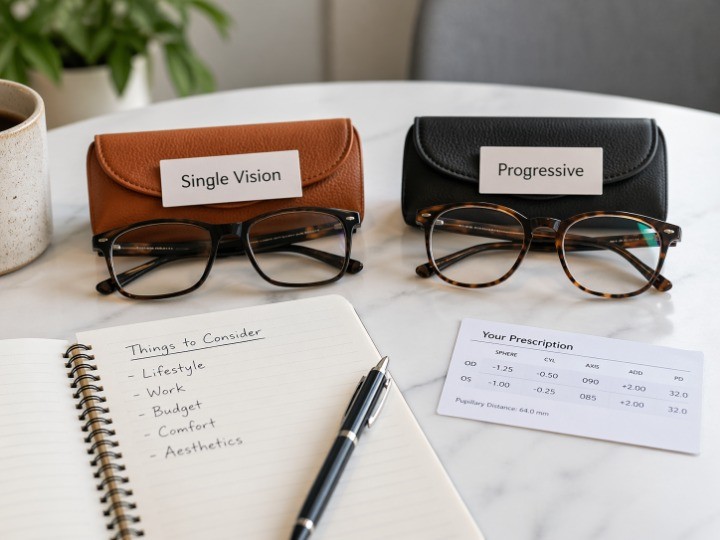
If you are comparing single vision vs progressive lenses, you are trying to answer a simple question: which option will make daily life easier?
Many people feel unsure because both lens types solve real problems, but they do it in very different ways. One option gives you clear vision for one distance at a time. The other tries to cover several distances in one pair. If you choose the wrong one, you may spend more, feel less comfortable, and still end up buying another pair later.
This guide explains the real difference between single vision and progressive lenses. It also shows where each option works best, where it falls short, and how to choose the one that fits your reading, computer use, driving, and budget.
What Is the Difference Between Single Vision and Progressive Lenses?
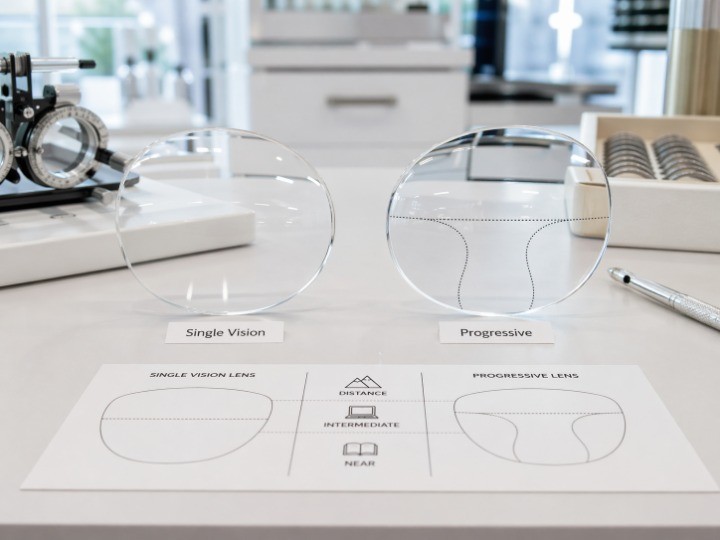
Single vision lenses correct one distance. Progressive lenses correct several distances in one lens. That is the clearest short answer.
A single vision lens has one prescription power across the whole lens. If it is made for distance, the full lens works for distance. If it is made for reading, the full lens works for near work. The design is simple, and that simplicity is one of its biggest strengths.
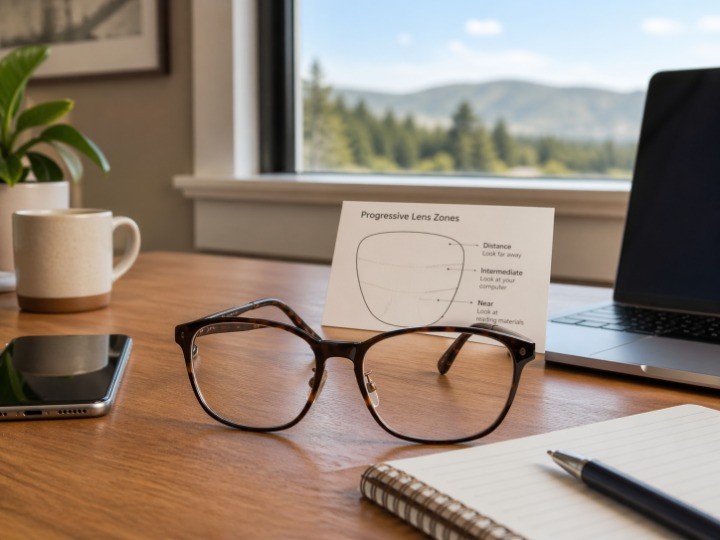
A progressive lens works differently. It changes power from top to bottom. The upper part usually supports distance vision. The middle part helps with intermediate tasks such as computer use. The lower part supports near tasks such as reading. You do not see a visible line, but you do have to look through the correct part of the lens. For a basic medical overview of presbyopia treatment options, including progressives, see the Mayo Clinic guide.
| Feature | Single Vision Lenses | Progressive Lenses |
|---|---|---|
| Main purpose | Correct one distance | Correct multiple distances |
| Vision zones | One | Distance, intermediate, near |
| Visible line | No | No |
| Ease of use | Usually simple | Often needs adaptation |
| Best fit | One main task or one main distance | All-day switching between distances |
| Upfront cost | Usually lower | Usually higher |
This is why the decision is not really about which lens sounds more advanced. It is about which one matches the way you actually use your eyes each day.
What Are Single Vision Lenses?
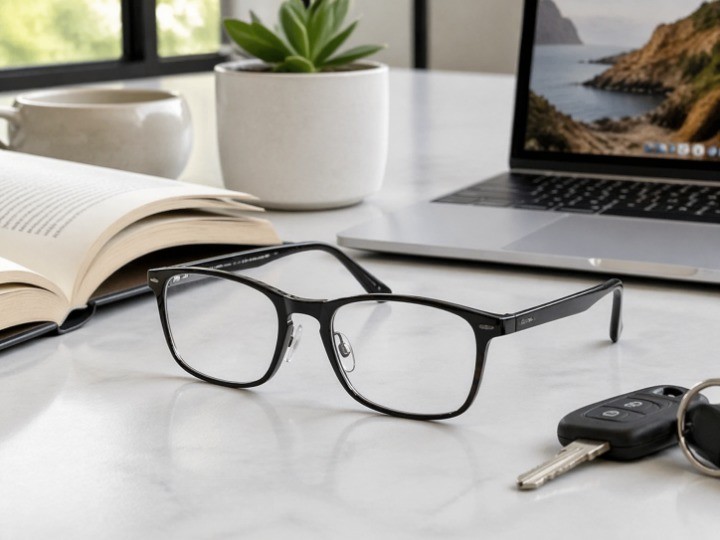
Single vision lenses are made for one viewing distance only. They may correct distance, near, or intermediate vision, but they only do one of those jobs at a time.
That sounds basic, but in many cases it is exactly what people need. If you drive most of the day, a single vision distance lens can work very well. If you spend hours reading or doing paperwork, a single vision reading lens can feel more natural and more comfortable. If you sit at one monitor for long periods, a dedicated computer lens can also make sense.
Single vision lenses often work well for:
- Distance-only wearers
- Reading-only wearers
- Computer users with one fixed setup
- Younger users with myopia, hyperopia, or astigmatism
- People who want the widest clear field for one task
The biggest advantage is clarity for one job. You do not need to search for the right area of the lens. You do not need to move your head more than usual. Most people also adapt quickly because the visual experience feels direct and stable.
The weakness is also obvious. If you need help at several distances, one pair of single vision glasses cannot do everything. That is why many people end up using more than one pair.
What Are Progressive Lenses?
Progressive lenses combine several viewing distances in one pair of glasses. They are designed for people who need help seeing far away, at arm’s length, and up close.
This usually becomes important when presbyopia starts. At that stage, many people can no longer focus comfortably up close, even if distance vision still seems manageable. They may notice that reading feels harder, phone text seems smaller, or screen work requires more effort than before. The National Eye Institute explains presbyopia as a normal age-related loss of near focusing ability.
A progressive lens tries to solve that problem without using a visible line. Instead of separating lens powers in a sharp step, it blends them gradually from top to bottom. That makes the lens look cleaner than a bifocal, and many people prefer that appearance.
Still, the design comes with a trade-off. Because the lens has several working areas, each area takes up only part of the lens. That can make the reading zone or intermediate zone feel narrower than a task-specific single vision lens.
So progressives offer convenience, but they also ask more from the wearer. You need to learn where to look. You also need the frame and fitting to work well with the lens design.
Single Vision vs Progressive Lenses in Real-Life Use
The real difference appears in daily use, not in product names. This is where most buying decisions become clear.
If your day revolves around one main distance, single vision usually feels better. If your day involves constant switching between distances, progressive lenses often feel more practical.
| Daily Scenario | Better Fit in Many Cases | Why |
|---|---|---|
| Reading for long periods | Single vision reading lenses | Wider near zone |
| Computer work at one setup | Single vision computer lenses or office progressives | More task-specific comfort |
| Driving | Single vision distance lenses | Wide, stable distance view |
| Phone + desk + meetings + driving | Progressive lenses | One pair for many distances |
| Occasional glasses use | Single vision lenses | Less re-learning of zones |
| All-day wear after presbyopia begins | Progressive lenses | Better convenience |
A person who reads documents all day may not care about all-in-one convenience. That person may care more about a wide, calm reading area. In that case, single vision reading lenses may feel better than progressives.
A person who moves between a laptop, a phone, face-to-face conversations, and driving may feel annoyed by switching glasses all day. In that case, progressives may offer a better overall experience, even if each zone is not as wide as a dedicated single vision lens.
This is why single vision vs progressive lenses is not a theoretical comparison. It is a practical fit question. The better choice depends on what you actually do, not on what sounds more premium.
Pros and Cons of Single Vision Lenses
Single vision lenses work best when one distance matters most. They solve one problem clearly and directly.

Pros
- Wide and stable field of view
- Fast adaptation for most users
- Lower upfront cost in many cases
- Easy frame compatibility
- Strong performance for dedicated reading, distance, or computer use
Cons
- Only one distance stays clear
- Many users need more than one pair
- Switching glasses can become annoying
- Less practical when several distances matter in the same day
Single vision lenses are often the smarter choice when your tasks stay predictable. If you know what distance you need most, the lens can stay focused on that one job. That often leads to better comfort and less compromise.
They also make sense for users who dislike change in visual behavior. If you want glasses that feel natural right away, single vision usually offers the easier path.
Pros and Cons of Progressive Lenses
Progressive lenses work best when daily convenience matters more than perfect performance at one single distance.
Pros
- One pair supports several distances
- No visible line
- Better for daily switching between tasks
- Useful for people with presbyopia
- Often more appealing in appearance than bifocals
Cons
- Adaptation takes time for many users
- Peripheral blur may feel uncomfortable
- Reading and computer areas may feel narrow
- Upfront cost is usually higher
- Good fitting matters much more
This is where expectations matter. Some people put on progressives and adjust quickly. Others feel side blur, a swimming effect, or a narrow reading area. That does not always mean the lens is poor. Sometimes it simply means the design does not match the person’s task pattern, frame choice, or tolerance level.
So progressive lenses can be an excellent solution, but they are not automatically the best solution for every person with presbyopia. For a consumer-friendly explanation of common trade-offs, see the American Academy of Ophthalmology overview of progressive lenses.
The Real Pain Points Behind the Choice
Most users do not struggle with the definitions. They struggle with the result of making the wrong choice.
One common issue is buying progressives with the hope that one pair will solve every visual problem perfectly. That expectation is often too high. Progressives reduce the need to switch glasses, but they do not always provide the widest reading area or the most relaxed setup for long computer sessions.
Another common issue is choosing single vision lenses because they cost less at first, then discovering that one pair is not enough. A user may buy distance glasses, then add reading glasses, then realize computer work still feels off. The first purchase looks cheaper, but the full solution may end up costing more.
There is also a comfort cost. The wrong lens can lead to eye strain, frustration, poor posture, and low satisfaction. In business settings, it can also lead to more returns, more fitting time, and more complaints.
That is why the decision matters. A lens does not succeed just because it looks correct on paper. It succeeds when it feels right in real use.
Single Vision vs Progressive Lenses for Different Daily Scenarios
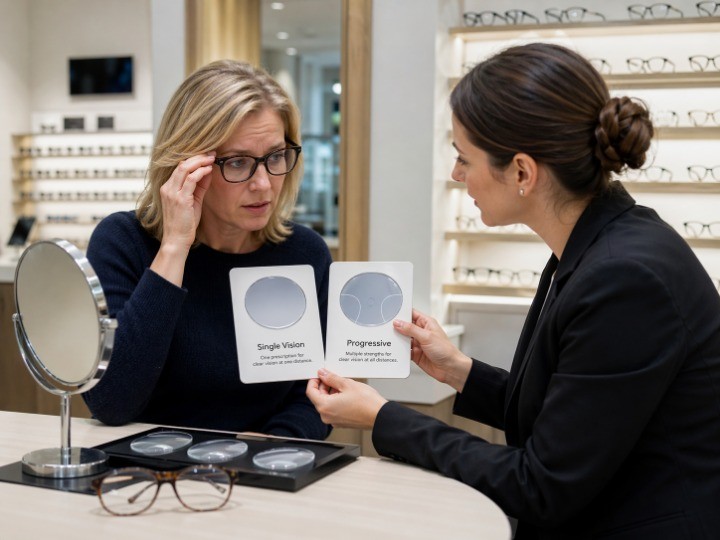
Different routines need different lens strategies. This is one of the most important points in the whole article.
For reading and close-up work, single vision reading lenses often feel better. They give you a wider near area and let you focus on the page without moving your head too much.
For computer work, the answer depends on the setup. If you sit at one screen distance for hours, a dedicated single vision computer lens may feel better. If your workday includes screen use plus meetings, walking, and other transitions, a progressive or office-style solution may be more practical.
For driving, single vision distance lenses often feel cleaner and wider. They give you a simple view of the road. Progressive lenses can still help if you need to look at the dashboard or navigation often, but some wearers never fully like how the side areas feel during motion.
For all-day switching between phone, desk, road, and conversation, progressives often make more sense. That is where they usually show their real value.
For occasional wearers, single vision may still feel easier. A person who wears glasses only at certain times may not want to relearn progressive zones each time.
For first-time wearers over 40, the key question is simple: do you want one task done very well, or several tasks handled in one pair? That question often leads to the right answer faster than age alone.
The Learning Curve of Progressive Lenses
Progressive lenses often require a learning period. That is normal, and it should be part of the decision from the start.
When you wear progressives, you do not look through the same part of the lens all the time. You need to aim your eyes and head toward the correct zone for distance, intermediate, or near work. For some users, that becomes natural quickly. For others, it takes patience.
The most common early complaints include:
- Side blur
- Narrow reading area
- Swimming sensation
- Trouble finding the right zone
- Needing to move the head more than expected
These complaints do not always mean the wearer made the wrong choice. Sometimes the brain and body simply need time to adapt. However, discomfort can also signal a real mismatch. The lens design may not suit the user’s work. The frame may be too small. The fitting may not be accurate enough. Or the wearer may simply need task-specific glasses instead.
A good adaptation process depends on honest expectations. Users do better when they know in advance that progressive lenses may feel strange at first. They also do better when they wear the lenses consistently rather than switching back and forth too soon.

When Two Pairs of Single Vision Glasses May Be Better Than One Pair of Progressives
Sometimes two simple pairs solve the problem better than one complex pair. That idea still makes sense, even though many buyers focus on all-in-one solutions.
A common example is one pair for reading and one pair for distance. Another example is one pair for computer work and one pair for general daily use. This setup often works well because each pair focuses on a single task, which means fewer compromises.
Two single vision pairs may be better if:
- You work at one fixed distance for long hours
- You want the widest possible clear field
- You are sensitive to progressive distortion
- You use glasses only in specific situations
- You want the simplest adaptation experience
This approach often works very well for office users. A dedicated computer lens can support posture, screen comfort, and long working sessions in a way that general progressive lenses may not fully match.
So while progressives offer convenience, separate single vision pairs still deserve serious consideration. In many real cases, they are the more effective answer.
Prescription and Age: How Vision Needs Affect the Best Choice
Age matters, but it should not control the decision by itself. Prescription needs and daily habits matter just as much.
Younger users with myopia, hyperopia, or astigmatism usually start with single vision lenses. Their visual problem often stays focused on one main type of correction, so a simple lens works well.
As people get older, presbyopia starts to change the situation. Near tasks become harder. Reading gets less comfortable. Screen work may require more effort. At that point, progressives become more attractive because they reduce the need to change glasses during the day. For a plain-language medical summary, see the MedlinePlus page on presbyopia.
Still, age does not tell the whole story. Two people at the same age may need very different solutions. One may read documents all day and prefer dedicated near lenses. Another may move between meetings, phone use, driving, and desk work, and may prefer progressives almost immediately.
Higher prescriptions also make lens choice more sensitive. The stronger the prescription, the more design, fitting, and comfort details begin to matter. That is why the best choice should come from actual visual behavior, not from age alone.
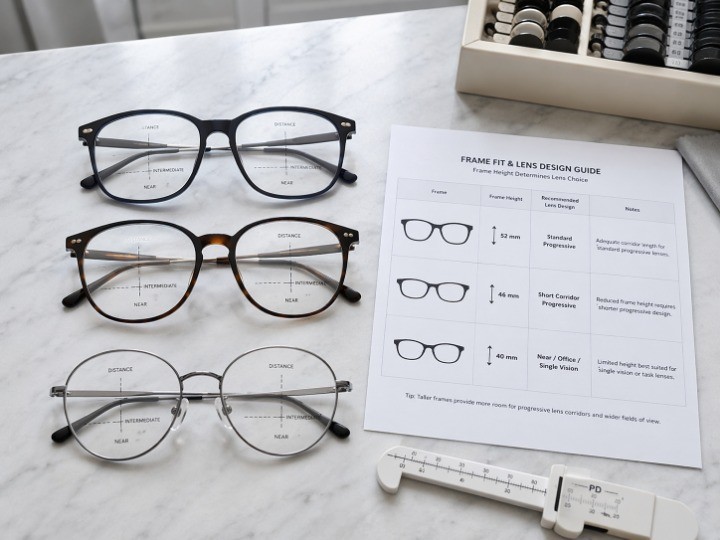
Frame Fit and Lens Design: An Overlooked Factor
A progressive lens depends heavily on proper fitting and frame choice. This is one reason why the same lens can feel excellent for one wearer and disappointing for another.
Progressive lenses need enough vertical space for distance, intermediate, and near zones. If the frame is too shallow or too small, the working areas may feel cramped. That can make reading harder, computer work less comfortable, and adaptation slower.
Single vision lenses are usually more forgiving. They do not divide the lens into several functional zones in the same way, so they place fewer demands on fitting height and frame depth.
This is why lens satisfaction is not just about the lens design itself. It is also about how the lens sits in the frame and how the frame sits on the face. A well-fitted lens often performs better than a poorly fitted premium lens.
For professional buyers, this point matters a lot. Good results come from the full system: lens type, lens design, frame choice, fitting quality, and real-world task match.
Single Vision vs Progressive Lenses on Budget
Single vision lenses usually cost less at first, but lower upfront cost does not always mean better overall value.
| Budget Question | Single Vision | Progressive |
|---|---|---|
| Initial price | Usually lower | Usually higher |
| Number of pairs needed | Often more than one | Often one main pair |
| Adaptation risk | Lower | Higher |
| Need for extra task pair later | Possible | Also possible |
| Best value when | One task dominates | Several tasks change throughout the day |
A user may choose single vision because it costs less, then end up buying reading glasses and computer glasses later. Another user may buy progressives and still want a dedicated office pair for long screen use. That is why price alone does not answer the question.
The better budget question is this: which option gives you the least trouble over time? That includes not only money, but also comfort, convenience, clarity, and the chance of needing another purchase later.
So when you compare value, do not focus only on the first order. Focus on how well the lens fits the actual routine.
How to Choose the Right Lens Type for You
Choose the lens that fits the way you use your eyes most often. That rule works better than choosing the lens that sounds more advanced.
Choose single vision lenses if:
- You mainly need one distance corrected
- You want the widest clear area for one task
- You wear glasses only part time
- You want easy adaptation
- You need dedicated reading or computer glasses
Choose progressive lenses if:
- You have presbyopia
- You switch often between far, mid, and near tasks
- You want one main pair for everyday use
- You prefer not to wear bifocals
- You are willing to allow time for adaptation
Consider separate task-specific glasses if:
- You work long hours at a computer
- You read for long periods
- You tried progressives and still felt uncomfortable
- Your posture and work distance stay fixed
- You care more about maximum clarity than one-pair convenience
This step should feel practical, not theoretical. If you understand your daily routine clearly, the lens choice often becomes much easier.
Single Vision or Progressive? A Quick Decision Guide
Use this section if you want the shortest possible answer.
| Your Priority | Better Choice |
|---|---|
| One-distance clarity | Single vision |
| Reading only | Single vision reading lenses |
| Heavy screen work | Single vision computer lenses or office-style solutions |
| One pair for all-day use | Progressive lenses |
| Easiest adaptation | Single vision |
| Presbyopia with frequent task switching | Progressive lenses |
| Lowest upfront cost | Single vision |
| Highest convenience | Progressive lenses |
 Frequently Asked Questions
Are progressive lenses better than single vision lenses?
Not by default. Progressive lenses are better for all-day flexibility across several distances. Single vision lenses are often better for one-distance clarity and simpler use.
Which is better for driving: single vision or progressive lenses?
If driving is your main task, single vision distance lenses often feel cleaner and wider. If you also need to look at the dashboard, mirrors, and navigation often, progressives may be more convenient.
Can progressive lenses replace reading glasses?
They can for many users, but not always in the most comfortable way for long reading sessions. Some people still prefer dedicated reading or office glasses for extended close work.
Why do progressive lenses feel blurry on the sides?
Because the lens blends several powers into one surface. That design helps you see at different distances, but it also creates less useful areas at the edges for some wearers.
Are progressive lenses worth it for first-time wearers?
They often are if you already need near, intermediate, and distance support during the same day. They may be less worthwhile if your visual work stays focused on one main distance.
Can I switch back from progressive lenses to single vision lenses?
Yes. Many people use both. They may wear progressives as an everyday pair and keep single vision reading or computer glasses for specific tasks.
Final Verdict
When people compare single vision vs progressive lenses, they usually want one simple answer. The most honest answer is this: single vision lenses are often better for one clear task, while progressive lenses are often better for handling several distances in one day.
So the right choice depends on how you live, work, read, drive, and use screens. If you want simplicity, wide clear zones, and fast adaptation, single vision often wins. If you want one pair that helps you move through different distances with less switching, progressives often make more sense.
Find the Right Lens Option for Your Needs
If you are comparing lens strategies for a retail range, a brand program, or a distribution channel, start with the real use case. The more closely the lens matches the wearer’s routine, the better the result is likely to be.
Vena Optics supports professional buyers with single vision, progressive, bifocal, photochromic, blue light, high-index, and PC lens solutions, along with OEM and customization support. A good lens recommendation starts with a clear understanding of how the lens will actually be used.