


Many buyers approve a supplier after checking samples, price sheets, and lead time. Then the real problems start in bulk orders: unstable power, coating complaints, remake costs, and weak traceability. Those risks matter because refractive error remains one of the leading causes of vision impairment worldwide, and spectacle lenses only create value when factories deliver consistent quality at scale. ()
This guide explains what quality control an optical lens factory should actually have, which checkpoints matter most, and how you can judge whether a supplier is ready for long-term OEM, private-label, or wholesale cooperation. For related lens background, you can also review the , , and .
 Why This Question Matters More Than Most Buyers Think
A weak QC system creates commercial risk, not only product defects.
When lens quality slips, the damage rarely stops at one scratched or off-power pair. Buyers face rework, returns, replacement freight, delayed fulfillment, service pressure from labs or retailers, and lower trust in the brand. In prescription eyewear, quality problems also matter because the finished lens must match the intended correction, not just look acceptable on the surface. ISO 21987 specifically addresses mounted spectacle lenses relative to the prescription order, which shows how important finished accuracy is after edging and assembly. ()
Sample approval also gives many buyers a false sense of security. A factory can produce a good hand-checked sample and still struggle in larger runs if raw materials vary, coating parameters drift, or inspection criteria are unclear. That is why the real question is not whether a factory can make one good lens. The real question is whether it can repeat that result across batches and over time. ISO 8980-1 focuses on optical and geometrical properties for uncut finished single-vision and multifocal spectacle lenses, which reflects that consistency must be built into the system, not guessed at after production. ()
What Quality Control Really Means in an Ophthalmic Lens Factory
Quality control is not just final inspection. It is a controlled process from materials to shipment.
A serious ophthalmic lens QC system should cover incoming materials, in-process controls, finished-goods inspection, release approval, complaint handling, and traceability. If a supplier only talks about “strict final inspection,” that is not enough. Strong factories prevent defects early, rather than sorting them late. That mindset also aligns with how established standards split requirements across optical properties, transmittance, coating durability, abrasion resistance, and mounted-lens verification. ()
In practice, buyers should separate four ideas:
• QA sets the system, procedures, and discipline. • QC checks whether the product meets defined requirements. • Validation proves a process can reliably deliver the intended result. • Corrective action explains how the factory responds when something fails.
If a supplier cannot explain these differences in simple language, the factory usually relies too much on end-of-line sorting and too little on process stability.
The Main Quality Dimensions Every Optical Lens Factory Should Control
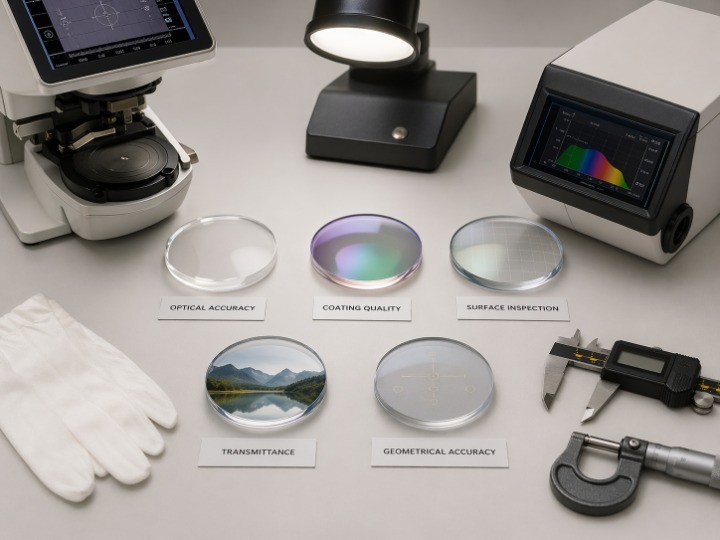 A good optical lens factory must control optical accuracy, geometry, surface quality, transmittance, and coating performance.
That list is not marketing language. It reflects the structure of the main ophthalmic lens standards. ISO 8980-1 covers optical and geometrical properties. ISO 8980-3 covers transmittance. ISO 8980-4 addresses anti-reflective coating requirements and durability testing. ISO 8980-5 covers minimum requirements for abrasion-resistant spectacle lens surfaces. ANSI Z80.1 applies to prescription ophthalmic lenses in edged or assembled form and also points buyers toward tolerances and processing quality in finished work. ()
| QC area | What the factory should control | Why the buyer should care |
|---|---|---|
| Optical accuracy | Sphere, cylinder, axis, prism, add power, progressive performance | Poor vision, remakes, claim disputes |
| Geometrical accuracy | Thickness, diameter, base curve, centration, edge consistency | Poor fit, edging problems, weak cosmetics |
| Surface quality | Scratches, pits, haze, contamination, edge defects | Visible defects and complaint risk |
| Transmittance | Clear transmission, UV behavior, tint consistency, blue-cut behavior | False claims and unstable lens function |
| Coating quality | Adhesion, reflectance consistency, hardness, durability | High remake rate and post-shipment failures |
This table also shows why buyers should not treat “quality control” as one broad promise. Each quality dimension has its own failure modes, test methods, and buyer consequences.
Incoming Quality Control Before Production Starts
 If incoming materials are unstable, the finished lens will be unstable too.
Incoming QC should verify resin substrates, monomers, hard-coat chemicals, tint materials, and coating consumables before production begins. The factory should define supplier qualification rules, incoming sampling rules, and lot acceptance criteria. Without that step, later inspection becomes expensive and reactive because the root problem entered the process before manufacturing even started. ()
At this stage, buyers should ask for evidence such as supplier approvals, batch numbers, retained samples, incoming inspection records, and quarantine rules for suspect material. A supplier that cannot show lot-level discipline at incoming inspection usually cannot show strong traceability later, even if the sales team says the factory is “very strict.”
Useful incoming QC checks often include:
• Resin or substrate identification • Lot-to-lot appearance and dimensional checks • Chemical shelf-life and storage verification • Coating material batch records • Nonconformance handling before release to production
In-Process Quality Control During Manufacturing
 The best factories prevent defects in process instead of discovering them after coating and packing.
In-process QC should monitor the parameters that actually move product quality. In ophthalmic lens manufacturing, that often includes casting stability, curing conditions, surfacing settings, coating-cycle control, cleanliness, and operator discipline at defined control points. Vena Optics also positions its own manufacturing around calibrated instruments, batch records, and material-to-final-inspection traceability, which is the right direction because process control is where bulk consistency is won or lost. ()
The most common weak point is environmental control. Dust, humidity swings, contamination, and uneven handling often show up later as surface defects, coating issues, or appearance complaints. That is why a coating line is only as strong as its housekeeping, calibration, and control discipline. ISO coating and abrasion standards matter, but factories still need stable day-to-day execution to meet them consistently. ()
Strong in-process controls usually include:
-
First-piece approval at the start of a run
-
Patrol checks during production
-
Defined hold points before coating or release
-
Calibration status checks on measuring equipment
-
Escalation rules when trends drift out of control
Final Inspection Before Packing and Shipment
 Final inspection should confirm that the lens meets the order, the standard, and the shipment requirement.
Final inspection should never be a quick cosmetic glance. At minimum, the factory should verify prescription-related values, appearance, labeling, order matching, and release status. For mounted or processed lenses, the finished product must still correspond to the prescription order, which is exactly why ISO 21987 exists. ANSI Z80.1 also applies to prescription lenses in edged or assembled form, not only to uncut stock. ()
For export programs, final inspection may also need market-specific compliance support. In the United States, spectacle lenses sold as eyewear must comply with impact-resistant lens requirements, and FDA guidance states that a certificate illustrating compliance with 21 CFR 801.410 should accompany each lot seeking entry into the U.S. FDA also says testing records must be maintained for three years from shipment. ()
A useful final inspection checklist includes:
• Power and prescription verification • Appearance inspection under defined lighting • Coating and edge-condition inspection • Thickness and diameter confirmation • Label and carton matching • Release approval before shipment
Special QC Requirements for Different Lens Types
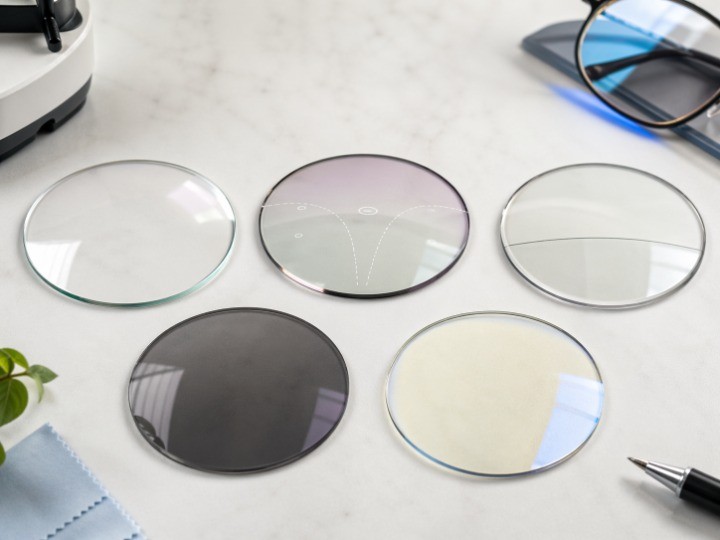 Different lens categories create different QC risks, so one inspection plan does not fit every product.
Single-vision lenses usually require strong control of basic optical accuracy, appearance, and order matching. Progressive lenses add more complexity because buyers care about corridor behavior, fitting reference accuracy, add stability, and marking consistency. Photochromic lenses need control over activation speed, color uniformity, and fade-back behavior. Blue-cut, tinted, and UV-focused products add transmittance and claim-verification risk, which links directly to ISO 8980-3. ()
| Lens type | QC focus | Common buyer concern |
|---|---|---|
| Single vision | Power, axis, cosmetics, labeling | Basic consistency across bulk orders |
| Progressive | Add power, reference markings, optical design stability | Adaptation complaints and remake rate |
| Bifocal | Segment position and alignment | Usability and visible mismatch |
| Photochromic | Activation, color uniformity, fade-back | “Sample was better than bulk” complaints |
| Blue-cut / UV | Transmittance and claim accuracy | Overstated marketing claims |
| High-index / PC | Stress sensitivity, coating compatibility, impact expectations | Fragility, coating failure, compliance support |
If you also manage product planning around adaptive sunwear or coating packages, our and articles can support related line planning.
Coating Quality Control Is One of the Biggest Risk Points
 Coating quality often decides whether a lens program feels premium or becomes a complaint problem.
Many eyewear complaints start after shipment, not at the factory gate. The lens looked acceptable when packed, but later the buyer sees peeling, inconsistent residual color, haze, weak cleanability, or fast surface wear. ISO 8980-4 addresses anti-reflective coating requirements and durability testing, while ISO 8980-5 covers abrasion-resistant claims. Those standards exist because coating performance is not cosmetic decoration. It is a functional quality issue. ()
This is where buyers should ask sharper questions. Does the factory test adhesion? Does it control residual color consistently? Does it verify scratch or abrasion claims with a defined method? Does it separate basic AR from premium AR with better top-coat behavior? If the sales answer stays vague, the QC system is probably vague too.
Common coating failure modes include:
• Peeling or poor adhesion • Haze after wear or cleaning • Pinholes or contamination points • Unstable residual color across batches • Surface durability below the claimed level
Process Control vs Final Inspection
Final inspection alone cannot guarantee stable bulk quality.
A factory can sort obvious defects at the end, but it cannot sort its way into a truly capable process. If coating conditions drift, if surfacing parameters vary, or if raw materials are inconsistent, the cost of final sorting rises fast and the chance of escapes rises with it. That is why strong buyers prefer factories that can explain control plans, escalation rules, and corrective actions before they talk about “100% inspection.” ()
The strongest suppliers usually show three habits:
• They define critical control points before defects happen • They react to trends, not only to rejects • They can explain why a defect happened and how they prevented recurrence
That is the real difference between a factory that manages quality and a factory that only sorts failures.
Measurement, Metrology, and Calibration
You cannot trust QC data if you do not trust the measuring system behind it.
Optical lens factories rely on instruments such as lensmeters, thickness gauges, spectrophotometers, abrasion test setups, and coating-related verification equipment. Those readings only help buyers when the instruments are calibrated, repeatable, and used with defined methods. That principle is built into the way ISO and ANSI requirements are written: they do not just say “quality should be good.” They specify properties and verification methods. ()
So when a supplier says a lens passed inspection, ask a second question: with which equipment, under what method, and how was the instrument controlled? That question often separates a presentation-level QC story from a real manufacturing system.
Sampling, AQL, and Batch Release Control
A good factory matches its inspection method to the product risk, the order type, and the market requirement.
Some checks make sense as 100% inspection. Others work better through sampling. The right balance depends on whether you are buying stock lenses, custom prescription jobs, semi-finished products, or export-bound lots with special regulatory requirements. FDA import guidance for impact-resistant lenses even refers to statistically significant sampling and an AQL expectation in U.S. import control, which shows that batch-release logic is not optional paperwork. ()
In practical sourcing terms:
• Use tighter release logic for custom or higher-risk orders • Require clear batch identification before shipment • Match AQL rules to the complaint cost, not just the inspection cost • Ask who signs off shipment release and on what evidence
AQL is useful, but only when the factory defines it clearly and applies it consistently.
Documentation, Traceability, and Corrective Action
If a factory cannot trace a problem, it cannot control a recurring problem.
Traceability should connect raw materials, process lots, inspection records, test reports, packaging records, and customer complaints. This matters for routine quality management, but it matters even more for export claims, bulk remakes, and customer audits. FDA says testing records for impact-resistant lenses must be maintained for three years from shipment, and that requirement reinforces a broader point: documentation is part of product control, not an afterthought. ()
A mature documentation system should include:
• SOPs and inspection criteria • Batch records and lot traceability • Nonconformance reports • CAPA or corrective-action records • Complaint closure and verification evidence
When buyers ask for these records, good factories do not become defensive. They become specific.
Standards and Certifications Buyers Should Know
Standards help buyers turn vague quality promises into checkable requirements.
For uncut finished spectacle lenses, the ISO 8980 family is the core reference set: Part 1 for optical and geometrical properties, Part 3 for transmittance, Part 4 for anti-reflective coatings, and Part 5 for abrasion-resistant claims. ISO 21987 addresses mounted spectacle lenses relative to the prescription order. ANSI Z80.1 covers prescription ophthalmic lenses in edged or assembled form in the U.S. context. These documents do not replace your own supplier specifications, but they give you a serious foundation for audits and purchasing decisions. ()
Useful external references include , , , , , and . Certification matters, but certification alone does not prove that a factory controls daily variation well.
What Buyers Should Ask During a Factory Audit
 The best audit questions force the factory to show evidence, not slogans.
Start with the basics: What are the incoming inspection rules? Which product characteristics are checked in process? Which checks are 100% and which are sampled? How are coating complaints investigated? How are instruments calibrated? How are lots traced from raw material to shipment? These questions fit the structure of the standards and expose whether the factory actually operates with discipline. ()
A simple buyer checklist before approving a supplier:
-
Ask for inspection standards and acceptance criteria
-
Ask for batch records and traceability examples
-
Ask for coating test evidence and abrasion-related support
-
Ask how the factory handles complaints and CAPA
-
Ask what changes when the order shifts from sample to mass production
-
Ask what documents support export-market compliance
If the answers stay general, your risk stays high.
Red Flags That Suggest a Weak QC System
You can often spot weak quality control before the first order is placed.
The biggest warning signs are simple: no clear acceptance criteria, no lot traceability, no defined coating evidence, no explanation of sample-to-bulk control, and no structured complaint process. Another major red flag is when the factory talks about “strict QC” but cannot show actual reports, sample records, or calibration discipline. That usually means the system depends too much on operator experience and too little on repeatable control. ()
Watch closely for these signals:
• Generic claims without data • No distinction between stock and custom inspection rules • No evidence behind abrasion or coating claims • No release logic for export-bound lots • No clear ownership of corrective action
A factory that cannot explain its QC system in plain operational terms is not ready for demanding wholesale programs.
What a Strong Optical Lens QC System Should Deliver
A strong QC system should make the buyer’s supply chain calmer, not busier.
When quality control works, buyers see more stable batches, fewer remakes, fewer post-shipment coating issues, clearer documentation, and faster claim handling. They also gain confidence when launching OEM or private-label programs because the factory can support repeatability, not only isolated good samples. That outcome is exactly what disciplined standards, traceability, and market-compliance support are meant to protect. ()
In short, good optical lens quality control should protect vision performance, commercial performance, and brand reputation at the same time.
Conclusion
A reliable supplier should control incoming materials, process parameters, finished-lens verification, coating durability, documentation, traceability, and corrective action. If one of those parts is weak, the whole system becomes fragile.
For buyers, the most useful shift is this: stop asking only whether the factory inspects lenses, and start asking how the factory prevents variation before it becomes a complaint. That one change will improve your supplier selection, your audit conversations, and your long-term order stability.
If you are reviewing suppliers for single-vision, progressive, photochromic, blue-cut, or coated lens programs, build your next comparison around real QC evidence: batch records, coating-test support, prescription verification methods, traceability samples, and shipment-release logic. That will tell you more than a polished product brochure.
If you want to compare related lens categories before finalizing your sourcing plan, you can explore the , , and