


Choosing the best lenses for reading should feel simple, but it often does not.
Most people run into the same problem. They hear about single-vision readers, progressives, bifocals, office lenses, lens materials, and coatings at the same time. Then they try to solve one clear need, reading comfortably, with too many mixed terms. The explains that presbyopia is a normal age-related refractive error that makes it harder to see things up close, and it usually appears after age 45. describes the same pattern and notes common symptoms such as reduced focusing ability for near objects, eyestrain, and headache. ()
This guide breaks the topic into practical parts. It explains which lens types work best for books, phones, documents, and screens, how lens material changes comfort, when coatings help, and when ready-made readers stop being enough. For more background on related lens categories, you can also point readers to the .
 What Are the Best Lenses for Reading? A Quick Answer
Single-vision reading lenses are usually the best choice for dedicated near work. They give the widest clear reading area, they feel easy to adapt to, and they work especially well for books, labels, printed documents, and close detail work. NEI lists glasses and contact lenses as standard treatment options when presbyopia gets worse, including over-the-counter readers and prescribed lenses.
That said, the best answer changes when the task changes. A person who reads for hours at one distance usually needs something different from a person who reads, checks a screen, and walks around all day. The best reading lens is not the most advanced lens. It is the lens that matches the reading distance, the daily routine, and the amount of visual switching involved.
If you want to support this section with internal reading, you can naturally link to , , and .
Why People Need Reading Lenses in the First Place
People need reading lenses because near focusing changes with age. NEI explains that presbyopia happens when the lens inside the eye gets harder and less flexible, so it stops focusing light correctly on the retina. That change makes nearby objects look blurry. NEI also notes that everyone develops presbyopia with age, usually after 45.
The symptoms are familiar to most adults. Text starts to look soft at normal reading distance. People hold their phones farther away. They need stronger light. They feel more tired after reading. MedlinePlus lists reduced near focusing ability, eyestrain, and headache among the common symptoms, while NEI adds the habit of holding reading materials farther away. ()
This issue also matters beyond comfort. The says presbyopia is projected to reach 2.1 billion cases by 2030. WHO also says that near-vision correction for presbyopia can increase average median income in low-income communities by over 30%, which shows that good near correction affects productivity as well as daily comfort. ()
The Main Types of Lenses for Reading
The main lens designs for reading are easy to name, but they do different jobs. Single-vision reading lenses correct one near distance. Bifocal lenses combine distance and near vision in one lens with a visible segment. Progressive lenses combine distance, intermediate, and near vision without a visible line. Office or occupational lenses focus more on near and intermediate ranges for desk-based work.
That means the real question is not simply which lens type exists. The real question is which lens type fits the way someone reads. Many articles stay too broad at this point. They list lens categories, but they do not explain how the reading task changes the answer. A book, a phone, a cash register, and a desktop monitor do not sit at the same distance, so they should not all lead to the same lens recommendation.
| Lens type | Best use | Main strength | Main limitation |
|---|---|---|---|
| Single-vision reading lenses | Books, documents, labels | Wide near field and easy adaptation | No distance support |
| Bifocal lenses | Reading plus distance | Clear near segment | Limited intermediate range |
| Progressive lenses | Mixed all-day use | One pair for several distances | Narrower near area |
| Office / occupational lenses | Desk and screen work | Better near + intermediate comfort | Less useful for full-time distance use |
Single-Vision Reading Lenses: When They Are the Best Choice
 Single-vision reading lenses are usually the best lenses for reading when reading is the main task. The whole lens works for near vision, so the reading area feels wider and more stable than it does in a progressive lens. That makes this design a strong choice for books, long documents, recipes, crafts, close inspection work, and other fixed-distance tasks.
This is also why many people keep a dedicated pair of readers even after they buy progressives. A progressive lens may feel more convenient, but convenience and reading performance are not the same thing. If someone spends long periods reading without needing distance vision, a dedicated near lens often feels calmer and easier.
The main downside is obvious. Once the person looks across the room, the lens no longer helps. That makes single-vision readers less practical when the day includes frequent switching between near work and distance viewing. For a deeper internal comparison, you can link to .
Progressive Lenses for Reading: Better for Some Users, Worse for Others
 Progressive lenses work best when one pair needs to handle more than reading. They allow the wearer to move between distance, intermediate, and near vision without changing glasses. That is the main reason they remain popular among adults who want one pair for most of the day.
Still, progressives are not always the best reading lens in the pure sense of reading comfort. The near zone is only one part of the lens design. That means the reading area usually feels narrower than a dedicated reader. Some people accept that trade-off easily because they value convenience. Others never fully like it because they read a lot and want a wider near field.
A practical rule helps here. Choose progressives for flexibility, not for the widest reading area. If the person reads for long sessions at one distance, single-vision readers often feel better. If the person moves between reading, screen use, conversation, and walking around, progressives often make more sense.
Bifocal Lenses for Reading: Where They Still Make Sense
Bifocal lenses still make sense when someone wants reading and distance support in one pair but prefers a simpler structure than a progressive lens. The visible segment gives a direct near zone, and some wearers like that clarity because it feels easy to use right away.
This design can still work well for practical daily tasks. A person who wants straightforward near support and does not care about the visible line may find bifocals very effective. They can also be a sensible step for someone who does not want to adapt to a progressive corridor.
However, bifocals do have a clear weakness. They do not give true intermediate support. That matters much more today because reading happens on monitors and tablets, not only on paper. So bifocals still serve some wearers well, but they do not fit every modern reading habit.
Computer and Office Lenses: The Reading Option Many People Overlook
 Reading on a screen is not the same as reading a book. A screen often sits farther away, and the person usually holds the head and neck differently. The notes that spending a lot of time at the computer or focusing on one thing can cause eye strain or fatigue. That point matters because desk work often creates a different visual demand from close paper reading.
This is where office or occupational lenses can work better than standard readers. They are designed to support near and intermediate distances together, which makes them useful for computer-heavy routines. If someone reads emails, edits spreadsheets, checks paperwork, and looks up at coworkers or shelves, an office lens often feels more natural than a basic reader.
This category is easy to miss because many buying guides only compare single-vision readers with progressives. In real life, a desk-based routine often needs something more specific than either extreme. If the main problem happens at a screen, office lenses deserve serious attention.
Which Reading Lens Is Best for Different Real-Life Situations?
The best reading lens depends on the reading situation. That is the simplest and most useful way to answer the keyword. A lens should match the task first, then the material and coating after that.
| Situation | Best lens choice | Why it often works best |
|---|---|---|
| Reading books or long printed material | Single-vision reading lenses | Wide near field and stable focus |
| Reading a phone for short periods | Mild readers or flexible progressives | Quick near support |
| Computer-heavy desk work | Office / occupational lenses | Better intermediate comfort |
| One pair for reading and moving around | Progressive lenses | Multi-distance convenience |
| Existing distance prescription + near difficulty | Prescription progressives or bifocals | Handles more than near vision |
This use-case approach works better than chasing one universal answer. It also prevents one of the most common mistakes in lens buying: assuming the most versatile lens is automatically the best lens. The best lens is the one that handles the main task with the fewest compromises.
OTC Reading Glasses vs Prescription Reading Lenses
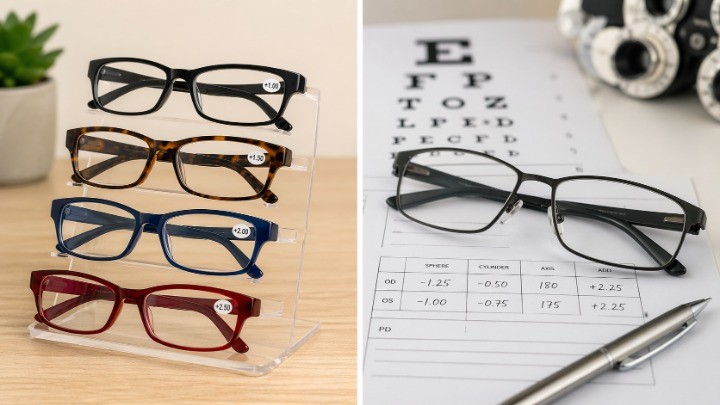 Over-the-counter reading glasses can work well when the need is simple. NEI says some people use OTC reading glasses as presbyopia gets worse. MedlinePlus also notes that people who do not need distance glasses may only need half glasses or reading glasses.
Prescription reading lenses usually make more sense when the two eyes do not need the same correction, when astigmatism matters, or when the wearer already uses prescription glasses for distance. MedlinePlus also notes that adding bifocals to an existing prescription can be the best solution in some cases, and it explains that nearsighted people may sometimes remove their distance glasses to read.
This is why ready-made readers feel fine for some people and disappointing for others. The power may seem close, but the visual system is not always balanced. A convenient starting point is not always the right long-term answer.
How Strong Should Reading Lenses Be?
The right reading strength is the weakest power that gives clear, comfortable vision at the actual working distance. Stronger is not automatically better. If the power is too strong, the reading distance can become too short, and that often makes the reading posture worse.
If symptoms feel uneven, persistent, or more complex than simple near blur, guessing is not enough. A proper exam is the better route. It saves time, reduces frustration, and makes the final lens choice more accurate.
Best Lens Materials for Reading Glasses
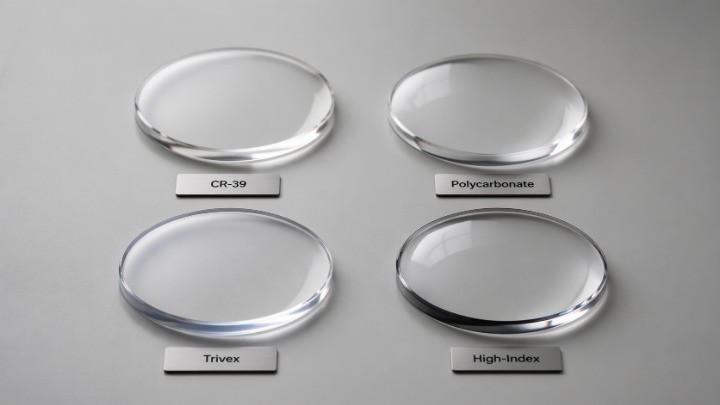 Lens material affects weight, thickness, durability, and sometimes comfort, but it does not replace the need for the right lens design. That point matters because many people compare CR-39, polycarbonate, Trivex, and high-index options too early. Material matters, but it matters after the person decides what the lens needs to do.
For most reading glasses, the best material depends on three practical things: how strong the prescription is, how light the frame should feel, and how rough daily handling will be. A moderate reading prescription in a comfortable frame often does not need the thinnest lens on the market.
| Material | Best for | Main advantage | Watch-out |
|---|---|---|---|
| CR-39 / standard plastic | Everyday reading use | Good value and balanced optics | Thicker in stronger powers |
| Polycarbonate | Lighter, more impact-resistant use | High durability and lighter feel | Not always the first choice for pure optical refinement |
| Trivex | Lightweight comfort with durability | Good mix of comfort and toughness | Usually costs more |
| High-index | Stronger prescriptions | Thinner appearance | Often unnecessary for mild reading needs |
For many readers, CR-39 or standard plastic remains a smart reading choice because the near prescription is often modest. Polycarbonate and Trivex become more attractive when low weight or added durability matters. High-index matters most when thickness becomes noticeably annoying, not as a default upgrade.
Lens Coatings That Can Improve the Reading Experience
Anti-reflective coating is usually the most useful coating for reading comfort. It helps reduce glare from lamps, overhead office lighting, and screens. That often makes text feel cleaner and easier to look at over longer sessions.
Scratch-resistant treatment also matters because reading glasses are handled often. They go on and off, sit on desks, travel in bags, and sometimes get cleaned too quickly. A lens that stays clearer for longer usually feels better to use day after day.
Blue-light filtering needs a more careful answer. The found that blue-light filtering lenses may not reduce short-term eyestrain associated with computer work, compared with non-blue-light filtering lenses. The review also found no clinically meaningful short-term advantage for reducing visual fatigue with computer use. ()
That does not mean every blue-light product has no value in every case. It does mean the evidence is much weaker than many buyers expect. If the goal is better reading comfort, anti-reflective performance usually matters more than blue-light marketing language.
What Most People Get Wrong When Choosing Reading Lenses
Most mistakes happen before the person even wears the finished lenses.
• They choose stronger power too soon. • They buy progressives when they mainly need a dedicated reader. • They ignore working distance and posture. • They focus on thinness before comfort. • They expect one cheap ready-made pair to solve every reading task.
These mistakes are common because people often shop by label instead of by use case. They compare “premium” features before they decide what distance and routine the lens actually needs to support. Once the person starts with the task instead of the product name, the decision becomes much easier.
How to Choose the Best Reading Lenses for Your Needs
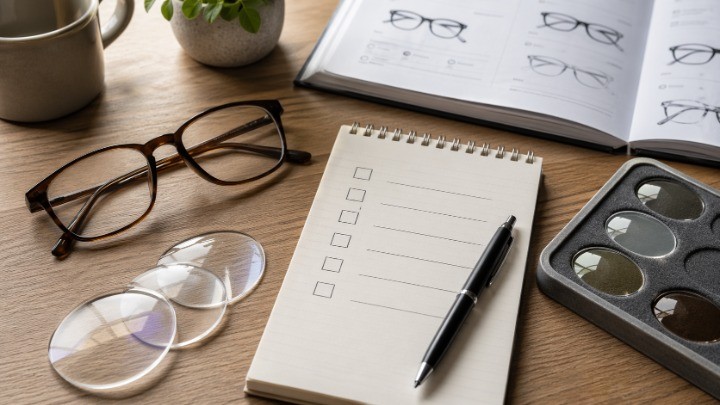 Start with the main reading distance. That step solves more confusion than any material upgrade or marketing feature. A paperback, a phone, and a desktop monitor do not sit at the same distance, so they should not automatically use the same lens strategy.
Then follow a simple order:
-
Identify the main task. Books, labels, paperwork, phone use, screen work, or mixed daily wear.
-
Decide whether one pair or task-specific pairs make more sense.
-
Choose the lens design first. Single vision, bifocal, progressive, or office.
-
Choose the material second. Think about weight, durability, and thickness.
-
Add coatings only when they solve a real problem.
-
Recheck frame fit, reading posture, and comfort before finalizing the lens.
This order works because the wrong lens design creates bigger problems than the wrong material. Material can refine the experience, but it cannot fix the wrong focal strategy.
For internal support, this section fits naturally with , , and .
Best Reading Lenses by User Type
Occasional readers often do well with simple single-vision readers, especially if they only need help for menus, labels, and short near tasks.
Heavy readers often prefer dedicated single-vision reading lenses because the wider near field feels calmer over long sessions.
Office and digital workers often do better with office lenses than with basic readers because the working distance is different and the screen sits farther away. The CDC notes that long periods at the computer or focusing on one thing can cause eye strain or fatigue, which supports a more task-specific lens choice for screen-heavy work. ()
People over 40 with changing near vision and existing distance correction often benefit more from prescription progressives or bifocals than from generic ready-made readers. People who want one pair for everything usually accept the trade-off of a narrower near field because convenience matters more to them than maximum reading width.
Final Thoughts
The best lenses for reading depend on how and where the reading happens. For pure near comfort, single-vision reading lenses often work best. For mixed daily tasks, progressive lenses often make more sense. For desk-heavy routines, office lenses deserve much more attention than they usually get.
If the lens choice follows real working distance, daily routine, and comfort needs, the decision becomes easier and the result usually feels better. That is the clearest way to avoid buying by buzzword, overpaying for the wrong upgrade, or ending up with reading glasses that still feel wrong.
For more lens education and category comparisons, readers can continue to the , review , compare , or read about .
If you are planning a reading-focused lens line, building educational content around presbyopia, or comparing near-vision solutions for your market, start with the lens design first, then confirm material, coating, and use scenario.